| |

| Piú votate - Mercury |

B-Mercury-PIA02240.jpgThe components of the surface of Mercury98 visiteCaption NASA originale:"Updated calibration and subsequent mosaicing have led to substantial improvements in the Mariner 10 color image data. This color composite was formed to especially highlight differences in opaque minerals (such as Ilmenite), Iron content and soil maturity.
K - Crater Kuiper shows color consistent with fresh material excavated from a subsurface unit that may have an "unusual" composition;
D - relatively dark and blue unit consistent with enhanced Titanium content;
B - bright red unit that may represent primitive crustal material
F - color unit that follows plains boundaries, interpreted as lava flows".
(4 voti)
|
|

ZZ-Mercury-Craters-Unnamed_Impact_Crater_with_Pond-PIA18371-PCF-LXTT-IPF.jpgImpact's Melt "Pond" (CTX Frame - Absolute Natural Colors; credits for the additional process. and color.: Dr Paolo C. Fienga/Lunar Explorer Italia/Italian Planetary Foundation)144 visiteThis High-Resolution Contextual (CTX) Image, taken by NASA - MESSENGER Spacecraft on the date of March, 10, 2014, shows us a few Ponds (---> small Lake-like Features) made of Impact Melt (remember that this kind of Surface Features appear to us way smoother than the Terrain which surrounds them).
In particular, these Melt Ponds (where the bigger one looks like some sort of a Flat Ellipse, with its Major Axis measuring approx. 1 Km - and visible at about 10 o' clock of the frame) were deposited (probably) as Fluid Ejecta (---> such as Ejecta made of liquid or semi-liquid Rock) coming from an Unnamed Impact Crater located to the North (top) of the picture, but not visible here.
Date acquired: March, 10th, 2014
Image Mission Elapsed Time (MET): 36770132
Image ID: 5908036
Instrument: Narrow Angle Camera (NAC) of the Mercury Dual Imaging System (MDIS)
Center Latitude: 63,77° North
Center Longitude: 254,70° East
Solar Incidence Angle: 72,5° (meaning that the Sun, at the time that the picture was taken, was about 17,5° above the imaged Local Mercurian Horizon)
Emission Angle: 6,3°
Sun-Mercury-Messenger (or "Phase") Angle: 78,9°
This picture (which is an Original NASA - MESSENGER Spacecraft's b/w and Map-Projected image published on the NASA - Planetary Photojournal with the ID n. PIA 18371) has been additionally processed, contrast enhanced, Gamma corrected, magnified to aid the visibility of the details and then colorized in Absolute Natural Colors (such as the colors that a human eye would actually perceive if someone were onboard the NASA - MESSENGER Spacecraft and then looked outside, towards the Surface of Mercury), by using an original technique created - and, in time, dramatically improved - by the Lunar Explorer Italia Team. Different colors, as well as different shades of the same color, mean, among other things, the existence of different Elements (Minerals) present on the Surface of Mercury, each having a different Albedo (---> Reflectivity) and Chemical Composition.MareKromium
(3 voti)
|
|

ZZ-Mercury-Craters-Scarlatti_Crater-PIA18215-PCF-LXTT-IPF.jpgScarlatti Crater (Absolute Natural Colors; credits for the additional process. and color.: Dr Paolo C. Fienga/Lunar Explorer Italia/Italian Planetary Foundation)131 visiteIn this image-mosaic, obtained by putting together three frames taken by the NASA - MESSENGER Spacecraft on March, 30, 2014, we can see, located almost at the center of the frame, the large (such as approx. 132 Km - such as about 81,97 miles - in diameter) Peak-Ring Basin known as Scarlatti.
While Scarlatti has a typical Peak-Ring in many respects, if you take a good look towards its North/Eastern Section (upper right side - Dx - of the Feature), you will be able to notice its "transition" to a relatively wide (in this case, approx. 30 Km - such as about 18,63 miles - across) sort of Collapse Pit, surrounded by High-Reflectance (white and reddish in color) Surface Material. This Pit (perhaps a Volcanic Vent or a Caldera, eons ago), according to several NASA Planetary Scientists, could have been - and we say, as IPF, reasonably, considering all the visible Features characterizing it - the site of some (most likely extremely ancient as well as really powerful) Explosive Volcanic Activity.
Date acquired: March, 30th, 2014
Images Mission Elapsed Time (MET): 38528557, 38528553, 38528551
Images ID: 6032934, 6032932, 6032931
Instrument: Wide Angle Camera (WAC) of the Mercury Dual Imaging System (MDIS)
Center Latitude: 40,70° North
Center Longitude: 258,90° East
Solar Incidence Angle: 86,2° (meaning that the Sun, at the time that the picture was taken, was about 3,8° above the imaged Local Mercurian Horizon)
Emission Angle: 51,1°
Sun-Mercury-Messenger (or "Phase") Angle: 137,3°
This picture (which is an Original NASA - MESSENGER Spacecraft's false colors and NON-Map-Projected image-mosaic published on the NASA - Planetary Photojournal with the ID n. PIA 18215) has been additionally processed, contrast enhanced, Gamma corrected, magnified to aid the visibility of the details and then re-colorized in Absolute Natural Colors (such as the colors that a human eye would actually perceive if someone were onboard the NASA - MESSENGER Spacecraft and then looked outside, towards the Surface of Mercury), by using an original technique created - and, in time, dramatically improved - by the Lunar Explorer Italia Team. Different colors, as well as different shades of the same color, mean, among other things, the existence of different Elements (Minerals) present on the Surface of Mercury, each having a different Albedo (---> Reflectivity) and Chemical Composition.MareKromium
(3 voti)
|
|

ZZ-Mercury-Craters-To_Ngoc_Van_Crater-PIA15201-PCF-LXTT-IPF-00.jpgTo Ngoc Van (CTX Frame - Absolute Natural Colors; credits for the additional process. and color.: Dr Paolo C. Fienga/Lunar Explorer Italia/Italian Planetary Foundation)94 visiteIn this beautiful view obtained by the NASA - MESSENGER Spacecraft on November, 8, 2011, we can see, once again, prominent, near the center of the degraded Impact Crater To Ngoc Van, an interesting (and really irregularly shaped) Collapse Pit (approx. 20 Km - such as about 12,42 miles - across). As a matter of fact, many samples of Impact Craters with one (or more) Collapse Pit/s located on their Floors, have already been identified across the Mercurian Surface and - most likely - they all formed as a consequence of (extremely ancient) phenomena of Explosive Volcanism.
Date acquired: November, 8th, 2011
Image Mission Elapsed Time (MET): 229277972
Image ID: 988708
Instrument: Wide Angle Camera (WAC) of the Mercury Dual Imaging System (MDIS)
Center Latitude: 52,89° North
Center Longitude: 248,60° East
Solar Incidence Angle: 60,3° (meaning that the Sun, at the time that the picture was taken, was about 29,7° above the imaged Local Mercurian Horizon)
Emission Angle: 23,0°
Sun-Mercury-Messenger (or "Phase") Angle: 83,4°
This picture (which is an Original NASA - MESSENGER Spacecraft's b/w and Map-Projected image published on the NASA - Planetary Photojournal with the ID n. PIA 15201) has been additionally processed, contrast enhanced, Gamma corrected, magnified to aid the visibility of the details and then colorized in Absolute Natural Colors (such as the colors that a human eye would actually perceive if someone were onboard the NASA - MESSENGER Spacecraft and then looked outside, towards the Surface of Mercury), by using an original technique created - and, in time, dramatically improved - by the Lunar Explorer Italia Team. Different colors, as well as different shades of the same color, mean, among other things, the existence of different Elements (Minerals) present on the Surface of Mercury, each having a different Albedo (---> Reflectivity) and Chemical Composition.MareKromium
(3 voti)
|
|

ZZ-Mercury-Craters-Unnamed_Craters-PIA17827-PCF-LXTT-IPF-00.jpgMercurian Nightfall (CTX Frame - Absolute Natural Colors; credits for the additional process. and color.: Dr Paolo C. Fienga/Lunar Explorer Italia/Italian Planetary Foundation)91 visiteWith the Sun already extremely low in the Sky over this Mercurian Region located in the Northern Hemisphere of the Innermost Planet of the Solar System (the Sun is only about 8° above the imaged Local Horizon), the long, deep and dark Shadows created by this specific Spatial Configuration, accentuate the very uneven (---> highly irregular) nature of the Terrain.
In fact, the Surface visible here (---> we are looking at a scene which is about 14,6 Km - such as a very little more than 9 miles - across) has been battered - for eons and eons - by a countless number of Meteors and other Cosmic Impactors, until the Hilly Surface that exists and we can see today was finally created. For the most attentive Viewers, we, as IPF, strongly suggest you to take a careful look at the (very unusually-looking) Surface Feature (probably an oblong Secondary Crater with a strange - and still illuminated - Central Peak) that is located on the lower portion of the frame, slightly towards the left (Sx).
Date acquired: November, 12th, 2013
Image Mission Elapsed Time (MET): 26543484
Image ID: 5181047
Instrument: Narrow Angle Camera (NAC) of the Mercury Dual Imaging System (MDIS)
Center Latitude: 67,11° North
Center Longitude: 249,80° East
Solar Incidence Angle: 82,0° (meaning that the Sun, at the time that the picture was taken, was about 8,0° above the imaged Local Mercurian Horizon)
Emission Angle: 36,9°
Sun-Mercury-Messenger (or "Phase") Angle: 118,9°
This picture (which is an Original NASA - MESSENGER Spacecraft's b/w and NON-Map-Projected image published on the NASA - Planetary Photojournal with the ID n. PIA 17827) has been additionally processed, contrast enhanced, Gamma corrected, magnified to aid the visibility of the details and then colorized in Absolute Natural Colors (such as the colors that a human eye would actually perceive if someone were onboard the NASA - MESSENGER Spacecraft and then looked outside, towards the Surface of Mercury), by using an original technique created - and, in time, dramatically improved - by the Lunar Explorer Italia Team. Different colors, as well as different shades of the same color, mean, among other things, the existence of different Elements (Minerals) present on the Surface of Mercury, each having a different Albedo (---> Reflectivity) and Chemical Composition.MareKromium
(3 voti)
|
|

ZZ-Mercury-Rupes-Terror_Rupes-PIA17881-PCF-LXTT-IPF-01.jpgTerror Rupes (EDM - Absolute Natural Colors; credits for the additional process. and color.: Dr Paolo C. Fienga/Lunar Explorer Italia/Italian Planetary Foundation)80 visiteIn this picture, we can better see the Southern Mercurian Relief known as "Terror Rupes": it is the long, Cliff-like Landform visible right in the middle of the frame. Terror Rupes is one of Mercury's most prominent Lobate Scarps, and it was so named after the HMS (---> Her Majesty's Ship) Terror: an eighteenth-century warship that, later, participated in Scientific Polar Explorations.
Date acquired: February, 4th, 2012
Image Mission Elapsed Time (MET): 236853865
Image ID: 1353252
Instrument: Wide Angle Camera (WAC) of the Mercury Dual Imaging System (MDIS)
Center Latitude: 69,30° South
Center Longitude: 96,00° East
Solar Incidence Angle: 80,3° (meaning that the Sun, at the time that the picture was taken, was about 9,7° above the imaged Local Mercurian Horizon)
Emission Angle: 50,9°
Sun-Mercury-Messenger (or "Phase") Angle: 114,5°
This picture (which is a crop taken from an Original NASA - MESSENGER Spacecraft's b/w and NON-Map-Projected image published on the NASA - Planetary Photojournal with the ID n. PIA 17881) has been additionally processed, contrast enhanced, Gamma corrected, magnified to aid the visibility of the details and then colorized in Absolute Natural Colors (such as the colors that a human eye would actually perceive if someone were onboard the NASA - MESSENGER Spacecraft and then looked outside, towards the Surface of Mercury), by using an original technique created - and, in time, dramatically improved - by the Lunar Explorer Italia Team. Different colors, as well as different shades of the same color, mean, among other things, the existence of different Elements (Minerals) present on the Surface of Mercury, each having a different Albedo (---> Reflectivity) and Chemical Composition.MareKromium
(3 voti)
|
|

ZZ-Mercury-Limb-PIA17787-PCF-LXTT-IPF.jpgMercurian Horizon (Absolute Natural Colors; credits for the additional process. and color.: Dr Paolo C. Fienga/Lunar Explorer Italia/Italian Planetary Foundation)73 visiteThree well known Mercurian Impact Craters are prominently featured in this view, taken by the NASA - MESSENGER Spacecraft on November, 16, 2013. The fascinating Peak-Ringed Impact Basin named Wang Meng (whose diameter is approx. 165 Km - such as about 102,465 miles) is visible toward the Mercurian Horizon, slightly to the left portion of the frame, while the Pit-Floored Impact Crater Glinka can be seen near the bottom left of the picture. Last, but not least, the Impact Crater known as Judah Ha Levi is about half way in between the first two that we mentioned herebefore.
Date acquired: November, 16th, 2013
Image Mission Elapsed Time (MET): 26888421
Image ID: 5205547
Instrument: Wide Angle Camera (WAC) of the Mercury Dual Imaging System (MDIS)
Center Latitude: 10,04° North
Center Longitude: 251,20° East
This picture (which is an Original NASA - MESSENGER Spacecraft's b/w and NON-Map-Projected image published on the NASA - Planetary Photojournal with the ID n. PIA 17787) has been additionally processed, contrast enhanced, Gamma corrected, magnified to aid the visibility of the details and then colorized in Absolute Natural Colors (such as the colors that a human eye would actually perceive if someone were onboard the NASA - MESSENGER Spacecraft and then looked down, towards the Limb of Mercury), by using an original technique created - and, in time, dramatically improved - by the Lunar Explorer Italia Team. Different colors, as well as different shades of the same color, mean, among other things, the existence of different Elements (Minerals) present on the Surface of Mercury, each having a different Albedo (---> Reflectivity) and Chemical Composition.MareKromium
(3 voti)
|
|

ZZ-Mercury-Craters-Unnamed_Craters-CB-PIA17692-PCF-LXTT-IPF-0.jpgOn the Edge of Caloris Basin (CTX Frame - Possible Absolute Natural Colors; credits for the additional process. and color. Dr Paolo C. Fienga/Lunar Explorer Italia/Italian Planetary Foundation)101 visiteThis picture, which is an image-mosaic made of 3 (three) frames taken by the NASA - MESSENGER Spacecraft on October, 24, 2013, features several Unnamed Impact Craters (being the larger one, visible near the top of the image, approximately 54 Km - such as about 33,53 miles - in diameter) that are all located in the proximities of the Eastern Edge of the Giant Caloris Basin. The two larger Unnamed Impact Craters seen here have excavated (obviously, at the time of their formation, and according to NASA's Scientists) "Low Reflectance Material", and they both show extrenmly bright Hollows (which, in fact, caused an oversaturation of the picture in the areas where thay are present) within their relatively flat Floors.
The Orange/Reddish Deposits visible in the North/Eastern Quadrant (---> center and upper right corner) of the scene, exhibit a so-called "Spectral Signature" that is similar to the one usually left by Pyroclastic Deposits, and this circumstance suggests that this Region (just like way many others on Mercury) might have, once, been the Site of Explosive Volcanism.
Date acquired: October, 24th, 2013
Images Mission Elapsed Time (MET): 24470528, 24960452, 24470516
Images ID: 5033545, 5068359, 5033542
Instrument: Wide Angle Camera (WAC) of the Mercury Dual Imaging System (MDIS)
Center Latitude: 23,72° North
Center Longitude: 179,10° East
Solar Incidence Angle: 24,8° (meaning that the Sun, at the time that the picture was taken, was about 65,2° above the imaged Local Mercurian Horizon)
Emission Angle: 8,4°
Sun-Mercury-Messenger (or "Phase") Angle: 33,2°
This frame (which is an Original NASA - MESSENGER Spacecraft's False Colors and Map-Projected image-mosaic published on the NASA - Planetary Photojournal with the ID n. PIA 17692) has been additionally processed, contrast enhanced, magnified to aid the visibility of the details, Gamma corrected and then re-colorized in Absolute Natural Colors (such as the colors that a human eye would actually perceive if someone were onboard the NASA - MESSENGER Spacecraft and then looked down, towards the Surface of Mercury), by using an original technique created - and, in time, dramatically improved - by the Lunar Explorer Italia Team. Different colors, as well as different shades of the same color, mean, among other things, the existence of different Elements (Minerals) present on the Surface of Mercury, each having a different Albedo (---> Reflectivity) and Chemical Composition.MareKromium
(3 voti)
|
|

ZZ-Mercury-Craters-Unnamed_Crater-PIA17290-PCF-LXTT-IPF-0.jpgUnnamed and (relatively) Fresh Impact Crater (CTX Frame - Absolute Natural Colors; credits for the additional process. and color.: Dr Paolo C. Fienga/Lunar Explorer Italia/Italian Planetary Foundation)93 visiteThis Absolute Natural Color Image-Mosaic shows us a bright (and, of course, relatively speaking, "fresh") Impact Crater - approx. 33 Km (such as about 20,49 miles) in diameter - exhibiting possible evidence of a Pyroclastic Deposit on it's Eastern Side (---> Dx of the Crater for the Observer), as well as a series of Secondary Impact Craters which have unearthed some - still unknown - kind of Sub-Surface Material, barely visible (and lightly gray-colored) in the North-Eastern corner of the picture (---> upper right quadrant).
Date acquired: November, 6th, 2011
Images Mission Elapsed Time (MET): 229105596, 229105592, 229105588
Images ID: 980566, 980565, 980564
Instrument: Wide Angle Camera (WAC) of the Mercury Dual Imaging System (MDIS)
Center Latitude: 25,42° North
Center Longitude: 266,80° East
Solar Incidence Angle: 52,3° (meaning that the Sun, at the time that the picture was taken, was about 37,7° above the imaged Local Mercurian Horizon)
Emission Angle: 16,8°
Sun-Mercury-Messenger (or "Phase") Angle: 69,1°
This picture (which is an Original NASA - MESSENGER Spacecraft's false colors Map-Projected image-mosaic published on the NASA - Planetary Photojournal with the ID n. PIA 17290) has been additionally processed, contrast enhanced, magnified and then re-colorized in Absolute Natural Colors (such as the colors that a human eye would actually perceive if someone were onboard the NASA - MESSENGER Spacecraft and then looked down, towards the Surface of Mercury), by using an original technique created - and, in time, dramatically improved - by the Lunar Explorer Italia Team. Different colors, as well as different shades of the same color, mean, among other things, the existence of different Elements (Minerals) present on the Surface of Mercury, each having a different Albedo (---> Reflectivity) and Chemical Composition.MareKromium
(3 voti)
|
|
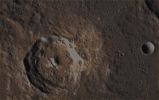
ZZ-Mercury-Craters-Unnamed_Crater-PIA17290-PCF-LXTT-IPF-1.jpgUnnamed and (relatively) Fresh Impact Crater (EDM - Absolute Natural Colors; credits for the additional process. and color.: Dr Paolo C. Fienga/Lunar Explorer Italia/Italian Planetary Foundation)88 visiteThis Absolute Natural Color Image-Mosaic shows us a bright (and, of course, relatively speaking, "fresh") Complex Mercurian Impact Crater - approx. 33 Km (such as about 20,49 miles) in diameter - that exhibits Terraced and Multi-Layered Inner Walls and Slopes - with some Collapse Feature (Mass-Wasting?) here and there -, an also quite Complex Central Peaks' System and, last but not least, the (more than just) possible evidence of a large Pyroclastic Deposit located on it's Eastern Side (---> Dx of the Crater for the Observer), and mostly concentrated in the Region going from about 1 to 4 o'clock of its Outer Surroundings.
Date acquired: November, 6th, 2011
Images Mission Elapsed Time (MET): 229105596, 229105592, 229105588
Images ID: 980566, 980565, 980564
Instrument: Wide Angle Camera (WAC) of the Mercury Dual Imaging System (MDIS)
Center Latitude: 25,42° North
Center Longitude: 266,80° East
Solar Incidence Angle: 52,3° (meaning that the Sun, at the time that the picture was taken, was about 37,7° above the imaged Local Mercurian Horizon)
Emission Angle: 16,8°
Sun-Mercury-Messenger (or "Phase") Angle: 69,1°
This picture (which is a crop from an Original NASA - MESSENGER Spacecraft's false colors Map-Projected image-mosaic published on the NASA - Planetary Photojournal with the ID n. PIA 17290) has been additionally processed, contrast enhanced, magnified and then re-colorized in Absolute Natural Colors (such as the colors that a human eye would actually perceive if someone were onboard the NASA - MESSENGER Spacecraft and then looked down, towards the Surface of Mercury), by using an original technique created - and, in time, dramatically improved - by the Lunar Explorer Italia Team. Different colors, as well as different shades of the same color, mean, among other things, the existence of different Elements (Minerals) present on the Surface of Mercury, each having a different Albedo (---> Reflectivity) and Chemical Composition.MareKromium
(3 voti)
|
|

ZZ-Mercury-Volcanic_Features-Vent-PIA15245-PCF-LXTT-IPF.jpgVolcanic Vent on the Edge of Caloris Basin (Absokute Natural Colors; credits for the additional process. and color.: Dr Paolo C. Fienga/Lunar Explorer Italia/Italian Planetary Foundation)70 visiteThis kidney-shaped Surface Depression (which is approximately 23 Km - such as 14,283 miles - across its longest dimension) lies along the Inner Margin of the giant Caloris Basin and it was first imaged during the NASA - MESSENGER Spacecraft's first Fly-By of the innermost Planet in the Solar System, about 2 years ago. The Rimless, non-circular Surface Depression is, in fact, the Vent of a small, explosive Volcano, and it is similar to many other Volcanic Vents that have been discovered on Mercury. The small number of superposed Impact Craters indicates that this Feature is, just in a manner of speaking, relatively "young" as to the surrounding Terrain. Notice, also, the considerable number of bright Hollows that seem to characterize a large portion of the Inner Rim as well as the East-facing Slopes of the small Impact Crater located right outside the Eastern Margin of the Vent, at about 4 o'clock of the Main Feature.
Note: for another view of this Volcanic Vent and its extremely interesting surroundings (seen on a larger scale), please refer to the APOD of December, 22nd, 2012.
Date acquired: June 7th, 2011
Image Mission Elapsed Time (MET): 215894570
Image ID: 347724
Instrument: Narrow Angle Camera (NAC) of the Mercury Dual Imaging System (MDIS)
Center Latitude: 22,5° North
Center Longitude: 146,1° East
Resolution: 28 meters/pixel
Solar Incidence Angle: 39,6° (meaning that the Sun, at the time that the picture was taken, was about 50,4° above the imaged Local Mercurian Horizon)
Emission Angle: 45,5°
Sun-Mercury-Messenger (or "Phase") Angle: 78,3°
This picture (which has been cropped from an Original NASA - MESSENGER Spacecraft b/w frame published on the NASA - Planetary Photojournal with the ID n. PIA 15245) has been additionally processed and then colorized in Absolute Natural Colors (such as the colors that a human eye would actually perceive if someone were onboard the NASA - MESSENGER Spacecraft and then looked down, towards the Surface of Mercury), by using an original technique created - and, in time, dramatically improved - by the Lunar Explorer Italia Team. Different colors, as well as different shades of the same color, mean, among other things, the existence of different Elements (Minerals) present on the Surface of Mercury, each having a different Albedo (---> Reflectivity) and Chemical Composition.MareKromium
(3 voti)
|
|

ZZ-Mercury-Craters-Donalaitis_Crater-PIA16958-PCF-LXTT-IPF-1.jpgDonelaitis Crater (Absolute Natural Colors; credits for the additional process. and color.: Dr Paolo C. Fienga/Lunar Explorer Italia/IPF)125 visiteThis composite of three frames, taken by the NASA - MESSENGER Spacecraft in August 2011, shows us the recently named Donalaitis Crater (whose diameter is approx. 84,5 Km - such as about 52,47 miles - and it lies well visible at the center of the image). As you can see, this Complex Mercurian Impact Crater exhibits some extremely unusually-looking bright yellow-orangish Deposits on its Floor. These colorful and very bright Deposits, as you may easily notice, contrast starkly with the much darker and gray colors (with pale brown/reddish nuances and some brighter white spots - where the latter could be, perhaps, some Hollows-covered areas) of the surrounding (and highly cratered) Terrain.
Donelaitis Crater was named after Kristijonas Donelaitis (1714 - 1780), a Lithuanian poet. His classic poem, 'The Seasons (Metai)', describes the lives of Lithuanian peasants, who at the time of its writing were being pushed into serfdom as most of their country was annexed by the Russian Empire.
Date acquired: August, 21st, 2011
Images Mission Elapsed Time (MET): 222408661, 222408681, 222408665
Images ID: 658976, 658981, 658977
Instrument: Wide Angle Camera (WAC) of the Mercury Dual Imaging System (MDIS)
Center Latitude: 51,81° South
Center Longitude: 39,11° East
Resolution: 874 meters/pixel
Solar Incidence Angle: 56,2° (meaning that the Sun, at the time that the picture was taken, was about 33,8° above the imaged Local Mercurian Horizon)
Emission Angle: 0,5°
Sun-Mercury-Messenger (or "Phase") Angle: 55,7°
This picture (which has been cropped from an Original NASA - MESSENGER Spacecraft false color image-mosaic published on the NASA - Planetary Photojournal with the ID n. PIA 16958) has been additionally processed and then colorized in Absolute Natural Colors (such as the colors that a human eye would actually perceive if someone were onboard the NASA - MESSENGER Spacecraft and then looked down, towards the Surface of Mercury), by using an original technique created - and, in time, dramatically improved - by the Lunar Explorer Italia Team. Different colors, as well as different shades of the same color, mean, among other things, the existence of different Elements (Minerals) present on the Surface of Mercury, each having a different Albedo (---> Reflectivity) and Chemical Composition.MareKromium
(3 voti)
|
|
| 248 immagini su 21 pagina(e) |
|
|
|
|
|
12 | |
|
|
|
|
|
|





