| Piú votate - Artistic Views of the Solar System |

Flash-PIA02108.jpgFlash!!!114 visiteThis image shows a flash produced in a laboratory by a high-velocity bead slamming into dust. Though the flash itself can't be resolved, its brilliant effects can be seen in this three-second time exposure. Scientists say that the collision between Deep Impact's Impactor and comet Tempel 1 may produce a similar flash.
This flash occurred when a quarter-inch sphere smashed into powdered dust at a speed of 6,4 Km-per-second (about 4 miles-per-second).
Even though the actual flash lasted less than 50 millionths of a second, the camera recorded the hot debris in the impact crater (center) and the streaking ejecta.
This experiment was performed at NASA's Ames Research Center, Moffett Field, Ca.
(9 voti)
|
|

En route to Titan.jpgHuygens Probe: en route to Titan126 visiteThe Huygens Probe, after deploying from the Cassini Orbiter, en route into the murky atmosphere of Saturn's largest moon, Titan.
(9 voti)
|
|

Martian_Residual_Lake-2779-22384.jpgResidual Lake on Mars80 visitenessun commentoMareKromium
(8 voti)
|
|

UB-313.jpgUB 313: is this the "10th Planet"?82 visiteWhat do you call an outer Solar System object that is larger than Pluto? Nobody is yet sure, but the question arose recently when 2003 UB313, an object currently twice as far out as Pluto and not in the plane with the rest of the Planets, was verified recently to be 30% wider than Pluto. UB313's size was estimated (of course in a VERY approximate way!) by measuring how much infrared light this celestial body emits. Previous size estimates were based only on visible light and greatly affected by how reflective the object is.
Whether 2003 UB313 is officially declared a planet will be answered shortly by the International Astronomical Union (IAU).
In the above picture, a scientific artist has imagined UB313 in its distant orbit around the Sun, coupled with a hypothetical moon.
(8 voti)
|
|

Unknown_Centaur.JPGUnknown Centaur82 visitenessun commentoMareKromium
(7 voti)
|
|

Venus-Lightning.jpgVenusian Lightnings72 visiteCaption ESA:"This artist’s concept of Venus, dated 2006, suggests the presence of lightning in the atmosphere". MareKromium
(7 voti)
|
|

The_Rings-PIA10082.jpgMittens72 visiteCaption NASA:"This is an artist concept of the view from Cassini during the star occultation that detected "Mittens," the small object to the right of the star. As Cassini watched the star pass behind Saturn's F-Ring (foreground), the star blinked out when Mittens blocked it, indicating it may be a solid moonlet".MareKromium
(7 voti)
|
|
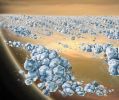
The_Rings-PIA10081.jpgIcy Rings73 visiteCaption NASA:"This is an artist concept of a close-up view of Saturn's Ring particles. The planet Saturn is seen in the background (yellow and brown).
The particles (blue) are composed mostly of ice, but are not uniform. They clump together to form elongated, curved aggregates, continually forming and dispersing. The space between the clumps is mostly empty. The largest individual particles shown are a few meters (yards) across". MareKromium
(7 voti)
|
|

Volcanoes-Olympus_and_Clouds.jpgOlympus, in a Sea of Clouds (Painting by Gordon Legg, based on Viking Orbiter mosaic P17444. From NASA SP-444, 1980) 137 visiteThis painting, based on a mosaic of black-and-white Viking Orbiter images of Olympus Mons, shows the volcano's flanks and complex caldera protruding above thin clouds of water ice. MareKromium
(6 voti)
|
|

Enceladus~2.jpgEnceladian Geysers130 visiteDa "NASA - Picture of the Day" dell'8 Giugno 2006:"In this stunning Saturnian vista - one in a series of artist's visions of volcanos on alien worlds - icy geysers erupt along narrow fractures in inner moon Enceladus. The majestic plumes were actually discovered by instruments on the Cassini Spacecraft during close encounters with bright and shiny Enceladus last year. Researchers now suspect the plumes originate from near-surface pockets of liquid water with temperatures near 273 kelvins (0° Celsius) - hot when compared to the distant moon's surface temperature of 73 kelvins (- 200° C). A dramatic sign that tiny, 500km-diameter Enceladus is surprisingly active, these ice volcanos hold out another potential site in the search for water and origin of life beyond planet Earth.
Enceladus' ice volcanos also likely produce Saturn's faint but extended E-Ring".
(6 voti)
|
|

Bardarbunga.jpgBardarbunga278 visiteMother Earth when is pissed...
And, please, do not confuse this funny-named Icelandic Volcano with the Italian "Bunga-Bunga" dance (or party)...MareKromium
(5 voti)
|
|

Earth___Moon-Galileo.jpgThe Earth-Moon System98 visiteCaption NASA originale:"A double planet? From 6,4 MKM away on December 16, 1992, NASA's Robot Spacecraft Galileo took this picture of the Earth-Moon System. The bright, sunlit half of the Earth contrasts strongly with the darker subdued colors of the Moon.
Our Moon is one of the largest moons in the Solar System. It is even larger than the planet Pluto. In this picture, the Earth-moon system actually appears to be a double planet".
(5 voti)
|
|
| 91 immagini su 8 pagina(e) |
 |
|
|
5 | |
|
|








