| Piú votate - Artistic Views of the Solar System |
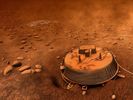
Titan-IMG001958-br500.jpgHuygens' Landing Site107 visiteThis is an artist's interpretation of the area surrounding the Huygens Landing Site, based on images and data returned on Jan. 14, 2005.
On January 14, 2005, the European Space Agency's (ESA) Huygens Probe reached the upper layer of Titan's atmosphere and landed on the surface after a parachute descent 2 hours and 28 minutes later.
As part of the joint NASA/ESA/ASI mission to Saturn and its Moons, the Huygens Probe was sent from the Cassini spacecraft to explore Titan, Saturn's largest moon. Titan's organic chemistry may be like that of the primitive Earth around 4000 MY ago, and it may hold clues about how life began on our Planet.
Nota: permetteteci un piccolo commento su questo "grande successo". Di dati significativi sull'ambiente di Titano (p.e.: temperature medie nel ciclo giorno/notte; presenza o meno di venti; presenza o meno di polveri in sospensione; componenti primari dell'atmosfera a varie altitudini etc.), ad oggi, non ci pare ne sìano emersi. A parte qualche "sembra" e qualche "si sta ancora studiando" non c'è ancora nulla di solido su cui lavorare (o almeno speculare). E questo per non dire delle fotografie di Titano al suolo: dovevano dirci tanto. Alla fine, quelle poche (ed orrende) immagini ricevute non ci hanno detto assolutamente niente.
La "Discesa dell'Europa su Titano" (come si scrisse in tono trionfalistico un anno fa - per poi dimenticare tutto in 24 ore...) fu dunque vera gloria?
Ai posteri l'ardua sentenza...

(13 voti)
|
|

Gusev Crater.jpgGusev Crater: an artistic interpretation147 visite"...The landing site and the Columbia Hills are within Gusev Crater, a bowl about 150 Km (about 95 miles) in diameter. It was selected for the Spirit mission because the shape of the terrain suggests the crater once held a lake. Volcanic deposits appear to have covered any sign of ancient lakebed geology out on the plain, but scientists say the hills expose older layers that have been lifted and tipped by a meteorite impact or other event...".
"Spirit has climbed to the hilltop and looked over the other side, but NASA did not do this just to say we can do it. The Mars rovers are addressing fundamental questions about Martian history and planetary environments," said NASA's Mars Exploration Program Director Doug McCuistion.
The crest of "Husband Hill" offers Spirit's views of possible routes into a basin to the south with apparently layered outcrops. Shortly after Spirit landed, it observed a cluster of seven hills about 3 kilometers (2 miles) east of its landing site. NASA proposed naming the range "Columbia Hills" in tribute to the last crew of Space Shuttle Columbia. The tallest of the hills commemorates Rick Husband, Columbia's commander.
(13 voti)
|
|
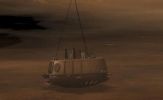
Titan-IMG001293-br500.jpgHuygens is landed on Titan!103 visitenessun commento
(13 voti)
|
|
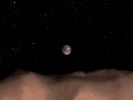
Toutatis.jpgEarth from the asteroid "Toutatis"109 visiteOn September 29, 2004, the Earth came within 1 million miles of the asteroid Toutatis - the closest predicted approach of our fair planet to a sizable asteroid or comet in this century. Coming within 1 million miles (or about 4 times the Earth-Moon distance), Earth would appear to be nearly the size of the full moon in the asteroid's sky, as suggested in this illustration. In Earth's sky, Toutatis appeared only as a faint object rapidly moving against a background of stars. Also known as Earth-Crossing Asteroid (ECA) 4179, Toutatis is in an eccentric 4 year orbit which moves it from the asteroid belt between Mars and Jupiter to just inside Earth's orbit. When the Earth passed near it in 1992 Toutatis was imaged by radar and seen to be 2 irregularly shaped lumps, perhaps joined by a narrow neck. This bizarre object is about 3 Km wide, 5,5 Km long and is tumbling through space. Studies of Toutatis and other ECA's help reveal connections between the Solar System's meteorites main-belt asteroids and comets.
(13 voti)
|
|

Mars Express-PIA04802_modest.jpgMars Express111 visitenessun commento
(13 voti)
|
|

SchiaparelliCrater-processed.jpgA thick layer of dust over Schiaparelli Crater84 visitenessun commentoMareKromium
(12 voti)
|
|

Mars-A.jpgMars, a LONG time ago...103 visitenessun commento
(12 voti)
|
|

Terminator.jpgLunar Terminator97 visitenessun commento
(12 voti)
|
|

s going to Titan-IMG000616-br500.jpgDown to Titan!92 visiteCaption NASA originale:"This artist's conception of the Cassini orbiter shows the Huygens probe separating to enter Titan's atmosphere. After separation, the probe drifts for about 3 weeks until reaching its destination, Titan. Equipped with a variety of scientific sensors, the Huygens probe will spend 2-2,5 hours (maybe more) descending through Titan's dense, murky atmosphere of nitrogen and carbon-based molecules, beaming its findings to the distant Cassini orbiter overhead. The probe could continue to relay information for up to 30 minutes after it lands on Titan's frigid surface, after which the orbiter passes beneath the horizon as seen from the probe".
(12 voti)
|
|

Landing on Mars.jpgLanding on Mars156 visiteA livello di curiosità Vi suggeriamo, se volete vedere una ricostruzione davvero molto credibile di un futuro "landing on Mars" (a base di paracadute prima ed airbags poi), la sequenza della discesa della capsula di emergenza con 5 astronauti a bordo che viene presentata nel discreto Sci-Fi Movie "Red Planet".
(12 voti)
|
|

Landing on Titan (3).jpgSaturn, through the fog of Titan129 visiteTitan's surface may hold lakes of liquid ethane and methane, sprinkled over a thin veneer of frozen methane and ammonia. Most of the brownish-orange color comes from more heavily processed hydrocarbons present in Titan's atmosphere and on its surface. Artistic license has been used to exaggerate the size of the orbiter, the sharpness of the icy features, the tilt of Saturn's rings, and the visibility of the planet through Titan's atmosphere.
(12 voti)
|
|

Mars-C.jpgMars, NOW...93 visitenessun commento
(11 voti)
|
|
| 91 immagini su 8 pagina(e) |
 |
3 | |
|
|
|
|








