| Piú votate - Pluto and Charon: The "Double Planet" |

ZZ-ZZ-ZZ-ZZ-ZZ-Nhov20110401_0515.jpgWhere's New Horizons? April 2011 (2) - Full Trajectory: Overhead View 113 visiteThis image shows New Horizons' Current Position along its full planned trajectory. The green segment of the line shows where New Horizons has traveled since launch; the red indicates the Spacecraft's future path. Positions of stars with magnitude 12 or brighter are shown from this perspective, which is above the Sun and "north" of Earth's orbit.MareKromium
(4 voti)
|
|

ZZ-ZZ-ZZ-ZZ-ZZ-Nhsv-20110401_0515.jpgWhere's New Horizons? April 2011 (3) - Full Trajectory - Side View 115 visiteAlso this image shows New Horizons' Current Position along its full planned trajectory. The green segment of the line shows where New Horizons has traveled since launch; the red indicates the Spacecraft's future path. Positions of stars with magnitude 12 or brighter are shown from this perspective, which is slightly above the Orbital Plane of the Planets. MareKromium
(4 voti)
|
|

ZZ-ZZ-ZZ-ZZ-20100727_LORRIM_lg.jpgOn the Way to Pluto: Messier 779 visiteCaption NASA:"The New Horizons team calibrates the Long Range Reconnaissance Imager (LORRI) by taking pictures of the Open Star Cluster Messier 7 (M 7). This is the first LORRI image of M 7 taken during Annual Checkout (ACO); the 100-millisecond manual exposure was taken on June 25, 2010. A preliminary comparison of this image to a 2008 LORRI picture of M7 indicated no degradation or change in LORRI's performance".MareKromium
(4 voti)
|
|

Pluto-421596main_s1006ay-1.jpgSurface Color-Variations on Pluto58 visiteSince its discovery in 1930, Pluto has been a speck of light in the largest ground-based telescopes. But NASA's Hubble Space Telescope has now mapped the Dwarf Planet in never-before-seen detail. The new map is so good, astronomers have even been able to detect changes on the Dwarf Planet's Surface by comparing Hubble images taken in 1994 with the newer images taken in 2002-2003. The task is as challenging as trying to see the markings on a soccer ball 40 miles away.
Hubble's view isn't sharp enough to see craters or mountains, if they exist on the surface, but Hubble reveals a complex-looking and variegated world with white, dark-orange, and charcoal-black terrain. The overall color is believed to be a result of UltraViolet radiation from the distant Sun breaking up Methane that is present on Pluto's Surface, leaving behind a dark, molasses-colored, carbon-rich residue.
Astronomers were very surprised to see that Pluto's brightness has changed — the Northern Pole is brighter and the Southern Hemisphere is darker and redder. Summer is approaching Pluto's North Pole, and this may cause surface ices to melt and refreeze in the colder shadowed portion of the Planet. The Hubble pictures underscore that Pluto is not simply a ball of ice and rock but a dynamic world that undergoes dramatic atmospheric changes.MareKromium
(4 voti)
|
|

C-Pluto_Charon.jpgPluto and Charon, from the Subaru Telescope55 visiteThe excellent quality of its 8,3-meter primary mirror and the stability of the atmosphere above Mauna Kea, Hawaii, allowed the Subaru Telescope to provide clearly separated images of Pluto and Charon using its Cooled Infrared Spectrograph/Camera.
This image is produced from three 2-second exposures taken through infrared filters on June 9, 1999.
MareKromium
(4 voti)
|
|

ZZ-ZZ-Nhsv3-060808_NHpassSaturn.jpgWhere's New Horizons? June 2008 - Full Trajectory: Overhead View54 visiteNew Horizons crossed the orbit of Saturn on June 8, passing yet another interplanetary milepost on its voyage to Pluto and the icy environs of the Kuiper Belt.
Spinning in healthy, electronic hibernation, New Horizons reached a distance of 10.06 AU (Astronomical Units; such as about 935 MMs or about 1,5 BKM) from the Sun at 10:00 UT (Universal Time), becoming the first spacecraft to journey beyond Saturn’s orbit since Voyager 2 passed the ringed planet nearly 27 years ago. In fact, Voyager 1 and 2, at the edge of the Sun’s Heliosphere some 100 AU away, are the only Spacecrafts operating farther out than New Horizons.
New Horizons reached Saturn's distance just two years and four months after launch - by far a faster transit to Saturn than any previous spacecraft. (Voyager 1, the previous record holder, made the trip in approximately three years and two months)
New Horizons has crossed the orbits of three planets since its launch in January 2006, though only one – Jupiter, in February 2007 – was close enough for a gravity boost and for the Spacecraft to study. Saturn is more than 1,4 BMs (about 2,3 BKM) from New Horizons at present.
After a productive two-week series of system checks, maintenance activities, and software and command uploads,the Spacecraft is humming through the Outer Solar System at a speed of 40.850 miles (65.740 Km) per hour. The New Horizons Team expects to keep the Spacecraft in hibernation until Sept. 2, 2008. MareKromium
(4 voti)
|
|

ZZ-ZZ-ZZ-Pluto-lorri_pluto_im01_1x1_oct2007_ppt.pngPluto54 visiteThis image demonstrates the first detection of Pluto using the High-Resolution mode on the New Horizons Long-Range Reconnaissance Imager (LORRI). The mode provides a clear separation between Pluto and numerous nearby background stars. When the image was taken on October 6, 2007, Pluto was located in the constellation Serpens, in a region of the sky dense with background stars.
Typically, LORRI’s exposure time in Hi-Res mode is limited to approx. 0,1", but by using a special pointing mode that allowed an increase in the exposure time to 0,967", scientists were able to spot Pluto, which is approximately 15.000 times fainter than human eyes can detect.
New Horizons was still too far from Pluto (3,6 BKM, or 2,2 BMs) for LORRI to resolve any details on Pluto’s surface – that won’t happen until Summer 2014, approximately one year before closest approach. For now the entire Pluto System remains a bright dot to the Spacecraft’s telescopic camera, though LORRI is expected to start resolving Charon from Pluto – seeing them as separate objects – in summer 2010.MareKromium
(4 voti)
|
|

ZZ-ZZ-Nhcp20071201_0488.jpgWhere's New Horizons? December 2007 (1) - Current Position54 visiteThis image shows New Horizons' current position. The green segment of the line shows where New Horizons has traveled since launch; the red indicates the Spacecraft's path toward Jupiter, Pluto and beyond. Positions of stars with magnitude 12 or brighter are shown from this perspective, which is above the Sun and "North" of Earth's orbit.
What Is an AU? The graphics on these pages note New Horizons' distance from Earth, Jupiter and Pluto in AU, or Astronomical Units. One AU is the average distance between the Sun and Earth, about 93 MMs or 149,6 MKM.
Heliocentric Velocity.
The current position graphic also notes the Spacecraft's Heliocentric Velocity (HV), such as its speed with respect to the Sun - in kilometers per second.
One kilometer per second is equivalent to 0,62 miles per second, or 2237 miles per hour.MareKromium
(4 voti)
|
|

ZZ-ZZ-Nhsv20071201_0488.jpgWhere's New Horizons? December 2007 (3) - Full Trajectory - Side View54 visiteThis image shows New Horizons' current position along its full planned trajectory. The green segment of the line shows where New Horizons has traveled since launch; the red indicates the Spacecraft's future path.
Positions of stars with magnitude 12 or brighter are shown from this perspective, which is slightly above the Orbital Plane of the Planets. MareKromium
(4 voti)
|
|

ZR-Pluto System 04.jpgPluto's System: second scheme of the possible orbits54 visiteAlthough a full orbital solution for the satellites cannot be determined from only two HST measurements, it turns that their paths closely follow that expected for objects orbiting the Pluto System's barycenter in a perfect circle in the same plane as Charon's orbit. In this diagram, the barycenter is the dot in the center, Pluto's orbit is the smallest ellipse, Charon's orbit is the next ellipse (its position on May 15 and May 18 are indicated by the filled and open circles, respectively), an orbit that is consistent with P2's measured positions is next, followed by an orbit that is consistent with P1's measured positions. For both of the latter cases, the filled squares are positions on May 15 and open squares are positions on May 18.
Note: the so-called "projection effects" cause the circular orbits to look elliptical on the plane of the sky.
(4 voti)
|
|
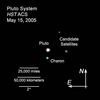
ZO-Pluto System.jpgPluto's System: Facts, Data, Men and early Picture55 visiteFast Facts — Recent Technical information (Oct. 2005)
Object Name: Pluto
Object Description: Planet
Distance: Although its orbit is highly eccentric, Pluto's average distance from the Sun is 39,44 Astronomical Units (A.U.) or roughly 3,6 BMs (such as about 5,9 BKM).
Dimensions: Pluto has a diameter of roughly 1.475 miles (about 2.280 Km) at the equator.
About the Data Description: these HST data are from proposal 10427: H.A. Weaver (JHU/APL), M.W. Buie (Lowell Obs.), S.A. Stern, J.R. Spencer, E. Young, and L.A. Young (SwRI); and proposal 9391: M.W. Buie and W.M. Grundy (Lowell Obs.), E. Young, L.A. Young, and S.A. Stern (SwRI). M. Mutchler (STScI) and A.J. Steffl (SwRI) are also on the science team.
Instrument: ACS/WFC ACS/HRC
Exposure Date(s): May 15/18, 2005 various dates in 2002 and 2003
Filters: F606W (V) F475W (B) and F555W (V)
(4 voti)
|
|

ZZ-ZZ-ZZ-ZZ-ZZ-ZZ-Z-Pluto-Map.jpgA few names for the Main Features of Pluto71 visiteEcco i nomi di alcune delle aree e Regioni di maggior interesse di Plutone. Su molte, devo dire che la scelta é stata felice. Su qualcuna.... Beh, decidete Voi.
Alcyonia Lacus, a possible frozen Nitrogen Lake on Pluto's Surface, is named for the bottomless lake in or in the vicinity of Lerna, a region of Greece known for springs and swamps; the Alcyonian lake was one of the entrances to the underworld in Greek mythology.
Elcano Montes is a mountain range honoring Juan Sebastián Elcano (1476–1526), the Spanish explorer who in 1522 completed the first circumnavigation of the Earth (a voyage started in 1519 by Magellan).
Hunahpu Valles is a system of canyons named for one of the Hero Twins in Mayan mythology, who defeated the lords of the underworld in a ball game.
Khare crater honors planetary scientist Bishun Khare (1933–2013), an expert on the chemistry of planetary atmospheres who did laboratory work leading to several seminal papers on tholins – the organic molecules that probably account for the darkest and reddest regions on Pluto.
Kiladze crater honors Rolan Kiladze (1931–2010), the Georgian (Caucasus) astronomer who made pioneering early investigations the dynamics, astrometry and photometry of Pluto.
Lowell Regio is a large region honoring Percival Lowell (1855–1916), the American astronomer who founded Lowell Observatory and organized a systematic search for a planet beyond Neptune.
Mwindo Fossae is a network of long, narrow depressions named for the Nyanga (Eastern Dem. Rep. Congo/Zaire) epic hero who traveled to the Underworld and after returning home became a wise and powerful king.
Piccard Mons is Mountain and suspected Cryo-Volcano that honors Auguste Piccard (1884–1962), a 20th century inventor and physicist best known for his pioneering balloon flights into Earth's Upper Atmosphere.
Pigafetta Montes honors Antonio Pigafetta (c. 1491–c. 1531), the Italian scholar and explorer who chronicled the discoveries made during the first circumnavigation of the Earth, aboard Magellan's ships.
Piri Rupes is a long cliff honoring Ahmed Muhiddin Piri (c. 1470–1553), also known as Piri Reis, an Ottoman navigator and cartographer known for his world map. He also drew some of the earliest existing maps of North and Central America.
Simonelli Crater honors astronomer Damon Simonelli (1959–2004), whose wide-ranging research included the formation history of Pluto.
Wright Mons honors the Wright brothers, Orville (1871–1948) and Wilbur (1867–1912), American aviation pioneers credited with building and flying the world's first successful airplane.
Vega Terra is a large land mass named for the Soviet Vega 1 and 2 missions, the first Spacecraft to fly balloons on another planet (Venus) and to image the Nucleus of a Comet (1P/Halley).
Venera Terra is named for the Venera missions sent to Venus by the Soviet Union from 1961–1984; they included the first human-made device to enter the Atmosphere of another Planet, to make a soft landing over there and to return images from an alien planetary surface.MareKromium
(3 voti)
|
|
| 75 immagini su 7 pagina(e) |
 |
|
4 | |
|
|





