| Piú votate - Neptune and His Moons |

Triton-PIA01538_modest.jpgGeologic processes on Triton (2)62 visiteCaption NASA originale:"Part of the complex geologic history of icy Triton, Neptune's largest satellite, is shown in this Voyager 2 photo, which has a resolution of 900 meters (2.700 feet) per picture element. The photo was received as part of a Triton-mapping sequence between 3:30 and 5:30 a.m. (PDT). This view is about 500 Km (300 miles) across.
It encompasses 2 depressions, possibly old impact basins, that have been extensively modified by flooding, melting, faulting and collapse. Several episodes of filling and partial removal of material appear to have occurred. The rough area in the middle of the bottom depression probably marks the most recent eruption of material. Only a few impact craters dot the area, which shows the dominance of internally driven geologic processes on Triton".
(4 voti)
|
|

Triton-PIA01536_modest.jpgTriton (through green, violet and ultraviolet filters)64 visiteCaption NASA originale:"This color photo of Neptune's large satellite Triton was obtained on Aug. 24 1989 at a range of 530.000 Km (or 330.000 miles). The resolution is about 10 Km (6,2 miles), sufficient to begin to show topographic detail. The image was made from pictures taken through the green, violet and ultraviolet filters. In this technique, regions that are highly reflective in the ultraviolet appear blue in color. In reality, there is no part of Triton that would appear blue to the eye. The bright southern hemisphere of Triton, which fills most of this frame, is generally pink in tone as is the even brighter equatorial band. The darker regions north of the equator also tend to be pink or reddish in color".
(4 voti)
|
|

Neptune-June2011-HST.jpgOne Neptunian Day...103 visiteCaption NASA:"Neptune rotates once on its axis in about 16 hours. So, spaced about 4 hours apart these 4 images of the Solar System's most distant Gas Giant cover one Neptune day. Recorded by the Hubble Space Telescope in late June 2011, they combine exposures made with visible and Near-InfraRed filters to show high-altitude Clouds composed of Methane ice crystals against the Planet's normally blue Cloud Tops.
Because Neptune's axis of rotation is tilted to its orbital plane by 29°, compared to Earth's 23,5°, Neptune experiences seasons analogous to Earth's.
As early Summer comes to Neptune's Southern Hemisphere and Winter to the North, Hubble observations have shown Cloud activity shifting to the Northern Hemisphere. In fact the progression of Neptune's seasons has come around once since its position was predicted by French mathematician Urbain Le Verrier and British mathematician John Couch Adams, and the Planet was subsequently discovered by German astronomer Johann Galle on September 23, 1846. With an orbital period of approximately 165 years, this week on July 12, 2011, Neptune has been once around the Sun since its discovery date".MareKromium
(3 voti)
|
|

Triton_Mosaic.JPGTriton (photo-mosaic - credits: NASA)62 visiteCaption NASA:"This picture of Triton is a mosaic of the highest resolution images taken by Voyager 2 on Aug. 25, 1989 from a distance of about 40.000 Km (approx. 24.800 miles). The mosaic is superimposed on the lower resolution mapping images taken about 2 hours earlier in order to fill in gaps between high resolution images. The smallest features that can be seen on the images are about 0,8 Km (approx. 0,5 miles) across.
The Terminator (such as the line separating the day from the night) is at the top of the picture and is centered at about 30° North Lat. and 330° East Longitude.
These highest resolution images were targeted for the Terminator Region to show details of the topography by the shadows it casts. Near the center of the picture is a depression filled with smooth plains that are probably ices which were once erupted in a fluid state. The depth of the depression is about 300 meters (900 feet) and the prominent fresh impact crater on its floor is about 20 Km (approx. 12 miles) in diameter and about 1 Km (such as approx. 0,6 mile) deep. On the right is an elongate crater with adjacent dark deposits above it. This feature may be an explosive eruption vent formed by gaps within the ice.
The linear structure on the left is probably a fracture along which fresh ice has been extruded".MareKromium
(3 voti)
|
|

Neptune-StrechedNaturalColors.JPGNeptune and a few of His Moons (Voyager 2 - Natural, but enhanced, Colors; credits: NASA)78 visiteCaption NASA:"Voyager 2 was the first spacecraft to observe the planet Neptune and its two satellites: Triton, the largest, and Nereid.
The most obvious feature of the Planet is its blue color, the result of Methane in the Atmosphere. Research continues on Neptune's two largest satellites and the additional 6 that were discovered by Voyager 2's investigation". MareKromium
(3 voti)
|
|

Neptune-HST4.JPGMoments of Neptune (HST - False Colors; credits: NASA, L. Sromovsky and P. Fry - University of Wisconsin-Madison)72 visitenessun commentoMareKromium
(3 voti)
|
|

Neptune-PIA09927.jpgThe "Hot" South Pole of Neptune85 visiteCaption NASA:"These thermal images show a "hot" South Pole on the Planet Neptune. These warmer temperatures provide an avenue for Methane to escape out of the deep atmosphere.
The images were obtained with the Very Large Telescope in Chile, using an imager/spectrometer for mid-infrared wavelengths on Sept. 1 and 2, 2006.
The telescope is operated by the European Organization for Astronomical Research in the Southern Hemisphere (known as ESO).
Scientists say Neptune's South Pole is "hotter" than anywhere else on the Planet by about 10° Celsius (50 degrees Fahrenheit). The average temperature on Neptune is about -200° Celsius (-392 degrees Fahrenheit).
The upper left image samples temperatures near the top of Neptune's troposphere (near 100 millibar pressure, which is 1/10th the Earth atmospheric pressure at sea level). The hottest temperatures are indicated at the lower part of the image, at Neptune's south pole (see the graphic at the upper right).
The lower two images, taken 6.3 hours apart, sample temperatures at higher altitudes in Neptune's stratosphere. They do show generally warmer temperatures near, but not at, the south pole. They also show a distinct warm area which can be seen in the lower left image and rotated completely around the back of the planet and returned to the earth-facing hemisphere in the lower right image".MareKromium
(3 voti)
|
|

Triton-PIA01994.jpgStrange "surface features" on Triton (clouds?!?)62 visiteCaption NASA originale"Already intriguing patterns of unknown origin appear on the surface of Neptune's largest satellite, Triton, in this image returned by Voyager 2. The image was taken Aug. 22, 1989, from a distance of about 4 MKM (approx. 2.5 MMs). Voyager images show that Triton's diameter is about 2.720 Km (approx. 1.690 miles) and that it is one of the brightest objects in the Solar System, reflecting about 70% of the sunlight that strikes it. This is the Hemisphere of Triton that always faces away from Neptune. The South Pole is near the bottom of the image. Triton's rotation axis is tilted so that the latitude at the center of the disk is 55° South. Dark regions at the top of the disk extend from roughly the equator to beyond 20° North. The margin between the bright and dark regions varies with longitude around the satellite. The gray, featureless area just to the right of the center of the disk is due to a reseau (reticule mark) in the camera".
(3 voti)
|
|
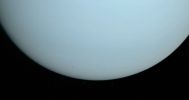
Z-Thalassa_and_Despina.jpgThalassa and Despina transiting (Credits: NASA/JPL - Voyager 2 Mission; Credits for the additional process.: "zelario12" - https://creativecommons.org/licenses/by-sa/2.0/deed.en)137 visitenessun commentoMareKromium
(2 voti)
|
|
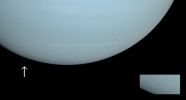
Z-Naiad.jpgNaiad transiting Neptune (Credits: NASA/JPL - Voyager 2 Mission; Credits for the additional process.: "zelario12" - https://creativecommons.org/licenses/by-sa/2.0/deed.en)112 visitenessun commentoMareKromium
(2 voti)
|
|
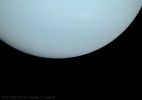
Z-Despina.jpgDespina transiting Neptune (Credits: NASA/JPL - Voyager 2 Mission; Credits for the additional process.: "zelario12" - https://creativecommons.org/licenses/by-sa/2.0/deed.en)132 visiteImmagine molto "datata", ma sempre molto bella ed ottimamente elaborata da tale "zelario12", al quale faccio i miei complimenti.MareKromium
(2 voti)
|
|

Neptune-PIA21629.jpgNeptune from the Saturnian Sky (Natural Colors; credits: NASA/JPL-Caltech/Space Science Institute)129 visiteCaption NASA:"On August 25, 1989, NASA's Voyager 2 made its historic Fly-By of Neptune and its largest moon, Triton. The Cassini Spacecraft took this image to celebrate the anniversary of that event.
Neptune appears in this Natural Color composite as a pale blue disk (similar to Cassini's image of Uranus from 2014), just below and to the right of image center. Most of the faint specks in the image are background stars, although some are likely Cosmic Rays (charged particles that strike the camera detector).
By imaging Neptune, Cassini's Solar System family portrait-taking is complete. The Mission's Planetary Photojournal includes all of the major Planets except Mercury, which is too close to the Sun to be imaged, as well as dwarf planet Pluto.
This view was acquired by the Cassini narrow-angle camera on Aug. 10, 2017, at a distance of approximately 2,72 Billion Miles (such as approx. 4,38 BKM) from Neptune. Red, blue and green filter images were combined to create this Natural Color image".MareKromium
(2 voti)
|
|
| 96 immagini su 8 pagina(e) |
 |
|
|
|
6 | |
|





