| Piú votate - Neptune and His Moons |
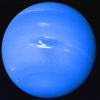
A-Neptune-PCF-LXTT.jpgBlue, Blue Neptune! (Natural Colors; credits for the additional process. and color.: Dr Paolo C. Fienga - Lunexit Team)116 visiteNeptune Data and Statistics
Discovered by Johann Gotfried Galle
Date of discovery = AD 1846
Mass (kg) = 1.024e+26
Mass (Earth = 1) = 1,7135e+01
Equatorial radius = 24.746 Km
Equatorial radius (Earth = 1) = 3,8799e+00
Mean density (gm/cm^3) = 1,64
Mean distance from the Sun = 4.504.300.000 Km
Mean distance from the Sun (Earth = 1) = 30,0611
Rotational period (hours) = 16,11
Orbital period (years) = 164,79
Mean orbital velocity = 5,45 Km per second
Tilt of axis = 29,56°
Orbital inclination = 1,774°
Equatorial surface gravity (m/sec^2) = 11,0
Equatorial escape velocity = 23,50 Km per second
Magnitude (Vo) = 7,84
Mean cloud temperature = from - 193°C to - 153°C
Atmospheric pressure (bars) = from 1 to 3
Atmospheric composition: Hydrogen 85%; Helium 13% and Methane 2% MareKromium
(5 voti)
|
|

Neptune-V2.jpgBright Neptunian Clouds99 visiteCaption NASA:"This Voyager 2 HR Natural Color image, taken about two hours before closest approach, provides obvious evidence of vertical relief in Neptune's bright Cloud Streaks. These clouds were observed at a latitude of 29° North near Neptune's Eastern Terminator. The linear cloud forms are stretched approximately along lines of constant latitude and the Sun is toward the lower left.
The bright sides of the clouds which face the sun are brighter than the surrounding cloud deck because they are more directly exposed to the Sun.
Shadows can be seen on the side opposite the Sun. These shadows are less distinct at short wavelengths (violet filter) and more distince at long wavelengths (orange filter). This can be understood if the underlying cloud deck on which the shadow is cast is at a relatively great depth, in which case scattering by moleculres in the overlying Atmosphere will diffuse light into the shadow. Because molecules scatter blue light much more efficiently than red light, the shadows will be darkest at the longest (reddest) wavelengths, and will appear blue under white light illumination.
The resolution of this image is roughly 11 Km (about 6,8 miles) per pixel and the range is only 157.000 Km (approx. 98.000 miles). The width of the Clouds Streaks range from about 50 to about 200 Km (approx. 31 to 124 miles), and their shadow widths range from about 30 to about 50 Km (approx. 18 up to 31 miles). Cloud heights appear to be of the order of approx. 50 Km (about 31 miles).MareKromium
(5 voti)
|
|

Triton-PIA02234~0.jpgTriton (possible Natural Colors; credits for the additional process. and color.: Dr Paolo C. Fienga - Lunexit Team)74 visitenessun commentoMareKromium
(5 voti)
|
|

Triton-PIA12184.jpgVolcanic Plains on Triton (possible Natural Colors; credits: Lunexit)64 visiteCaption NASA:"This view of the Volcanic Plains of Neptune's moon Triton was produced using topographic maps derived from images acquired by NASA's Voyager Spacecraft during its August 1989 flyby, 20 years ago this week (August 2009).
Triton, Neptune's largest moon, was the last solid object visited by the Voyager 2 Spacecraft on its epic 10-year tour of the Outer Solar System.
This regional view shows a variety of Terrains on Triton, including the smooth Volcanic Plains in the foreground, formed by icy lavas. Parts of this Surface have been eroded, forming mounds and depressions with relief of tens to a few hundred meters (several hundred feet). The round pits and mounds across the center of the scene are probably volcanic explosion or collapse craters, the largest of which (at bottom center) is approx. 250 meters deep (820 feet) and approx. 15 Km (about 9 miles) across.
Many of these pits are aligned in chains similar to those seen in basaltic volcanic areas on Earth, such as Craters of the Moon National Monument in Idaho, except the lavas on Triton are water and other ices that erupted onto the Surface.
In the distance is one of two large walled smooth plains of unknown origin. These plains are roughly 200 Km (about 124 miles) across.
The Surface of Triton is very rugged, scarred by rising blobs of ice (Diapirs), Faults and Volcanic Pits and Lava Flows composed of water and other ices. The Surface is also extremely young and sparsely cratered. It may even be younger than the Surface of Europa, one of the first objects visited by the Voyager Spacecraft and could be geologically active today.
Although locally very rugged, Triton has no large mountains or deep basins and regional relief is low, a consequence of its high internal heat and the low strength of most ices. This scene is on the order of 500 Km (about 310 miles) across and is taken from a new flyover movie across the Equatorial Regions of Triton commemorating the Voyager 20-year anniversary of this flyby.
Vertical relief has been exaggerated by a factor of 25 to aid interpretation".MareKromium
(5 voti)
|
|

Triton-PIA12187.jpgTritonian Terminator74 visitenessun commentoMareKromium
(5 voti)
|
|

Neptune-PIA01982.jpgClouds near the "Eye" of Neptune (Natural Colors; credits: Lunexit)87 visiteCaption NASA:"The bright cirrus-like clouds of Neptune change rapidly, often forming and dissipating over periods of several to tens of hours. In this sequence, Voyager 2 observed cloud evolution in the region around the Great Dark Spot (GDS).
The surprisingly rapid changes which occur separating each panel shows that in this Region Neptune's weather is perhaps as dynamic and variable as that of the Earth. However, the scale is immense by our standards -- the Earth and the GDS are of similar size -- and in Neptune's frigid Atmosphere, where temperatures are as low as 55 degrees Kelvin (-360 F), the cirrus clouds are composed of frozen Methane rather than Earth's crystals of water ice".MareKromium
(5 voti)
|
|

Neptune-PIA01995.jpgSouth Polar Clouds and Shadows (Natural Colors; credits: Lunexit)69 visiteCaption NASA:"This image of Neptune's South Polar Region was obtained by the NASA Voyager 2 Probe narrow-angle camera on Aug. 23, 1989, when it was at a distance of about 25 MKM (about 1,6 MMs).
The smallest cloud features are 45 Km (about 28 miles) in diameter. Also this image shows the discovery of shadows in Neptune's Atmosphere, shadows cast onto a deep cloud bank by small elevated clouds. Located at about 68° South Lat., they are the first cloud shadows ever seen by the Voyager on any Planet.
The dark regions adjacent to the small bright clouds are believed to be shadows, because they are on the side of the cloud that is opposite to the incoming Sunlight and also because they lengthen in places where the Sun lies closer to the horizon".MareKromium
(5 voti)
|
|

Triton.JPGNorthern Latitudes on Triton62 visiteVoyager 2 took this picture of Neptune's largest satellite, Triton, from less than 80.000 Km (about 50.000 miles). The image shows an area in Triton's Northern Hemisphere.
The Sun is just above the horizon, so features cast shadows that accentuate height differences. The large, smooth area in the right-hand side of the image shows a single, fresh, impact crater. Otherwise there is no evidence of impacts such as those that have pocked the faces of most of the satellites Voyager 2 has visited.
Many low cliffs in the area, bright where they face the Sun, and when they face away from it, suggest and intricate history for Triton. The cliffs might be due either to melting of surface materials or, possibly, caused by unusual fluid materials that flowed sometime in Triton's past.MareKromium
(5 voti)
|
|

Neptune-HST2.JPGNeptune and a few of His Moons (HST; Natural Colors; credits: NASA)64 visitenessun commentoMareKromium
(5 voti)
|
|

Triton-PIA02234.jpgTriton, from 530.000 Km!71 visiteCaption NASA:"Voyager 2 was 530.000 Km (330,000 miles) from Neptune's largest satellite, Triton, when this photo was taken, Aug. 24, 1989. With a resolution of 10 Km (about 6 miles), this is the first photo of Triton to reveal surface topography. The South Pole, continuously illuminated by sunlight at this season, is at bottom left. The boundary between the bright Southern Hemisphere and the darker Northern Hemisphere is clearly visible. Both the darker regions to the north and the very bright sub-equatorial band show a complex pattern of irregular topography that somewhat resembles "fretted terrain" on parts of Venus and Mars.
The pattern of dark and light Regions over most of the Southern Hemisphere will require HR images for interpretation. Also evident are long, straight lines that appear to be surface expressions of internal, tectonic processes. No large impact craters are visible, suggesting that the crust of Triton has been renewed relatively recently that is, within the past billion years or less".MareKromium
(5 voti)
|
|

Nereid-CJH.gifNereid61 visiteNereid was discovered in 1949 by astronomer Gerard Kuiper. Nereid is about 340 Km (210 miles) in diameter and is so far from Neptune that it requires 360 days to make one orbit. Voyager's best photos of Nereid were taken from about 4,7 MKM (about 2,9 MMs). The photos show that the moon's surface reflects about 14% of the sunlight that strikes it, making it somewhat more reflective than Earth's Moon and more than twice as reflective as Proteus. Nereid's orbit is the most eccentric in the Solar System. Its distance to Neptune ranges from about 1.353.600 Km (about 841.100 miles) to 9.623.700 Km (such as about 5.980.200 miles).
(5 voti)
|
|

Triton-PIA02212_modest.jpgTriton from Voyager 2 (false colors?)60 visiteCaption NASA originale:"The smallest features that can be seen in this false color image of Neptune's largest satellite, Triton, are about 47 Km across. The image, taken by Voyager 2 early in the morning of Aug. 23, 1989, is a composite of three images taken through ultraviolet, green, and violet filters. The image offers an example of the kinds of puzzles scientists face on the eve of an encounter: mottling in the bright southern hemisphere may be the result of topography, if Triton's crust is predominantly water ice, which is rigid at Triton's surface temperature. Alternatively, the mottling could be due to markings on a smooth surface, if the crust is composed of nitrogen, carbon monoxide, or methane ice, since they are soft at the same temperature". Nota: in questo frame la NASA parla chiaramente di "false colors" mentre nel successivo dice "natural colors". Ora a noi i "colors" di Tritone, nei due frames, sembrano identici.
Sono dunque entrambi "natural" o "false"? Dov'è la verità?
(5 voti)
|
|
| 96 immagini su 8 pagina(e) |
 |
|
4 | |
|
|
|





