| Piú votate - Neptune and His Moons |

NEPTUNE5.jpgNeptune from Voyager 2113 visite...luminose che agiscono sulla lunghezza d'onda del rosso).
Il movimento delle meravigliose formazioni nuvolose che caratterizzano gli strati superiori dell'atmosfera del Pianeta, come riprese dalla Sonda Voyager 2, ci hanno anche permesso di calcolare la velocità approssimativa dei venti che le muovono.
E così, a seguito di questo semplice calcolo, è stato possibile accertare che i venti di Nettuno sono i più forti dell'intero Sistema Solare: essi soffiano, infatti, a circa 2000 Km orari!
(15 voti)
|
|

Neptune-PIA00048.jpgNeptune in true colors, from Voyager 276 visiteOriginal caption:"This image of clouds in Neptune's atmosphere is the first that tests the accuracy of the weather forecast that was made eight days earlier (nota: questa caption è relativa all'Estate del 1989) to select targets for the Voyager narrow angle camera. Three of the four targeted features are visible in this photograph; all 3 are close to their predicted locations.
The "Great Dark Spot" with its bright white companion is slightly to the left of center. The small bright "Scooter" is below and to the left, and the second "Dark Spot" with its bright core is below the Scooter. Strong eastward winds up to 400 mph cause the second dark spot to overtake and pass the larger one every five days. The spacecraft was 6,1 MKM (about 3,8 MMs) from the Planet at the time of camera shuttering, and the images uses the orange, green and clear filters of the camera".
Qualche nota sui Voyager 1 e 2: Voyager 1, launched September 5, 1977, visited Jupiter in 1979 and Saturn in 1980. It is now leaving the solar system, rising above the ecliptic plane at an angle of about 35 degrees, at a rate of about 520 million kilometers a year.
Voyager 2, launched August 20, 1977, visited Jupiter in 1979, Saturn in 1981 and Uranus in 1986 before making its closest approach to Neptune on August 25, 1989. Voyager 2 traveled 12 years at an average velocity of 19 kilometers a second (about 42,000 miles an hour) to reach Neptune, which is 30 times farther from the Sun than Earth is. Voyager observed Neptune almost continuously from June to October 1989. Now Voyager 2 is also headed out of the solar system, diving below the ecliptic plane at an angle of about 48 degrees and a rate of about 470 million kilometers a year.
Both spacecraft will continue to study ultraviolet sources among the stars, and their fields and particles detectors will continue to search for the boundary between the Sun's influence and interstellar space. If all goes well, we will be able to communicate with the two spacecraft for another 20 years, until their radioactive power sources can no longer supply enough electrical energy to power critical subsystems.
(14 voti)
|
|

NEPTUNE3.jpgNeptune from Voyager 2111 visiteUn ciclopico ed ultrasecolare uragano anche per Nettuno, quindi?
Sembra di si, anche se delle risposte più accurate potranno venire solo da esami ed osservazioni, rispettivamente, maggiormente prolungati e ravvicinate.
Ci sono Missioni alle viste per Nettuno?
Purtroppo no, e allora dobbiamo rimetterci all'HST e dobbiamo altresì sperare che qualcuno alla NASA si ricordi di rendere note le informazioni e le scoperte riguardanti questo mondo azzurro e bianco, così bello e rassicurante - in apparenza - eppure così lontano, violento (da tanti punti di vista) e diverso dal nostro.
(14 voti)
|
|

AA-Neptune-CJH.jpgSmiling Neptune and soft, white, water-clouds - from Voyager 2 (HR)74 visiteUn'immagine davvero meravigliosa, ottenuta dalla Sonda Voyager 2, durante il suo rapido passaggio accanto all'ultimo Gigante Gassoso del nostro Sistema Solare. Era il 31 Agosto 1989...
(13 voti)
|
|

Neptune_sEye-TheDarkSpot-V2-CJH.gifThe "Dark Spot" of Neptune69 visitenessun commento
(12 voti)
|
|

Neq-Neptune-PIA00057.jpgThe "haze" of Neptune (false colors)73 visiteCaption NASA originale:"This false color photograph of Neptune was made from Voyager 2 images taken through 3 filters: blue, green and a filter that passes light at a wavelength that is absorbed by methane gas. Thus, regions that appear white or bright red are those that reflect sunlight before it passes through a large quantity of methane. The image reveals the presence of a ubiquitous haze that covers Neptune in a semitransparent layer. Near the center of the disk, sunlight passes through the haze and deeper into the atmosphere, where some wavelengths are absorbed by methane gas, causing the center of the image to appear less red. Near the edge of the Planet, the haze scatters sunlight at higher altitude, above most of the methane, causing the bright red edge around the planet. By measuring haze brightness at several wavelengths, scientists are able to estimate the thickness of the haze and its ability to scatter sunlight. The image is among the last full disk photos that Voyager 2 took before beginning its endless journey into interstellar space".
(12 voti)
|
|

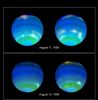
AA-Neptune-HST-PIA01284.jpgNeptune in "Primary Colors" - HST70 visiteCaption NASA originale:"These 2 NASA HST images provide views of weather on opposite hemispheres of Neptune. Taken Aug. 13, 1996, with Hubble's Wide Field Planetary Camera 2, these composite images blend information from different wavelengths to bring out features of Neptune's blustery weather. The predominant blue color of the planet is a result of the absorption of red and infrared light by Neptune's methane atmosphere. Clouds elevated above most of the methane absorption appear white, while the very highest clouds tend to be yellow-red as seen in the bright feature at the top of the right-hand image. Neptune's powerful equatorial jet - where winds blow at nearly 900 mph! - is centered on the dark blue belt just south of Neptune's equator. Farther south, the green belt indicates a region where the atmosphere absorbs blue light".
(12 voti)
|
|

AA-Neptune-HST-PIA01287_modest.jpgNeptune from HST86 visiteLa seconda serie di immagini del Pianeta Nettuno, ripreso dal Telescopio Spaziale Hubble. Poco da aggiungere rispetto a quanto già detto in precedenza se non che la (quasi totale) impossibilità di fotografare amatorialmente Nettuno dalle nostre latitudini dipende da un continuo e costante degrado dell'atmosfera che ci circonda: inquinamento gassoso ed inquinamento luminoso fanno a gara per vedere quale dei due sia il peggiore.
Purtroppo, sebbene per motivi ed in ambiti diversi, sono entrambi "letali"!
(12 voti)
|
|

NEPTUNE.jpgNeptune from Voyager 290 visiteL'anno di Nettuno, a livello di curiosità, dura circa 165 anni terrestri e, quindi, ognuna delle sue "stagioni" si estende per oltre 41 anni.
Adesso è ancora Primavera su Nettuno, ma l'Estate è alle porte (inizierà, nell'Emisfero Sud, nel 2005).
Può sembrare un fatto incredibile (basti pensare che la luce solare, su Nettuno, è circa 900 volte meno intensa di quanto essa lo sia sulla Terra) eppure, all'avvicinarsi dell'Estate, il clima di Nettuno sembra "rispondere" di conseguenza. E' stato infatti notato, mettendo a confronto immagini del Pianeta riprese dall'HST nel 1996 rispetto ad altre riprese (sempre dell'HST) nel 2002, un notevole incremento della sua luminosità superficiale causata dall'aumento di nuvole bianche presenti, appunto, nell'Emisfero Sud, cioè quello per cui l'Estate si sta rapidamente approssimando.
(12 voti)
|
|

AAA-NeptuneandTriton-CJH.gifNeptune and Triton in natural colors - from Voyager 265 visiteNon si possono fare commenti ad immagini suggestive come questa: Vi lasciamo con la Vostra Fantasia ed Immaginazione, per provare a sentire che cosa questa "corsa infinita" del Voyager 2 Vi suggerisce...
(11 voti)
|
|

Neq-Neptune-PIA00051.jpgNeptune in false colors64 visiteCaption NASA originale:"In this false color image of Neptune, objects that are deep in the atmosphere are blue, while those at higher altitudes are white. The image was taken by Voyager 2's wide-angle camera through an orange filter and two different methane filters. Light at methane wavelengths is mostly absorbed in the deeper atmosphere. The bright, white feature is a high altitude cloud just south of the Great Dark Spot. The hard, sharp inner boundary within the bright cloud is an artifact of computer processing on Earth. Other, smaller clouds associated with the Great Dark Spot are white or pink, and are also at high altitudes. Neptune's limb looks reddish because Voyager 2 is viewing it tangentially, and the sunlight is scattered back to space before it can be absorbed by the methane. A long, narrow band of high altitude clouds near the top of the image is located at 25° north latitude and faint hazes mark the equator and polar regions".
(11 voti)
|
|
AA-Neptune-HST-PIA01542.jpgThe weather on Neptune - HST61 visite Caption NASA originale:"Using powerful ground and space-based telescopes, scientists have obtained a moving look at some of the wildest, weirdest weather in the Solar System. Combining simultaneous observations of Neptune made by HST and NASA's Infrared Telescope Facility on Mauna Kea, a team of scientists led by Lawrence A. Sromovsky (University of Wisconsin-Madison) has captured the most insightful images to date of a planet whose blustery weather - monster storms and equatorial winds of 900MPH! - bewilders scientists. Blending a series of HST images, Sromovsky's team constructed a time-lapse rotation movie of Neptune, permitting scientists to watch the ebb and flow of the distant planet's weather. And while the observations are helping scientists tease out clues to the planet's stormy weather, they also are deepening some of Neptune's mysteries. The weather on Neptune, is an enygma: the mechanism that drives its near-supersonic winds and giant storms has yet to be discerned! On Earth, weather is driven by energy from the sun as it heats the atmosphere and oceans. On Neptune, the sun is 900 times dimmer and scientists have yet to understand how Neptune's weather-generating machinery can be so efficient".
(10 voti)
|
|
| 96 immagini su 8 pagina(e) |
1 |
 |
|
|
|
|
|





