| |

| Piú votate - Uranus and His Moons |

UranusfromHST-2.JPGUranus, from HST (Natural, but enhanced, Colors; credits: NASA)92 visitenessun commentoMareKromium
(5 voti)
|
|

Uranus-2007-01.jpgGoing, Going, Gone: Hubble captures Uranus's Rings on Edge (4)86 visitenessun commentoMareKromium
(5 voti)
|
|

Uranus-HST-PIA01282.jpgUranus from HST77 visiteThis NASA HST image of Uranus reveals the Planet's Rings and bright clouds and a high altitude haze above the Planet's South Pole.
Hubble's view was obtained on August 14, 1994, when Uranus was 1,7 BM (about 2,8 BKM) from Earth. These details, as imaged by the Wide Field Planetary Camera 2, were only previously seen by the Voyager 2 spacecraft, which flew by Uranus in 1986. Since then, none of these inner satellites has been further observed, and detailed observations of the Rings have not been possible.
Though Uranus' Rings were discovered indirectly in 1977 (through stellar occultation observations), they have never before been seen in visible light through a ground-based telescope.
Hubble resolves several of Uranus' Rings, including the outermost Epsilon-Ring. The Planet has a total of 11 concentric Rings of dark dust. Uranus is tipped such that its rotation axis lies in the plane of its orbit, so the Rings appear nearly face-on.
Three of Uranus' inner moons each appear as a string of three dots at the bottom of the picture. This is because the picture is a composite of three images, taken about six minutes apart, and then combined to show the moons' orbital motions. The satellites are, from left to right, Cressida, Juliet, and Portia. The moons move much more rapidly than our own Moon does as it moves around the Earth, so they noticeably change position over only a few minutes.
One of the four gas giant planets of our solar system, Uranus is largely featureless. HST does resolve a high altitude haze which appears as a bright "cap" above the planet's south pole, along with clouds at southern latitudes (similar structures were observed by Voyager). Unlike Earth, Uranus' south pole points toward the Sun during part of the planet's 84-year orbit. Thanks to its high resolution and ability to make observations over many years, Hubble can follow seasonal changes in Uranus's atmosphere, which should be unusual given the planet's large tilt.
The Wide Field/Planetary Camera 2 was developed by the Jet Propulsion Laboratory and managed by the Goddard Spaced Flight Center for NASA's Office of Space Science.
MareKromium
(5 voti)
|
|

Uranus-HST-PIA01283.jpgUranus' Rotation from HST86 visiteThese 3 NASA HST images of the planet Uranus reveal the motion of a pair of bright clouds in the Planet's Southern Hemisphere, and a high altitude haze that forms a "cap" above the Planet's South Pole.
Hubble's view was obtained on August 14, 1994, when Uranus was 1,7 BM (about 2,8 BKM) from Earth. These atmospheric details were only previously seen by the Voyager 2 spacecraft, which flew by Uranus in 1986. Since then, detailed observations of Uranus's atmospheric features have not been possible because the Planet is at the resolution limit of ground-based telescopes.
Hubble's Wide Field Planetary Camera 2 observed Uranus through a filter that is sensitive to light reflected by a pair of high altitude clouds. This makes a high altitude haze over Uranus' south polar region clearly visible, along with a pair of high altitude clouds or plume-type features that are 2500 and 1800 miles (4300 and 3100 kilometers) across, respectively. This sequence of images shows how the clouds (labeled A and B) rotate with the planet during the three hours that elapsed between the first two observations (left and center picture) and the five hours that elapsed between the second pair of observations (center and right picture). Some cloud motion might be due to high altitude winds on the planet. (Observations are indicated in Universal Time.)
By tracking the motion of high-altitude clouds, the new Hubble observations will allow astronomers to make new measurements of Uranus' rotation period. Based on the previous Voyager observations, Uranus spins on its axis at a faster rate than Earth does, completing one rotation every 7 hours, 14 minutes.
One of the four gas giant planets of our solar system, Uranus is largely featureless. Unlike Earth, Uranus' south pole points toward the Sun during part of the planet's 84-year orbit. Thanks to its high resolution and ability to make observations over many years, Hubble can follow seasonal changes in Uranus's atmosphere, which should be unusual given the planet's large tilt.
The Wide Field/Planetary Camera 2 was developed by the Jet Propulsion Laboratory and managed by the Goddard Spaced Flight Center for NASA's Office of Space Science.
MareKromium
(5 voti)
|
|

Uranus-Hurricane00.jpgUranian Hurricane (context image)79 visiteCaption NASA originale:"Just as we near the end of the hurricane season in the Atlantic Ocean, winds whirl and clouds churn 2 BMs away in the atmosphere of Uranus, forming a dark vortex large enough to engulf two-thirds of the United States.
Lawrence Sromovsky of the University of Wisconsin-Madison leads a team that used NASA's HST to take the first definitive images of a dark spot on Uranus. The elongated feature measures 1.100 by 1.900 miles (such as about 1.700 by 3.000 Km).
There have been prior unconfirmed sightings of dark spots on Uranus, including sketches made in the early 1900s, low-contrast ultraviolet Voyager spacecraft flyby images in 1986, and near-infrared observations taken from a ground-based Observatoryin 1993. However, no other HST images taken almost every Summer from 1994 up to 2006 have shown such a dark spot.
This indicates that the current dark disturbance probably formed very recently (...)".
(5 voti)
|
|

UranusinTime.jpgUranus along the years...89 visiteCaption NASA originale:"This diagram shows how the inclination of orbits of Uranus' moons have appeared increasingly more oblique over the past 12 years due to Uranus's orbit about the Sun. Hubble Space Telescope has been watching Uranus over that period and has traced, in detail, our changing view of the Planet. Uranus is tilted so that its spin axis lies nearly in its orbital plane. This means that only around the time when Uranus's equator is aimed at the Sun (every 42 years) do the orbits of its satellites lie edge-on to the Sun, allowing their shadows to strike the Planet, producing Solar Eclipses on the Planet".
(5 voti)
|
|

Miranda.jpgExtremely anomalous surface features on Miranda (HR)78 visitenessun commento
(5 voti)
|
|

AB-Ariel-vg2_2684535.jpgCrescent Ariel (HR)93 visitenessun commento
(5 voti)
|
|

VA-Uranus_ Rings-V2-PIA01985_modest.jpgUranus' Rings (2)81 visiteGli Anelli di Urano, come appare del tutto evidente sin dalla prima istantanea, sono molto più sottili e "deboli" rispetto a quelli di Saturno. In realtà, l'effetto "scenico" delle due serie di anelli è incomparabile: quelli di Saturno sono - come possiamo vedere ogni giorno - un autentico capolavoro di Ingegneria Celeste il quale in parte utilizza, per il suo "equilibrio", anche le delicate risonanze di alcune Lune minori. Gli Anelli di Urano (al pari di quelli di Nettuno), invece, appaiono possedere una natura - oltre che un'apparenza - diversa.
Essi, infatti, potrebbero essere effettivamente la semplice (e anche la sola) conseguenza della disintegrazione di un corpo celeste (un satellite? Un asteroide?) avvicinatosi troppo ad Urano ed i cui residui sono rimasti in orbita attorno ad esso. E' questa, a nostro avviso, la "chiave di lettura" (o almeno una di esse) per comprendere una parte dei misteri dei "Signori degli Anelli".
(5 voti)
|
|
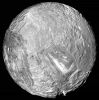
Miranda.jpgMiranda (full disk)135 visiteLe "Verona Rupes" sono in basso, leggermente alla Dx dell'Osservatore.MareKromium
(4 voti)
|
|

Oberon-PIA01352-PCF-LXTT-IPF.jpgIcy Oberon (Absolute Natural Colors; credits for the additional process. and color.: Dr Paolo C. Fienga - Lunar Explorer Italia/Italian Planetary Foundation)111 visiteUranus' outermost and largest moon, Oberon, can be very well seen in this NASA - Voyager 2 frame which was obtained January, 22, 1986, from a distance of approx. 2,77 Million KiloMeters (such as a little more than 1,72 Million Miles). The Clear-Filter Image, shuttered by the Voyager's Narrow-Angle Camera, shows us that Oberon displays several distinct Highly Reflective (---> High-Albedo) "Patches" of its Surface which also show - and this circumstance still sounds kind of strange/unusual - very Low-Albedo Centers. Some of the bright Patches are suggestive of Radial Patterns that could represent the visible consequence of powerful Impact Events which occurred on a basically Ice-rich Surface (in other words, we may be looking at Rayed Impact Craters that formed - were excavated - on an extremely hard and frozen Surface) .
On average, Oberon reflects (in all directions) only about 20% (twenty-percent) of the Incident Sunlight and that fact makes it Celestial Body with a (relatively) Low Albedo. The moon is about 1600 Km (such as approx. 993,6 miles) in diameter; the resolution of this image is roughly 51 Km (such as about 31,67 miles) per pixel. This frame was taken 2 (two) days before Voyager's 2 Closest Approach to Oberon (at which point the Spacecraft flew-by Oberon at a distance of approx. 471.000 Km - such as about 292.491 miles - from its frozen Surface).
This frame (which is an Original NASA - Voyager 2 Spacecraft Natural Color image published on the NASA - Planetary Photojournal with the ID n. PIA 01352) has been additionally processed, contrast enhanced, magnified to aid visibility of the Surface details and then re-colorized, according to an educated guess carried out by Dr Paolo C. Fienga/LXTT/IPF, in what they should be its Absolute Natural Colors (such as the colors that a human eye would actually perceive if someone were onboard the NASA - Voyager 2 Spacecraft and then looked outside, towards the Uranian moon Oberon), by using an original technique created - and, in time, dramatically improved - by the Lunar Explorer Italia Team. Different colors, as well as different shades of the same color, mean, among others, the existence of different Elements present on the Surface of Oberon, each having a different Albedo (---> Reflectivity) and Chemical Composition.
Note 1: it is possible (but we, as IPF, have no way to be one-hundred-percent sure of such a circumstance), that the actual luminosity of Oberon - as it is in this frame - would appear, to an average human eye, a little bit lower than it has been shown (or, better yet: interpreted) here.
Note 2: the "squared" feature visible at about 4 o'clock of Oberon's disk (almost on the Limb of the moon and right on the Terminator Line), is just an original image defect.MareKromium
(4 voti)
|
|

UMBRIEL-PIA00040-PCF-LXTT-IPF.jpgUmbriel (Absolute Natural Colors; credits for the additional process. and color.: Dr Paolo C. Fienga/Lunar Explorer Italia/Italian Planetary Foundation)100 visiteThe Southern Hemisphere of the Uranian moon Umbriel displays heavy Cratering in this NASA - Voyager 2 image, taken on January 24, 1986, at a distance of approx. 557.000 Km (such as a little less than 346.000 miles) from the Surface of the moon. This frame, taken through the Clear-Filter of Voyager's Narrow-Angle Camera, is the most detailed image of Umbriel that we have, with a resolution of about 10 Km (such as 6,21 miles) per picture element.
Umbriel is the darkest of Uranus' larger moons and the one that appears to have experienced the lowest level of Geological Activity. It has a diameter of about 1200 Km (a little more than 745 miles) and its Surface reflects only 16% of the light that receives; in the latter respect, Umbriel is similar to the Lunar Highland Areas of our own Moon. Umbriel, as we wrote herebefore, is heavily cratered, but it lacks the numerous Bright-Ray Craters that are commonly seen on the other large Uranian Natural Satellites; this fact, among other things, results in a relatively uniform Surface Albedo (---> Reflectivity).
The prominent Impact Crater visible on the Terminator (at about 11 o'clock of Umbriel's disk) is approx. 110 Km (such as 68,3 miles) across and it shows a really bright Central Peak. On the other hand, the strangest Surface Feature visible in this image (on the Limb of Umbriel, right at 12 o'clock of the disk) is a curious-looking Bright Ring which represents the most reflective area seen on Umbriel itself. The Bright Ring is about 140 Km (approx. 87 miles) in diameter and it lies near the moon's Equator. The nature of the Bright Ring is unknown, although it might be a very large Frost Deposit, perhaps associated with (located on top and near) the Rim of a huge Impact Cater. The few white spots that can be barely seen against the black background are not stars, but just just image artifacts, due to 'noise' in the data received on Earth.
This frame (which is the Original NASA - Voyager 2 b/w image published on the NASA - Planetary Photojournal with the ID n. PIA 00040) has been additionally processed and then colorized, according to an educated guess carried out by Dr Paolo C. Fienga (LXTT-IPF), in Absolute Natural Colors (such as the colors that a human eye would actually perceive if someone were onboard the NASA - Voyager 2 Spacecraft and then looked outside, towards the Neptunian moon Triton), by using an original technique created - and, in time, dramatically improved - by the Lunar Explorer Italia Team. Different colors, as well as different shades of the same color, mean, among others, the existence of different Elements present on the Surface of Triton, each having a different Albedo (---> Reflectivity) and Chemical Composition.MareKromium
(4 voti)
|
|
| 109 immagini su 10 pagina(e) |
|
|
|
|
6 | |
|
|
|
|
|





