| Piú votate - Uranus and His Moons |

VH-Juliet-V2.jpgJuliet - Voyager 292 visitenessun commento
(9 voti)
|
|

Uranus-Hurricane02.jpgUranian Hurricane (detail 2)88 visitenessun commento
(8 voti)
|
|

Miranda-vg2_2684626.jpgThe "limb" of Miranda79 visitenessun commento
(8 voti)
|
|
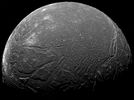
Ariel.jpgAriel (HR)88 visiteLa tormentata superficie di Ariel si rivela in tutto il suo (comunque grande) fascino.
Una serie di impressionanti fratture tettoniche (forse un raffreddamento troppo rapido?) caratterizza l'Est e l'Ovest di questo mondo lontano; svariati mega-canyons, lunghi e profondi, passano attraverso l'equatore di Ariel, frammentandosi e ramificandosi poi in centinaia di crepacci minori; distese simili ai "mari" della Luna contraddistinguono una buona parte della sua superficie la quale, inoltre, sembra avere delle aree (alla Vostra Sx - Eastern limb) la cui albedo (alta) appare molto diversa rispetto al resto del Pianeta.
Da notare che, a differenza di quanto accade per le altre lune di Urano (come per la maggior parte delle lune dei quattro Giganti Gassosi), non riusciamo a distinguere che un modesto numero di crateri da impatto e questa circostanza è sicuramente strana: che Ariel sia passata, magari, attraverso una parziale e "recente" (in senso geologico) ridefinizione della sua superficie?
(8 voti)
|
|

VO-Uranus-PIA00032.jpgUranus in natural and false colors79 visiteCaption NASA originale:"These two pictures of Uranus - one in true color (left) and the other in false color - were compiled from images returned Jan. 17, 1986, by the narrow-angle camera of Voyager 2. The spacecraft was 9,1 MKM (5,7 MMs) from the planet, several days from closest approach. The picture at left has been processed to show Uranus as human eyes would see it from the vantage point of the spacecraft. The picture is a composite of images taken through blue, green and orange filters. The darker shadings at the upper right of the disk correspond to the day-night boundary on the planet. Beyond this boundary lies the hidden northern hemisphere of Uranus, which currently remains in total darkness as the planet rotates.
The blue-green color results from the absorption of red light by methane gas in Uranus' deep, cold and remarkably clear atmosphere. The picture at right uses false color and extreme contrast enhancement to bring out subtle details in the polar region of Uranus. Images obtained through ultraviolet, violet and orange filters were respectively converted to the same blue, green and red colors used to produce the picture at left. The very slight contrasts visible in true color are greatly exaggerated here. In this false-color picture, Uranus reveals a dark polar hood surrounded by a series of progressively lighter concentric bands. One possible explanation is that a brownish haze or smog, concentrated over the pole, is arranged into bands by zonal motions of the upper atmosphere. The bright orange and yellow strip at the lower edge of the planet's limb is an artifact of the image enhancement. In fact, the limb is dark and uniform in color around the planet".
(8 voti)
|
|
VM-Sycorax.jpgSycorax79 visitenessun commento
(8 voti)
|
|

VL-Rosalind-V2.jpgRosalind - Voyager 290 visitenessun commento
(8 voti)
|
|

VD-Bianca-V2.jpgBianca - Voyager 288 visiteUn'immagine scarsamente significativa? Secondo noi no. Non è certamente un frame magnifico, ma non sempre per vedere (e per capire!) qualcosa di grande e di complesso dobbiamo fare affidamento sulla sola "bellezza". Urano, in questo frame, è vicino alla Sonda, è luminoso ed appare sovraesposto (sembra più il Sole che un pianeta...); gli Anelli di Urano si mostrano piuttosto bene ed evidenziano tanti dettagli. Bianca è solo un puntino, apparentemente insignificante, ma che, con la sua sola presenza, comunque contribuisce a mantenere in equilibrio una parte del Sistema degli Anelli di Urano (essa è, dunque, per Urano, una "Shepherd Moon", così come lo sono Mimas ed Hyperion - oltre ad altre Lune interne minori - per Saturno"). Interessante, vero?!?
(8 voti)
|
|

Uranus-2005.jpgGoing, Going, Gone: Hubble captures Uranus' Rings on Edge (2)91 visiteCaption NASA:"With further analysis of the Hubble data, Astronomer Mark Showalter of the SETI Institute in Mountain View, Calif., hopes to detect some of the small moons that may shepherd the debris into distinct rings.
Until Voyager 2 flew by Uranus in January 1986, the Rings were only known from the way they temporarily blocked the light of stars passing behind the Planet. Hubble provided some of the first images of the Ring System as viewed from Earth's distance of approx. 2 BMs.
The advent of adaptive optics gave ground-based observers using large telescopes comparatively sharp views.
The Rings were discovered in 1977, so this is the first time for a Uranus Ring crossing to be observed from Earth. Earth's orbit around the Sun permits 3 opportunities to view the Rings in an "edge-on" configuration: Uranus made its first ring crossing as seen from Earth on May 3; it made its second crossing on August 16 and will cross for the third time on February 20, 2008.
Though the last ring crossing relative to Earth will be hidden behind the Sun, most of Earth's premier telescopes, including Keck, Hubble, the European Southern Observatory's Very Large Telescope and the Hale Telescope on Mt. Palomar, plan to focus on the planet again in the days following December 7, 2007. On December 7 the rings will be perfectly edge-on to the Sun".MareKromium
(7 voti)
|
|

Uranus-Hurricane01.jpgUranian Hurricane (detail 1)91 visitenessun commento
(7 voti)
|
|

Miranda-vg2_p29524.jpgThe tormented surface of Miranda (false colors - elab. NASA)76 visitenessun commento
(7 voti)
|
|

AB-Ariel-vg2_p29523.jpgAriel (HR)90 visitenessun commento
(7 voti)
|
|
| 109 immagini su 10 pagina(e) |
 |
3 | |
|
|
|
|
|
|





