| |

| Piú votate - Jupiter: the "King" and His Moons |

Europa-Icy cliffs-PIA01182.jpgIcy cliffs on Europa (extreme detail mgnf)82 visiteThis image, taken by the camera onboard NASA's Galileo spacecraft, is a very HR view of the Conamara Chaos region on Jupiter's moon Europa. It shows an area where icy plates have been broken apart and moved around laterally. The top of this image is dominated by corrugated plateaux ending in icy cliffs over a hundred meters (a few hundred feet) high. Debris piled at the base of the cliffs can be resolved down to blocks the size of a house. A fracture that runs horizontally across and just below the center of the Europa image is about the width of a freeway.
North is to the top right of the image, and the sun illuminates the surface from the east. The image is centered at approx. 9° North Latitude and 274° West Longitude. The image covers an area approx. 1,7 by 4 Km (about 1 by 2,5 miles). The resolution is 9 mt (roughly 30 feet) per picture element. This image was taken on December 16, 1997 at a range of 900 Km (about 540 miles) by Galileo's Solid State Imaging System.
(7 voti)
|
|

IO 7.jpgIo & Jupiter (from Voyager 2)69 visiteUn'immagine da guardare in parallelo ad un altro "transito" di Io davanti a Giove: questo è un frame (eccezionale!) Voyager 2; il precedente, come ricorderete, era un frame Cassini. Tecnologicamente parlando, c'è un "abisso" tra la Sonda Voyager e la Sonda Cassini ma, alla prova delle immagini, i risultati "visivi" ottenuti sono sostanzialmente analoghi. E questa è un'altra ragione della nostra diffidenza nei confronti della NASA (e dell'ESA): se negli Anni '70 ed '80 eravamo già capaci di simili risultati, come mai oggi, AD 2005, non siamo neppure in grado di dire quali sìano i veri colori e le vere (da un punto di vista dell'occhio umano) "sfumature" di Marte, Giove e Saturno? Eravamo bravissimi 25 anni fa e "stupidi" adesso, oppure non avevamo capito niente 25 anni fa mentre ora tutto e chiaro (si fa per dire)? O forse NON c'è stata reale "evoluzione" da un punto di vista tecnologico? O magari la "Verità" è così incredibile che divulgarla è ritenuto periglioso?
Domande: sempre domande...
(7 voti)
|
|

JUPITER from 77,6 MKM.jpgJupiter from 77,6 MKM58 visiteDid you know that the "Planet With The Shortest Day" is Jupiter?
The planet Jupiter has the shortest day of all the nine major planets in the Solar System: it spins around on its axis once every 9 hrs 55 mins and 29,69 secs. Jupiter is about five times further from the Sun than the Earth and so it's years are much longer than Earth years: Jupiter completes one "year" in 4.332,6 Earth days. Jupiter is also one of the brightest objects in the night sky (jointly with the star Syrius and planet Venus in our Northern Hemisphere and with the Alpha and Beta Centauri star system in the Southern Hemisphere).
(7 voti)
|
|

Europa-2-PCF-LXTT.jpgRising Europa (Absolute Natural Colors; credits for the additional process. and color.: Dr Paolo C. Fienga - Lunexit Team)159 visitenessun commentoMareKromium
(6 voti)
|
|

Europa-Chaotic_Terrain-Conamara_Chaos-PIA01404-PCF-LXTT.jpgEuropa: Conamara Chaos Region (Absolute Natural Colors; credits for the additional process. and color.: Dr Paolo C. Fienga - Lunexit Team)254 visitenessun commentoMareKromium
(6 voti)
|
|

Orbital_Resonance.gifThe "Orbital Resonance" (GIF-Movie; credits: http://fisicaondemusica.unimore.it.)54 visitePremessa: il moto di un Corpo Celeste in orbita attorno ad un altro Corpo Celeste di massa molto maggiore (ex.: un pianeta attorno ad una stella, o un satellite attorno ad un pianeta) è un "Moto Periodico Semplice" ("Moto Circolare Uniforme").
Ora, può accadere che due (o più) pianeti si trovino ad orbitare attorno alla medesima stella (o che due - o più - satelliti si trovino ad orbitare attorno al medesimo "Parent Planet") con tempi di rivoluzione (---> i "Periodi del loro Moto") i quali stanno tra loro in rapporto di due piccoli interi (come 2:1, 2:3, ecc. - si legge "due a uno", "due a tre" etc.).
In questo caso, anche la loro reciproca attrazione gravitazionale verrà ad assumere un carattere di periodicità: essa cioè aumenterà quando i due pianeti si avvicinano, e diminuirà quando essi si allontanano.
Se queste variazioni della forza attrattiva gravitazionale sentita da ciascun pianeta saranno significative per la sua orbita, questa potrà modificarsi. Ed a tal punto sarà possibile identficare due scenari:
1) il moto dei pianeti diviene instabile: le orbite cambiano lentamente finché i due corpi non si influenzano più sensibilmente. (nota: nel caso di un Corpo Celeste Maggiore ed uno minore, questo effetto si risolverà nello "scacciare" il corpo minore da certe zone dello spazio, "liberando" la strada al Corpo Maggiore)
2) i due pianeti non si avvicinano mai abbastanza da influenzarsi violentemente, e quindi entrano in risonanza stabile.
(nota: le loro orbite, in questo caso, subiranno delle modificazioni le quali verranno poi compensate - rectius: annullate - dal verificarsi di modificazioni contrarie nell'arco di ogni rivoluzione)
per maggiori info: http://fisicaondemusica.unimore.it.MareKromium
(6 voti)
|
|

Io-PIA10249.jpgTvashtar Eruption from New Horizons109 visiteCaption NASA:"This New Horizons image of Jupiter's volcanic moon Io was taken at 13:05 Universal Time during the Spacecraft's Jupiter flyby on February 28, 2007. It shows the reddish color of the deposits from the giant volcanic eruption at the volcano Tvashtar, near the top of the sunlit crescent, as well as the bluish plume itself and the orange glow of the hot lava at its source. The relatively unprocessed image on the left provides the best view of the volcanic glow and the plume deposits, while the version on the right has been brightened to show the much fainter plume, and the Jupiter-lit night side of Io.
New Horizons' color imaging of Io's sunlit side was generally overexposed because the Spacecraft's color camera, the super-sensitive Multispectral Visible Imaging Camera (MVIC), was designed for the much dimmer illumination at Pluto. However, two of MVIC's four color filters, the blue and "Methane" filter (a special filter designed to map Methane frost on the Surface of Pluto at an infrared wavelength of 0.89 microns), are less sensitive than the others, and thus obtained some well-exposed views of the surface when illumination conditions were favorable. Because only two color filters are used, rather than the usual three, and because one filter uses infrared light, the color is only a rough approximation to what the human eye would see.
The red color of the Tvashtar plume fallout is typical of Io's largest volcanic plumes, including the previous eruption of Tvashtar seen by the Galileo and Cassini Spacecrafts in 2000, and the long-lived Pele plume on the opposite side of Io. The color likely results from the creation of reddish three-atom and four-atom Sulfur molecules (S3 and S4) from plume gases rich in two-atom Sulfur molecules (S2 After a few months or years, the S3 and S4 molecules recombine into the more stable and familiar yellowish form of Sulfur consisting of eight-atom molecules (S8), so these red deposits are only seen around recently-active Io volcanos.
Though the plume deposits are red, the plume itself is blue, because it is composed of very tiny particles that preferentially scatter blue light, like smoke. Also faintly visible in the left image is the pale-colored Prometheus plume, almost on the edge of the disk on the Equator at the 9 o'clock position.
Io was 2,4 MKM from the Spacecraft when the picture was taken, and the center of Io's disk is at 77° West Longitude, 5° South Latitude. The Solar Phase Angle (such as the angle formed by the Sun, Io and New Horizons) was 107°".MareKromium
(6 voti)
|
|

Io-PIA02520.jpgMountains on Io (MULTISPECTRUM; credits: Lunexit)54 visiteCaption NASA:"This image taken by NASA's Galileo Spacecraft during its close flyby of Jupiter's moon Io on November 25, 1999 shows some of the curious mountains found there. The Sun is illuminating the scene from the left, and because it is setting, the Sun exaggerates the shadows cast by the mountains. By measuring the lengths of these shadows, Galileo scientists can estimate the height of the mountains. The mountain just left of the middle of the picture is 4 Km (13.000 feet) high and the small peak to the lower left is 1,6 Km (5000 feet) high.
These mountains, like others imaged during a previous Galileo flyby of Io in October '99, seem to be in the process of collapsing. Huge landslides have left piles of debris at the bases of the mountains. The ridges that parallel their margins are also indicative of material moving down the mountainsides due to gravity.
North is to the upper left of the picture. The image, centered at 8,1° South Latitude and 78,7° East Longitude, covers an area approx. 210-by-110 Km (such as about 130-by-70 miles). The resolution is 267 meters (880 feet) per picture element.
The image was taken at a range of approx. 25.000 Km (about 16.000 miles) by Galileo's onboard camera".
MareKromium
(6 voti)
|
|

Io-PIA02540.jpgRifting at Hi'iaka Patera (MULTISPECTRUM-2; credits: Lunexit)71 visiteCaption NASA:"NASA's Galileo Spacecraft acquired the images in this mosaic of Hi-iaka Patera (the irregularly shaped, dark depression at the center of the image) and two nearby mountains on November 25, 1999 during its 25th orbit. The sharp peak at the top of the image is about 11 Km (about 36.300 feet) high, and the two elongated plateaus to the West and South of the caldera are both about 3,5 Km (11.500 feet) high.
The ridges on the North-Western mountain are often seen on Ionian mountains and are thought to be formed as surface material slides downslope due to gravity.
At low resolution, many of the dark features, called pateras, appear to be calderas -- depressions formed by collapse into an empty magma chamber. However, higher resolution images such as this one suggest a different origin. In the case of Hi-iaka, the Northern and Southern Margins of the pateras have very similar shapes which appear to fit together. This may indicate that the crust has been pulled apart here and the resulting depression has subsequently been covered by dark lava flows. Furthermore, the two mountains bordering Hi-iaka Patera also appear to fit together. However, the similar shapes and heights of the pateras margins and mountains could be coincidental. Galileo scientists are currently investigating whether mountains and pateras are related to each other and what could cause the surface of Io to rift apart in such a manner.
North is to the top of the mosaic and the sun is illuminating the surface from the left. The resolution is 260 meters (about 280 yards) per picture element. Galileo took the images at a distance of 26.000 Km (approx. 16.000 miles) from Io".MareKromium
(6 voti)
|
|

Io-100907_8.jpgIo: Global Map (false colors)55 visiteA: A global map of Jupiter’s moon Io derived from 8 images taken by the Long Range Reconnaissance Imager (LORRI) on the New Horizons Spacecraft, as it passed Jupiter on its way to Pluto in late February 2007. Details as small as 12 Km (7 miles) are visible. The map shows the comprehensive picture of Io’s volcanism obtained by New Horizons. Yellow ovals denote areas with new, faded or shifted plume deposits since the last images taken by the Galileo spacecraft in 2001. Green circles denote areas where probable new lava flows have occurred. Cyan diamonds indicate locations of active volcanic plumes, and orange hexagons are volcanic hot spots detected by the Linear Etalon Imaging Spectral Array (LEISA) instrument. For plumes and hot spots, symbol size indicates the approximate relative size and brightness of the features.
B-F: Comparison of New Horizons (NH) and earlier images of major surface changes discovered by New Horizons at Io’s volcanoes Masubi (45° South, 57° West) and North Lerna (55° South, 290° West). The scale bars are 200 Km long, and a is the solar phase angle. At Masubi, old lava flows seen by Voyager and Galileo (B) have been obscured at low phase angles (C) by deposits from two active plumes associated with a new 240-Km (150-mile) long dark lava flow, which is the longest lava flow known to have been erupted in the solar system since the discovery of Io volcanism in 1979. At North Lerna, a recent eruption has generated a 130-Km long lava flow (F), as well as an active plume that has produced a concentric pattern of deposits.
This image appears in the Oct. 12, 2007, issue of Science magazine, in a paper by John Spencer, et al.MareKromium
(6 voti)
|
|
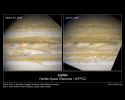
Jupiter-HST.jpgSomething's happening inside Jupiter...55 visiteMassive Jupiter is undergoing dramatic atmospheric changes that have never been seen before with the keen "eye" of NASA's Hubble Space Telescope.
Jupiter's turbulent clouds are always changing as they encounter atmospheric disturbances while sweeping around the planet at hundreds of miles per hour. But these Hubble images reveal a rapid transformation in the shape and color of Jupiter's clouds near the equator, marking an entire face of the globe.
The planet is wrapped in bands of yellows, browns, and whites. These bands are produced by the atmosphere flowing in different directions at various latitudes. Lighter-hued areas where the atmosphere rises are called zones. Darker regions where the atmosphere falls are called belts. When these opposing flows interact, storms and turbulence appear.
Between March 25 and June 5, Hubble's Wide Field and Planetary Camera 2 captured entire bands of clouds changing color. Zones have darkened into belts and belts have lightened and transformed into zones. Cloud features have rapidly altered in shape and size.
The image at left shows a thin band of white clouds above Jupiter's equator. The white color indicates clouds at higher altitudes in Jupiter's atmosphere. In the image at right, the band's white hue has turned brown, showing clouds deep within the planet's atmosphere. The whole band appears to have merged with the one below it.
In the same cloud band above the equator, the small swirls in the left-hand image have morphed into larger wave-like features in the right-hand photo. Dominating the band is a dark streak that resembles a snake. This serpent-shaped structure is actually a small tear in the cloud deck, which gives astronomers a view deep within the atmosphere.
Below the equatorial region, the brownish upside-down shark fin in the left-hand image disappears in the photo at right. Appearing instead are brownish tongue-shaped clouds with a stream of white swirls below them.
These global upheavals have been seen before, but not with Hubble's sharp resolution. Astronomers using ground-based telescopes first spied drastic atmospheric transformation in the 1980s. Another major disturbance was seen in the early 1990s, after Hubble was launched into space. The telescope, however, did not have the resolution to view the upheaval in fine detail. These higher-quality Hubble images may help astronomers understand how such global upheavals develop on Jupiter.
MareKromium
(6 voti)
|
|

Ganymede-lor_0035286134_0x630_sci_1.jpgThe "obscure outline" of Ganymede (2)54 visiteDescription: Ganymede crossing crescent Jupiter
Time: 2007-03-04 03:50:16 UTC
Exposure: 80 msec
Target: GANYMEDE
Range: 5,9 MKM MareKromium
(6 voti)
|
|
| 324 immagini su 27 pagina(e) |
|
|
|
|
|
9 | |
|
|
|
|
|
|





