| Piú votate - Jupiter: the "King" and His Moons |

Jupiter-00.jpgJupiter (natural colors)57 visitenessun commento
(8 voti)
|
|

Europa-PIA02500.jpgFrozen H2SO4 (Sulphuric Acid) on Europa?54 visiteFrozen Sulfuric Acid on Jupiter's moon Europa is depicted in this image produced from data gathered by NASA's Galileo spacecraft. The brightest areas, where the yellow is most intense, represent Regions of high frozen Sulfuric Acid concentration. Sulfuric Acid is found in "exhaust battery acid" and in Earth's acid rain.
This image is based on data gathered by Galileo's NIMS (Near Infrared Mapping Spectrometer).
Europa's Leading Hemisphere is toward the bottom right and there are enhanced concentrations of Sulfuric Acid in the Trailing Side of Europa (the upper left side of the image). This is the face of Europa that is struck by sulfur ions coming from Jupiter's innermost moon, Io. The long, narrow features that criss-cross Europa also show Sulfuric Acid that may be from sulfurous material extruded in cracks.
Galileo, launched in 1989, has been orbiting Jupiter and its moons since December 1995.
(8 voti)
|
|

Io-PIA00491.jpgIo: five views of the one and the same54 visiteFive color views of Jupiter's moon Io, as seen by NASA's Galileo spacecraft camera, were taken between the 25th and the 29th of June, 1996 Universal Time. The color is a composite of the red, green, and violet filters of the on board imaging system with the brightness of the violet bandpass increased to provide better color discrimination. The full disk images were intended for color mapping of Io's surface and for comparison to Voyager images. Where images overlap several features can be seen to change in relative brightness, perhaps due to unusual light scattering behavior or active phenomena. The crescent images were intended primarily for color imaging of active volcanic plumes on the bright limb and these images showed that the Voyager-era Loki plumes were no longer active and revealed a new plume at Ra Patera. The smallest features which can be discerned in the 5 views range from 9 to 23 kilometers and provide our best look at Io since the 1979 Voyager flybys. Sub-spacecraft longitudes on Io (from upper left to lower right) are 69, 338, 264, 211, and 221 W. North is to the top.
Launched in October 1989, Galileo entered orbit around Jupiter on December 7, 1995. The spacecraft's mission is to conduct detailed studies of the giant planet, its largest moons and the Jovian magnetic environment.
(8 voti)
|
|

Jupiter_s Rings-PIA01627.jpgThe Rings of Jupiter (1)57 visiteOriginal caption:"This schematic cut-away view of the components of Jupiter's Ring System shows the geometry of the Rings in relation to Jupiter and to the small inner moons, which are the source of the dust forming the Rings themselves. The innermost and thickest Ring, shown in gray shading, is the halo that ends at the Main Ring. The thin, narrow Main Ring, shown with red shading, is bounded by the 16- Km-wide (10-miles) satellite Adrastea and shows a marked decrease in brightness near the orbit of Jupiter's innermost moon, Metis. It is composed of fine particles knocked off Adrastea and Metis. Although the orbits of Adrastea and Metis are about 1000 Km (about 600 miles) apart, that separation is not depicted in this drawing. Impacts by small meteoroids (fragments of asteroids and comets) into these small, low-gravity satellites feed material into the Rings. Thebe and Amalthea, the next 2 moons in increasing distance from Jupiter, supply dust which forms the thicker, disk-like 'Gossamer' Rings".
(8 voti)
|
|

Io-Culann Tohill Patera-PIA03885_modest.jpgCulann-Tohill Patera55 visiteRepeated flybys of Io by NASA's Galileo spacecraft have allowed scientists to develop an understanding of Io's Tohil-Culann region of interconnected volcanoes and mountains.
An active volcano named Culann Patera (top center) is one of the most colorful volcanoes on Jupiter's innermost large moon (see PIA02535). It lies just north of an enigmatic mountain called Tohil Mons (see PIA03600). This mosaic image uses high-resolution Galileo images of Culann (200 meters or 660 feet per picture element) from the November 1999 flyby and high-resolution images of Tohil (165 meters or 540 feet per picture element) from the February 2000 flyby, and combines them with lower-resolution color images (1.4 kilometers or 0.9 mile per picture element) taken during the July 1999 flyby. Using the combined information, Galileo scientists have identified relationships among many colorful features in this complex.
The volcano Culann has produced both dark black and dark red lava flows, as well as diffuse, inner and outer rings of red and yellowish sulfur particles from explosive plumes (for example, PIA02502). Molten silicate rock inside Culann must occasionally mix with subsurface reservoirs of sulfur and sulfur dioxide to produce the plume deposits. The green color at the center of Culann and inside the older volcano Tohil Patera (center right) forms when red sulfur plume deposits land on dark black silicate lava flows and form a green veneer. The large white patch in southwestern Tohil Patera is rich in sulfur dioxide, and comparison with higher-resolution views (for example, PIA03527) suggests that this might be a region of cold sulfur dioxide flows. The small white patches on the mountain Tohil Mons might be deposits of sulfur dioxide snow that accumulate in grooves and at the bases of steep slopes in colder areas on the mountain. At upper right is a global view of Io showing the location of the mosaic.
Although Tohil Mons rises up to 6 kilometers (19,700 feet) above Io's plains, it is difficult to see in this image because the Sun was behind Galileo at the time it was taken. The topography of the mountainous region is clearer in a mosaic of images taken when the Sun was low in the sky, with illumination from the right (see figure below) The side-lit mosaic combines a high-resolution (330 meters or 1,100 feet per picture element) image from October 2001 with lower-resolution color images (1.4 kilometers or 0.9 mile per picture element) from July 1999.
(8 voti)
|
|

Jupiter_s limb-Gal-PIA00858_modest.jpgJupiter's limb and White Ovals, from Galileo54 visiteCaption NASA originale:"The oval shaped vortices in the upper half of the mosaic are two of the three long-lived White Ovals that formed to the south of the Red Spot in the 1930's and, like the Red Spot, rotate in a counterclockwise sense. The east to west dimension of the leftmost White Oval is 9000 Km. The White Ovals drift in longitude relative to one another, and are presently restricting the cyclonic structure. To the south, the smaller oval and its accompanying cyclonic system are moving eastward at about 0.4 degrees per day relative to the larger ovals. The interaction between these two cyclonic storm systems is producing high, thick cumulus-like clouds in the southern part of the more northerly trapped system".
(8 voti)
|
|
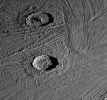
Ganymede-PIA01609.jpgRecent impact craters on Ganymede55 visiteOblique view of two fresh impact craters in bright grooved terrain near the north pole of Jupiter's moon, Ganymede. The craters postdate the grooved terrain since each is surrounded by swarms of smaller craters formed by material which was ejected out of the crater as it formed, and which subsequently reimpacted onto the surrounding surface. The crater to the north, Gula, which is 38 kilometers (km) in diameter, has a distinctive central peak, while the crater to the south, Achelous, (32 km in diameter) has an outer lobate ejecta deposit extending about a crater radius from the rim. Such images show the range of structural details of impact craters, and help in understanding the processes that form them.
North is to the top of the picture and the sun illuminates the surface from the right. The image, centered at 62 degrees latitude and 12 degrees longitude, covers an area approximately 142 by 132 kilometers. The resolution is 175 meters per picture element. The images were taken on April 5, 1997 at 6 hours, 33 minutes, 37 seconds Universal Time at a range of 17,531 kilometers by the Solid State Imaging (SSI) system on NASA's Galileo spacecraft.
(8 voti)
|
|
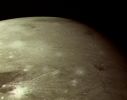
Ganymede-PIA01515.jpgThe North Pole of Ganymede (in real colors)54 visiteThis color picture as acquired by Voyager 1 during its approach to Ganymede on Monday afternoon (the 5th of March). At ranges between about 230 to 250 thousand km. The images show detail on the surface with a resolution of four and a half km. This picture is of a region in the northern hemisphere near the terminator. It shows a variety of impact structures, including both razed and unrazed craters, and the odd, groove-like structures discovered by Voyager in the lighter regions. The most striking features are the bright ray craters which have a distinctly 'bluer' color appearing white against the redder background. Ganymede's surface is known to contain large amounts of surface ice and it appears that these relatively young craters have spread bright fresh ice materials over the surface. Likewise, the lighter color and reflectivity of the grooved areas suggests that here, too, there is cleaner ice. We see ray craters with all sizes of ray patterns, ranging from extensive systems of the crater in the southern part of this picture, which has rays at least 300-500 kilometers long, down to craters which have only faint remnants of bright ejects patterns (such as several of the craters in the southern half of PIA01516; P21262). This variation suggests that, as on the Moon, there are processes which act to darken ray material, probably 'gardening' by micrometeoroid impact.
(8 voti)
|
|
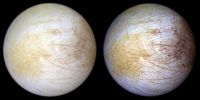
Europa-PIA01295.jpgEuropa in natural colors (Sn) and enhanced colors (Dx)62 visiteThis color composite view combines violet, green, and infrared images of Jupiter's intriguing moon, Europa, for a view of the moon in natural color (left) and in enhanced color designed to bring out subtle color differences in the surface (right). The bright white and bluish part of Europa's surface is composed mostly of water ice, with very few non-ice materials. In contrast, the brownish mottled regions on the right side of the image may be covered by hydrated salts and an unknown red component. The yellowish mottled terrain on the left side of the image is caused by some other unknown component. Long, dark lines are fractures in the crust, some of which are more than 3,000 kilometers (1,850 miles) long.
North is to the top of the picture and the sun fully illuminates the surface. Europa is about 3,160 kilometers (1,950 miles) in diameter, or about the size of Earth's moon. The finest details that can be discerned are 25 kilometers across. The images in this global view were taken in June 1997 at a range of 1.25 million kilometers by the Solid State Imaging (SSI) system on NASA's Galileo spacecraft, during its ninth orbit of Jupiter.
(8 voti)
|
|

Io-Volcanic Plumes and Flares-PIA00703.jpgVolcanic activity on Io ("Plumes" and "Flares")54 visitenessun commento
(8 voti)
|
|

Amalthea-PIA02532.jpgA white streak on Amalthea67 visite...spazio interstellare, nè per essere attratti ed ingurgitati definitivamente da Giove, come è invece accaduto alla Cometa Shoemaker-Levy. Molti Scienziati non escludono neppure l'ipotesi che possa trattarsi di frammenti di una Luna Gioviana disintegratasi (magari a seguito di una collisione) qualche milione di anni fa. La verità, come sempre, non sarà facile da trovarsi...
(8 voti)
|
|

Thebe-Amalthea-Metis-PIA02531.jpgThebe, Amalthea and Metis54 visiteUna curiosità: è difficile non notare la notevole somiglianza fra Thebe (il primo "macigno" da Sx) e la Luna Marziana Phobos.
E qual'è il "punto di contatto" fra questi due corpi celesti?
Ma si tratta, naturalmente, del grande cratere che, nel caso di Thebe, notiamo sulla Sx del piccolo Satellite. Un grande cratere che ci ricorda molto da vicino lo "Stickney Crater" di Phobos.
(8 voti)
|
|
| 324 immagini su 27 pagina(e) |
 |
|
|
|
6 | |
|
|
|
|
|





