| Piú votate - Jupiter: the "King" and His Moons |

Jupiter-V1-PIA01518_modest.jpgThe "Plume"55 visiteCaption NASA originale:"Reconstruction of a plume on Jupiter, photographed on March 1st, 1979".
Nota: in questo frangente per "plume" si intende uno 'sbuffo' di nuvole bianche e vaporose le quali si distinguono nettamente dal resto del paesaggio circostante.
L'espressione "plume", di regola, viene invece impiegata per indicare il 'pennacchio' di fumo che caratterizza i vulcani in fase eruttiva (innumerevoli sono, infatti, le "plumes" che vediamo sul piccolo - ma attivissimo! - Io).
(9 voti)
|
|

Jupiter-V2-PIA01527_modest.jpgThe "Red Spot" of Jupiter53 visiteCaption NASA originale:"The region of white clouds now extends from east of the Red Spot and around its northern boundary, preventing small cloud vortices from circling the feature. The disturbed region west of the Red Spot has also changed since the equivalent Voyager 1 image. It shows more small scale structure and cloud vortices being formed out of the wave structures. The picture was taken on July 3, 1979, from about 6 MKM".
(9 voti)
|
|

Ganymede-PIA00353~0.jpgGanymede from 2,6 MKM56 visiteThis picture was taken on March 4, 1979 at 2:30 A.M. PST by Voyager 1 from a distance of about 2,6 MKM (such as about 1,6 MMs). Ganymede is Jupiter's largest satellite with a radius of about 2600 Km which means about 1,5 times that of our Moon. Ganymede has a bulk density of only approximately 2,0 g/cc (almost half that of the Moon).
In the light of the above, Ganymede is probably composed of a mixture of rock and ice. The features here, the large dark regions, in the northeast quadrant, and the white spots, resemble features found on the Moon, mare and impact craters respectively. The long white filaments resemble rays associated with impacts on the lunar surface. The various colors of different regions probably represent differing surface materials. There are several dots on the picture of single color (blue, green, and orange) which are the result of markings on the camera used for pointing determinations and are not physical markings.
(9 voti)
|
|

Europa-Lineae-Minos_Linea-PIA00275.jpgEuropa: Minos Linea (detail mgnf) - false colors86 visiteFalse color has been used here to enhance the visibility of certain features in this composite of 3 images of the Minos Linea region on Jupiter's moon Europa taken on 28 June 1996 Universal Time by the Solid State Imaging Camera on NASA's Galileo spacecraft. Triple bands, lineae and mottled terrains appear in brown and reddish hues, indicating the presence of contaminants in the ice. The icy plains, shown here in bluish hues, subdivide into units with different albedos at infrared wavelengths probably because of differences in the grain size of the ice.
The composite was produced using images with effective wavelengths at 989, 757 and 559 nnmts. The spatial resolution in the individual images ranges from 1,6 to 3,3 Km (about 1 to 2 miles) per pixel.
The area covered, centered at 45° North and 221° West, is about 1.260 Km (approx. 780 miles) across.
(9 voti)
|
|

Io-Plumes-PIA01081.jpgMore "Plumes" on Io54 visitenessun commento
(9 voti)
|
|

Io-PIA00740.jpgThe "face" of Io53 visitenessun commento
(9 voti)
|
|
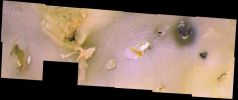
Io-Chain of Craters-PIA02566.jpgA chain of craters and "paterae" on Io54 visiteThis mosaic illustrates the range of "patera" morphology on Io.
But what is a "patera"? It is an irregular depression, or a complex one with scalloped edges, but which does not have the characteristics of an impact crater. The "paterae" on Io often correspond to active volcanic centers and are in some ways similar to calderas. What's a "caldera"? "Calderas" are large, usually roughly circular depressions that form by collapse over shallow magma chambers that have been partially emptied by volcanic eruptions. However, the "paterae" on Io are different from "calderas" seen elsewhere in the Solar System. They have many straight edges and sharp angles, suggesting that they are related to fractures in Io's crust. In many cases the lava can be seen to erupt from these straight edges. Planetary geologists aren't sure whether the paterae form over magma chambers or if they result from fractures and movements in the crust, and the lava subsequently follows the fractures.
(9 voti)
|
|

ZC-Jupiter from Mars-PIA04532_modest.jpgJupiter and 3 Galilean Moons from Mars82 visiteCi siamo chiesti tante volte, guardando Giove dalla Terra, come lo si vedrebbe da Marte. Ebbene, abbiamo trovato la risposta (grazie all'aiuto del Mars Global Surveyor Orbiter): in questo frame davvero eccezionale, Giove e 3 dei suoi 4 Satelliti Galileiani, così come li vedremmo da Marte! Un'immagine bellissima da guardare e su cui occorre riflettere molto. Perchè? Perchè conquistare lo Spazio, alle volte, vuol dire anche ampliare i confini dell'Immaginazione...
(9 voti)
|
|

Io-050107_08.jpgVolcanic Lights In the Night of Io54 visiteThis unusual image shows Io glowing in the darkness of Jupiter's shadow. It is a combination of eight images taken by the New Horizons Long Range Reconnaissance Imager (LORRI) between 14:25 and 14:55 Universal Time on February 27, 2007, about 15 hours before the spacecraft's closest approach to Jupiter. North is at the top of the image.
Io's surface is invisible in the darkness, but the image reveals glowing hot lava, auroral displays in Io's tenuous atmosphere and volcanic plumes across the moon. The three bright points of light on the right side of Io are incandescent lava at active volcanoes - Pele and Reiden (south of the equator), and a previously unknown volcano near 22 degrees north, 233 degrees west near the edge of the disk at the 2 o'clock position.
An auroral glow, produced as intense radiation from Jupiter's magnetosphere bombards Io’s atmosphere, outlines the edge of the moon’s disk. The glow is patchy because the atmosphere itself is patchy, being denser over active volcanoes. In addition to the near-surface glow, there is a remarkable auroral glow suspended 330 kilometers (200 miles) above the edge of the disk at the 2 o'clock position; perhaps this glowing gas was ejected from the new volcano below it. Another glowing gas plume, above a fainter point of light, is visible just inside Io's disk near the 6 o'clock position; this plume is above another new volcanic eruption discovered by New Horizons.
On the left side of the disk, near Io's equator, a cluster of faint dots of light is centered near the point on Io that always faces Jupiter. This is the region where electrical currents connect Io to Jupiter's magnetosphere. It is likely that electrical connections to individual volcanoes are causing the glows seen here, though the details are mysterious.
Total exposure time for this image was 16 seconds. The range to Io was 2.8 million kilometers (1.7 million miles), and the image is centered at Io coordinates 7 degrees south, 306 degrees west. The image has been heavily processed to remove scattered light from Jupiter, but some artifacts remain, such as dark patches in the background.
MareKromium
(8 voti)
|
|

Io-New_Horizons.jpgIo (HR)54 visiteCaption NASA:"Spewed from a volcano, a complex plume rises over 300 Km above the horizon of Jupiter's moon Io in this image from cameras onboard the New Horizons spacecraft. The volcano, Tvashtar, is marked by the bright glow (about 1 o'clock) at the moon's edge, beyond the terminator or night/day shadow line. The shadow of Io cuts across the plume itself. Also capturing stunning details on the dayside surface, the high resolution image was recorded when the spacecraft was 2,3 MKM from Io. Later it was combined with lower resolution color data by astro-imager Sean Walker to produce this sharp portrait of the solar system's most active moon. Outward bound at almost 23 Km-per-second, the New Horizons spacecraft should cross the orbit of Saturn in June next year, and is ultimately destined to encounter Pluto in 2015".
(8 voti)
|
|

Io-SouthernLimbandlight-PIA02250.jpgThe Southern limb of Io58 visitenessun commentoMareKromium
(8 voti)
|
|

Io-Tohill-Scarp-01.jpgThe mysterious Tohill Mons and Patera (2) - natural colors54 visitenessun commento
(8 voti)
|
|
| 324 immagini su 27 pagina(e) |
 |
|
|
5 | |
|
|
|
|
|
|





