| Piú votate - Jupiter: the "King" and His Moons |

Jupiter_s Rings-PIA01628.jpgThe Rings of Jupiter (2)56 visiteScientists studying data from Galileo spacecraft have found that the Ring System is made up of impact debris created when meteoroids, which are fragments of comets and asteroids, slam into Jupiter`s four smallest satellites. The top panel shows that the Main Ring (red) is formed mostly from meteoroid impact debris kicked up from the innermost moons, Metis (m) and Adrastea (a). Since both satellites orbit in paths not inclined to Jupiter's equator, the Main Ring appears as a narrow line. The middle panel shows the additional effect of dust ejected from the satellite Amalthea (A), responsible for producing 1 of the 2 moon components of the Gossamer Ring. Amalthea's orbit is inclined to Jupiter's equatorial plane and at different times the satellite's vertical position can range anywhere between the 2 extreme limits shown. Dust ejected from Amalthea (orange) produces a ring whose thickness equals Amalthea's vertical projections beyond Jupiter's equatorial plane. The lower panel shows the additional effect of dust ejected from Thebe (T), which makes up the second component (shown in green) of the gossamer ring. Again, the two positions shown represent the maximum projections of Thebe from Jupiter's equatorial plane. This component of the gossamer ring is thicker than the component due to Amaltheas dust because Thebe's orbit is more inclined than that of Amalthea.

(10 voti)
|
|

Ganymede-PIA00706.jpgCrescent Ganymede from Galileo54 visiteView of Ganymede from the Galileo spacecraft during its first encounter with the Jovian Satellite. North is to the top of the picture and the Sun illuminates the surface from the right. The finest details that can be discerned in this picture are about 6,7 Km across. It is 8:45:09 UT on June 26, 1996.
(10 voti)
|
|

Ganymede-V1-PIA02233_modest.jpgGanymede in HR (Voyager 1)55 visiteThis picture of Ganymede was taken on the afternoon of March 5, from a range of about 272.000 Km. The center of the picture lies at 13° Lat. and 359° Long. Many bright impact craters are shown that have radial ejecta patterns. These rays lie across and therefore are younger than the bright and dark background material. Many older impact craters are shown that have lost their rays probably by impact erosion. The bright background areas contain grooves and ridges that may be caused by faulting of the surface materials.
(10 voti)
|
|
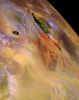
Io-Zal Patera-PIA02527.jpgZal Patera (False Colors; credits: NASA/JPL)55 visitenessun commento
(10 voti)
|
|

Io-Zal Region-PIA02554.jpgZal Region on Io54 visiteThis image shows one of many intriguing mountains on Jupiter's moon Io. The image was made by combining a recent high-resolution, black and white image with earlier low-resolution color data to provide a high-resolution, color view. NASA's Galileo spacecraft took both images.
The 240-kilometer (150-mile) long mountain in the image is south of the volcanic hot spot named Zal. The black and white version of this image was useful for showing the shape of the mountain and the small fans of debris piled against the base of its tall, steep cliffs. However, when colorized the relationship between different types of materials becomes apparent. For example, the bright, red material is believed to contain a compound of sulfur that forms when sulfur is boiled at a high temperature. Active eruptions of molten rock (lava) are the most likely source for the heat. Thus we see red sulfur where lava reaches the surface. Other sulfur compounds cover the yellow areas, and the black areas are fresh silicate lava that has not yet been coated by the yellow sulfurous materials. The green patches are still somewhat mysterious; they appear to form when red sulfur lands on warm lava and the two react in a manner that is still unknown.
In this image, it is clear that the red material has blown out of a long crack along the western side of the mountain. Lava has flowed from this crack and filled a depression (caldera). Some of the red sulfur close to the dark caldera appears to have been converted into green material. The fact that lava comes up along the faults that define the sides of the mountains provides important clues to how the mountains form and the state of the interior of Io. Scientists at the University of Arizona speculate that the formation of the mountains on Io may be related to plumes of hot material rising inside the fiery body of Io.
North is to the top and the setting sun is shining from the west. The image is centered at about 33 degrees north, 72 degrees west. The high-resolution image was taken on February 22, 2000 by NASA's Galileo spacecraft. The image was taken by the Galileo's onboard camera from a range of 33,500 kilometers (20,800 miles) and has a resolution of 335 meters (1,100 feet) per picture element. The color images were taken on July 3, 1999. They have resolutions of 1.3 kilometers (0.81 miles) per picture element and are illuminated from almost directly behind the spacecraft. They were taken at a distance of about 130,000 kilometers(81,000 miles) from Io.
(10 voti)
|
|

Jupiter-2006-19-d-xlarge_web.jpgFather and Son: Jupiter's Red Spots60 visitenessun commento
(9 voti)
|
|

Jupiter_s SouthPole-PIA07784.jpgThe South Pole of Jupiter54 visiteThe South Polar Regions shown here are less clearly visible because Cassini viewed them at an angle and through thicker atmospheric haze.
The round maps are polar stereographic projections that show the North or South Pole in the center of the map and the Equator at the edge.
(9 voti)
|
|

Jupiter-PIA01384.jpgThe Great Red Spot, from Voyager 157 visiteOriginal caption:"This view of Jupiter was taken by Voyager 1. This image was taken through color filters and recombined to produce the color image.
This photo was assembled from three black and white negatives by the Image Processing Lab at Jet Propulsion Laboratory".
(9 voti)
|
|

Ganymede-PIA00707.jpgFine details of Ganymede icy-surface55 visiteDramatic view of fine details in ice hills and valleys in an unnamed region on Jupiter's moon Ganymede. North is to the top of the picture and the sun illuminates the surface from the left. The finest details that can be discerned in this picture are only 11 mt across (similar to the size of an average house) some 2000 times better than previous images of this region. The bright areas in the left hand version are the sides of hills facing the sun; the dark areas are shadows. In the right hand version the processing has been changed to bring out details in the shadowed regions that are illuminated by the bright hillsides. The brightness of some of the hillsides is so high that the picture elements "spill over" down the columns of the picture. The image was taken on June 28, 1996 from a distance of about 1000 Km.
(9 voti)
|
|

Io-PIA00715.jpgIo: three views of the one and the same54 visiteThree views of the full disk of Jupiter's volcanic moon, Io, each shown in natural and enhanced color. These three views, taken by Galileo in late June 1996, show about 75 percent of Io's surface. North is up. The top disks are intended to show the satellite in natural color (but colors will vary with display devices) while the bottom disks show enhanced color (near-infrared-, green-, and violet-filtered images) to highlight details of the surface. These images reveal that some areas on Io are truly red, whereas much of the surface is yellow or light greenish. (Accurate natural color renditions were not possible from the Voyager images taken during the 1979 flybys because there was no coverage in the red.) The reddish materials may be associated with very recent fragmental volcanic deposits (pyroclastics) erupted in the form of volcanic plumes. Dark materials appear in flows and on caldera floors. Bright white materials correspond to sulfur dioxide frost, and bright yellow materials appear to be in new flows such as those surrounding Ra Patera. The red material may be unstable since the color appears to fade over time. This fading appears to occur most rapidly in the equatorial region and more slowly over the polar regions; surface temperature may control the rate of transformation. Comparisons of these images to those taken by the Voyager spacecraft 17 years ago have revealed that many changes have occurred on Io. Since that time, about a dozen areas at least as large as the state of Connecticut have been resurfaced. Io's diameter is 3632 km.
(9 voti)
|
|

Jupiter&Comet Shoemaker.jpgComet Shoemaker impacting Jupiter57 visiteQuesta spettacolare ripresa - ottenuta dall'HST - ci mostra alcuni dettagli relativi ai momenti successivi alla sequenza di impatti che, nel Luglio 1994, interessarono gli strati superiori dell'atmosfera di Giove.
Per quelli che non ricordano tutta la storia diciamo che queste immagini ci raccontano della fine (spettacolare, comunque) incontrata dai residui della cometa Shoemaker-Levy la quale, durante la sua corsa verso l'interno del Sistema Solare - ivi, lo Spazio di Giove -, venne "fatta a pezzi" (letteralmente) dalle onde gravitazionali provenienti dal Re dei Giganti Gassosi.
(9 voti)
|
|

Amalthea-PIA07248_modest.jpgAmalthea: just an "Ice Cube"!60 visiteThese images of Jupiter's moon Amalthea were taken with NASA's Galileo and Voyager spacecraft. Recent findings show that Amalthea is almost pure water ice, hinting that it may not have formed where it now orbits! This information challenges long-held theories about how moons form around giant planets. The image on the left shows the Escape Velocities (EV) color-coded on a shape model of Amalthea with the same viewpoint as the Voyager spacecraft image in the middle panel. Blue represents the lowest EV, barely 1 mt/second (about 3 feet) near the anti-Jupiter end, while red (barely visible) shows the region of much higher EV, nearly 90 mt/second (295 feet). The low EV result from the low density of Amalthea and from its rapid rotation as it orbits Jupiter.
The middle image is a composite from both Galileo and NASA's Voyager spacecraft and shows Amalthea from the anti-Jupiter side. The visible area is about 150 Km (about 93 miles) across.
The Sun is behind the spacecraft, resulting in loss of visible shadows. The brighter markings on the ends of a ridge are prominent in this view.
On the right is a Galileo image of Amalthea, (see PIA02532), with the bright spots on the end of Amalthea seen from the leading side of the satellite. Here the Sun is to the left and topography, such as the impact crater at the right, is visible.
Amalthea is Jupiter's fifth largest moon. It orbits about 181,000 kilometers (112,468 miles) from Jupiter, considerably closer than the Moon orbits Earth. It measures about 168 miles in length and half that in width. Galileo passed within about 99 miles of the moon on Nov. 5, 2002. After more than 30 close encounters with Jupiter's four largest moons, the Amalthea flyby was the last moon flyby for Galileo. The mission began orbiting the planet in 1995.
(9 voti)
|
|
| 324 immagini su 27 pagina(e) |
 |
|
4 | |
|
|
|
|
|
|
|





