| Piú votate - Jupiter: the "King" and His Moons |
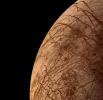
Europa-V2-PIA00459.jpgEuropa from Voyager 2 - the closest approach59 visiteCaption NASA originale:"This color image of the Jovian moon Europa was acquired by Voyager 2 during its close encounter on Monday morning, July 9, 1979. Europa, the size of our Moon, is thought to have a crust of ice perhaps 100 kilometers thick which overlies the silicate crust. The complex array of streaks indicate that the crust has been fractured and filled by materials from the interior. The lack of relief, any visible mountains or craters, on its bright limb is consistent with a thick ice crust hypothesis".
(11 voti)
|
|
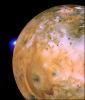
Io-Plumes from Loki-V1-PIA00010_modest.jpgLoki's eruption on Io (the "Plume")64 visiteUn'informazione importante per chi volesse provare a calcolare le dimensioni effettive della "piuma vulcanica" (conoscendo, ovviamente, le dimensioni di Io): l'immagine è stata scattata da (circa) 490.000 Km.
Original caption:"Voyager 1 image of Io showing active plume of Loki on limb. Heart-shaped feature southeast of Loki consists of fallout deposits from active plume Pele. The images that make up this mosaic were taken from an average distance of approximately 490.000 Km (about 340.000 miles)".
(11 voti)
|
|

Io-Eruptions-PIA00293.jpgContinuous eruptions on Io61 visiteThis image, taken by NASA's Galileo spacecraft, shows a new blue-colored volcanic plume extending about 100 kilometers (about 60 miles) into space from Jupiter's moon Io (see inset at lower left). The blue color of the plume is consistent with the presence of sulfur dioxide gas and 'snow' condensing from the gas as the plume expands and cools. Galileo images have also shown that the Ra Patera plume glows in the dark, perhaps due to the fluorescence of sulfur and oxygen ions created by the breaking apart of sulfur dioxide molecules by energetic particles in the Jovian magnetosphere. The images at right show a comparison of changes seen near the volcano Ra Patera since the Voyager spacecraft flybys of 1979 (windows at right show Voyager image at top and Galileo image at bottom). This eruptive plume is an example of a new type of volcanic activity discovered during Voyager's flyby in 1979, believed to be geyser-like eruptions driven by sulfur dioxide or sulfur gas erupting and freezing in Io's extremely tenuous atmosphere. Volcanic eruptions on Earth cannot throw materials to such high altitudes. Ra Patera is the site of dramatic surface changes. An area around the volcano of about 40,000 square kilometers, area about the size of New Jersey, has been covered by new volcanic deposits. The image was taken in late June 28, 1996 from a distance of 972,000 kilometers (604,000 miles).
(11 voti)
|
|

Io-Sodium cloud-2-PIA01109.jpgA sodium cloud from Io (1)80 visiteUna "Nube di Sodio da Io", intitola questa serie di 4 immagini. Ma di che cosa si tratta realmente?
Ebbene, in questo specifico frangente si tratta della ripresa di una "ondata" (letteralmente) di vapori di sodio provenienti da Io a seguito di una delle (tante) eruzioni che lo caratterizzano. Nulla di speciale, insomma.
Ma c'è una curiosità, a proposito dei "vapori di Sodio", che ci farebbe piacere raccontare: solo pochi Appassionati e Cultori della Materia, infatti, conoscono e sanno che cosa significa, in termini di navigazione interplanetaria, "rilasciare una nube di Sodio". Ebbene si tratta di un esperimento relativo alla verifica empirica circa la correttezza della traiettoria assunta da una qualsiasi Sonda interplanetaria durante il suo percorso (un check, insomma, che i campi gravitazionali degli astri accanto ai quali essa deve passare, passa o è passata, non abbiano, in qualche modo, determinato delle "deviazioni" impreviste).
(11 voti)
|
|

IO - TRUE COLOR FROM GALILEO.jpgIo in true colors88 visiteNASA's Galileo spacecraft acquired its highest resolution images of Jupiter's moon Io on 3 July 1999 during its closest pass to Io since orbit insertion in late 1995. This color mosaic uses the near-infrared, green and violet filters (slightly more than the visible range) of the spacecraft's camera and approximates what the human eye would see. Most of Io's surface has pastel colors, punctuated by black, brown, green, orange, and red units near the active volcanic centers. A false color version of the mosaic has been created to enhance the contrast of the color variations.
The improved resolution reveals small-scale color units which had not been recognized previously and which suggest that the lavas and sulfurous deposits are composed of complex mixtures (Cutout A of false color image). Some of the bright (whitish), high-latitude (near the top and bottom) deposits have an ethereal quality like a transparent covering of frost (Cutout B of false color image). Bright red areas were seen previously only as diffuse deposits. However, they are now seen to exist as both diffuse deposits and sharp linear features like fissures (Cutout C of false color image). Some volcanic centers have bright and colorful flows, perhaps due to flows of sulfur rather than silicate lava (Cutout D of false color image). In this region bright, white material can also be seen to emanate from linear rifts and cliffs.
Comparison of this image to previous Galileo images reveals many changes due to the ongoing volcanic activity.
Galileo will make two close passes of Io beginning in October of this year. Most of the high-resolution targets for these flybys are seen on the hemisphere shown here.
North is to the top of the picture and the sun illuminates the surface from almost directly behind the spacecraft. This illumination geometry is good for imaging color variations, but poor for imaging topographic shading. However, some topographic shading can be seen here due to the combination of relatively high resolution (1.3 kilometers or 0.8 miles per picture element) and the rugged topography over parts of Io. The image is centered at 0.3 degrees north latitude and 137.5 degrees west longitude. The resolution is 1.3 kilometers (0.8 miles) per picture element. The images were taken on 3 July 1999 at a range of about 130,000 kilometers (81,000 miles) by the Solid State Imaging (SSI) system on NASA's Galileo spacecraft during its twenty-first orbit.
(11 voti)
|
|

Europa-1.jpgRising Europa54 visitenessun commentoMareKromium
(10 voti)
|
|

Jupiter-2006-19-b-full_jpg.jpgJupiter's Red Spot Jr. and the surrounding "swirls"55 visitenessun commento
(10 voti)
|
|

Jupiter~1.jpgThe "Eyes" of Jupiter: a change of colors could mean a climate change?54 visiteJupiter's Great Red Spot is a swirling storm seen for over 300 years, since the beginning of telescopic observations. But in February 2006, planetary imager Christopher Go noticed it had been joined by Red Spot Jr - formed as smaller whitish oval-shaped storms merged and then developed the remarkable reddish hue. This sharp HST image showing the two salmon-colored Jovian storms was recorded in April 2006. About half the size of the original Red Spot, Red Spot Jr. is similar in diameter to planet Earth. Seen here below and left of the ancient storm system, it trails the Great Red Spot by about an hour as the planet rotates from left to right. While astronomers still don't exactly understand why Jupiter's red spots are red, they do think the appearance of Red Spot Jr. provides evidence for climate change on the Solar System's ruling Gas Giant.
(10 voti)
|
|
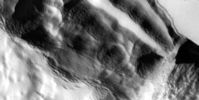
Io-PIA02597.jpgTelegonus Mensa in HR55 visiteA cliff slumps outward in these HR view that NASA's Galileo spacecraft captured of the edge of a mountain named Telegonus Mensa on Jupiter's moon Io. When Galileo flew near the South Pole of Io in October 2001, scientist's targeted this cliff to study the process of erosion. Water and wind cause most erosion on Earth, but Io has neither surface water nor atmosphere. The cliff is slumping due to gravity (?). The picture has a resolution of about 10 mt (33 feet) per picture element. Galileo's camera took it from a distance of about 1000 Km (about 620 miles). North is to the top and the Sun illuminates the surface from the upper right.
(10 voti)
|
|

Io-PIA01070.jpgAs Time Goes By...On Io! (1)57 visiteDetail of changes on Jupiter's moon Io in the Region around Volund as seen by the Voyager 1 spacecraft in April 1979 (left frame) and NASA's Galileo spacecraft in September 1996 (right frame). North is to the top of both frames which are approx. 600 by 600 Km. Note the new linear feature, which may be a volcanic fissure, trending east from the southern end of Volund. Dark diffuse material lies to the west and a ring of bright material which may be SO2- rich plume deposits appears to be centered near the middle of the new linear feature.
(10 voti)
|
|

Io-GalaiPatera-PIA00324.jpgGalai Patera54 visiteIo's volcanic plains are shown in this Voyager 1 image, which spans an area about 1030 km (640 miles) from left to right. North is about the 1:30 position. Numerous volcanic calderas and lava flows are visible here. The brown teardrop-shaped feature at left center is Galai Patera, a 100-km-long (62 mi) lava-flooded caldera (collapsed vent) of a volcano. The composition of Io's volcanic plains and lava flows has not been determined. The prevalent yellow, brown, and orange material may consist dominantly of sulfur with surface frosts of sulfur dioxide or of silicates (such as basalt) encrusted with sulfur and sulfur dioxide condensates. The whitish patches probably are freshly deposited SO2 frost.
(10 voti)
|
|

Io-LokiPatera-PIA00320.jpgLoki patera: an everlasting eruption...54 visiteA huge area of Io's volcanic plains is shown in this Voyager 1 image mosaic. Numerous volcanic calderas and lava flows are visible here. Loki Patera, an active lava lake, is the large shield-shaped black feature. Heat emitted from Loki can be seen through telescopes all the way from Earth. These telescopic observations tell us that Loki has been active continuously (or at least every time astronomers have looked) since the Voyager 1 flyby in March 1979. The composition of Io's volcanic plains and lava flows has not been determined, but they could consist dominantly of Sulphur (S) with surface frosts of S dioxide or of silicates (such as basalts) encrusted with S and S dioxide condensates. The bright whitish patches probably consist of freshly deposited SO2 frost. The black spots, including Loki, are probably hot sulfur lava, which may remain molten by intrusions of molten silicate magma, coming up from deeper within Io. The ultimate source of heat that keeps Io active is tidal frictional heating due to the continual flexure of Io by the gravity of Jupiter and Europa, another of Jupiter's satellites.
(10 voti)
|
|
| 324 immagini su 27 pagina(e) |
 |
3 | |
|
|
|
|
|
|
|
|





