| Piú votate - Jupiter: the "King" and His Moons |
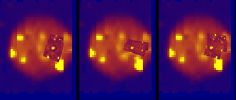
Io-active volcanoes-PIA02558_modest.jpgActive volcanoes on Io in 3 different months54 visiteCaption NASA originale:Changes in the volcanoes on Io can be seen in these 3 views, taken by NASA's Galileo spacecraft during its 3 flybys of Io in October and November 1999 and February 2000. All the images show the active volcanoes as bright yellow, corresponding to hot lava flows that appear glowing in infrared wavelengths. The 3 views were taken by the spacecraft's near-infrared mapping spectrometer and show the comparison of a typical low-resolution observation to the high-resolution views. The Prometheus volcano is seen near the middle of all three images. Before the recent flybys, only Prometheus and three other volcanoes were known to be active in this region. After these and other high-resolution observations, scientists were able to detect 14 volcanoes in the same area. The fainter volcanoes (hot spots) show some significant changes over intervals of 1 to 3 months. The area shown by all three observations put together is about 2 million square kilometers (about 770,000 square miles)".
(14 voti)
|
|
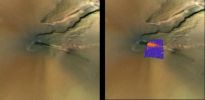
Io-Pele Volcano-PIA02560_modest.jpgThe "Pele" Volcano76 visitePele, one of Io's best-known volcanoes, was observed by the infrared spectrometer, an instrument onboard NASA's Galileo spacecraft, during the flyby of Jupiter's moon Io on February 22, 2000. The temperature map is shown here on the left in false color, superimposed on a visible color image of the Pele region obtained by the Voyager spacecraft in 1979. The red color represents the hottest lava flows. The purple colors are cooler materials. Preliminary results show that the temperatures of the hottest lava flows are at least 1,400 Kelvin (about 2,000 Fahrenheit), consistent with the temperatures of basaltic lava seen on the Kilauea volcano in Hawaii. It is possible that the eruption temperatures at Pele are even higher, as lava cools quickly once it starts to spread over the surface. The Voyager context image is 200 kilometers (124 miles) across.
(14 voti)
|
|

Io-Tohill Mons-PIA03600_modest.jpgTohill Mons56 visitenessun commento
(14 voti)
|
|

Himalia from 4,4MKM.jpgHimalia from 4,4 MKM69 visiteCassini spacecraft captured images of Himalia, the brightest of Jupiter's outer moons, on Dec. 19, 2000, from a distance of 4,4 MKM.
This near-infrared image, with a resolution of about 27 Km (such as roughly 17 miles) per pixel, indicates that the side of Himalia facing the spacecraft is ,ore or less 160 Km (about 100 miles) in the up-down direction. Himalia probably has a non-spherical shape. Scientists believe it is a body captured into orbit around Jupiter, most likely an irregularly shaped asteroid. In the main frame, an arrow indicates Himalia. North is up. The inset shows the little moon magnified by a factor of 10, plus a graphic indicating Himalia's size and the direction of lighting (with sunlight coming from the left). Cassini's pictures of Himalia were taken during a brief period when Cassini's attitude was stabilized by thrusters instead of by a steadier reaction-wheel system. No spacecraft or telescope had previously shown any of Jupiter's outer moons as more than a "star-like" single dot.
(14 voti)
|
|

Amalthea and Io-PIA01626.jpgAmalthea and Io (approx. true colors)139 visiteComposite view of Amalthea and Io at the same scale. The visible part of Amalthea is about 150 Km across. The colors are just approximate. Amalthea is actually much darker than Io, but is displayed at a similar brightness for ease of viewing. The shape of Amalthea is controlled largely by impact cratering and fragmentation. In contrast, Io, like Earth, has gravity sufficient to form it into a slightly ellipsoidal sphere. Amalthea is covered by craters because there are no processes which erode or cover them efficiently. On extremely volcanically active Io, impact craters are covered quickly by lavas and other volcanic materials. Some of the volcanic materials escape from Io and probably contribute to the reddish colors of Amalthea and the other small inner satellites. The Amalthea and Io composites, obtained by the Solid State Imaging (SSI) camera on NASA's Galileo spacecraft on different orbits, were placed side by side for comparison purposes. The Amalthea composite combines data taken with the clear filter of the SSI system during orbit six, with lower resolution color images taken with the green, violet, and 1 micrometer filters during orbit 4. The Io data was obtained on July 2nd, 1998 (orbit 14) using the green, violet, and 1 micrometer filters.
(11 voti)
|
|

Io-hot spots-PIA02589_modest.jpgHot-spots on Io (at night) - edited63 visiteCaption NASA originale:"The left-hand frame shows the best view that Galileo has yet provided of Io's nighttime temperatures. For reference, the right hand frame, based on Galileo camera images, shows the same hemisphere of Io in visible light. The thin bright crescent indicates the only observable portion illuminated by sunlight during the temperature measurements. Several volcanoes are identified on both images: "L-K" is Lei-Kung Fluctus, "L" is Loki, "Pi" is Pillan, "M" is Marduk and "Pe" is Pele".
(27 voti)
|
|

Jupiter-water cloud-GAL-PIA01639_modest.jpgWater clouds on Jupiter66 visiteThis false-color picture of a convective thunderstorm 10.000 Km(6.218 miles) northwest of Jupiter's Great Red Spot was obtained by NASA's Galileo spacecraft on June 26, 1996. The white cloud in the center is a tall, thick cloud about 1.000 Km (620 miles) across, standing 25 Km (15 miles) higher than most of the surrounding clouds. Its base extends off to the left and appears red in this representation. This red color indicates that the cloud base is very deep in the atmosphere, about 50 Km (30 miles) below the surrounding clouds. Most of the wisps and features in Jupiter's clouds are thick and thin ammonia clouds, forming at a pressure just less than Earth's sea level pressure. On Jupiter, water is the only substance to form a cloud at a depth where the pressure is about 5 times the Earth's sea level pressure. The red base of this thunderstorm is so deep that it can only be a water cloud. In 1979 NASA's Voyager spacecraft saw convective clouds of this type near the Great Red Spot. They erupted like this roughly once every 10 days and lasted a few days each. But Voyager's cameras could not allow the determination of the storms' altitude. It is thought that this storm is analogous to an Earth thunderstorm, with the cloud's high, bright, white portion comparable to the familiar anvil cloud on Earth. Whether any rain or snow is falling below this cloud is unknown, but there are indications that similar storms on Jupiter have lightning in them.
(13 voti)
|
|
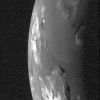
Io-PIA03530-1.jpgIo: the Loki Volcano from Galileo (RAW-HR and b/w Original NASA-Galileo Spacecraft Frame)60 visiteCaption NASA:"Light from the setting Sun falls across the Loki Volcanic Region on Jupiter's moon Io in this image taken by NASA's Galileo Spacecraft taken on October, 16, 2001.
The image was taken to examine the relative depths and heights of the major Surface Features existing in the Region. The Sun illuminates the surface from the right. Galileo's camera caught the large Volcanic Crater, or "Patera" of Loki near the Terminator (such as the boundary line between night and day). The image also shows several smaller craters plus shadows cast by the high peaks of several mountains.
Shadows cast by the low Sun should reveal any topography associated with Loki, such as a plateau in the center of the Patera or high Patera Walls. The near absence of shadows in this Region surprised Galileo scientists, as they had expected much more pronounced topography near Loki.
Another surprising aspect of this image is that features that have been black in previous Voyager and Galileo images of Loki, such as the dark Lava Flows visible inside the Patera, are here brighter than their surroundings. The best explanation is that the shiny, glassy surfaces of chilled Lava Flows look extremely dark when the Sun is directly overhead, but they reflect the Sun's light comparatively well when it shines at a low angle, in a similar manner to the reflective surfaces of bodies of water.
Other Volcanic Paterae in this image show the same unusual reflectance as seen at Loki. Some of them are being viewed at such an angle that these reflections from Lava Flows are the brightest features in the image. This image tells us that Lava Flows on Io chill quickly and form glassy surfaces, not unlike recently cooled lava flows in Hawaii.
The image has a resolution of about 1,1 Km (approx. 0,7 miles) per picture element. North is to the top of the picture".
(36 voti)
|
|

AA-Jupiter-PIA02666_modest.jpgJupiter from Cassini-Huygens121 visiteJupiter Data and Statistics
Mass (kg) = 1.900e+27
Mass (Earth = 1) = 3,1794e+02
Equatorial radius = 71.492 Km
Equatorial radius (Earth = 1) = 1,1209e+01
Mean density (gm/cm^3) = 1,33
Mean distance from the Sun = 778.330.000 Km
Mean distance from the Sun (Earth = 1) = 5,2028
Rotational period (days) = 0,41354
Orbital period (days) = 4332,71
Mean orbital velocity = 13,07 Km per second
Tilt of axis = 3,13°
Orbital inclination = 1,308°
Equatorial surface gravity (m/sec^2) = 22,88
Equatorial escape velocity = 59,56 Km per second
Magnitude (Vo) = - 2,70
Mean cloud temperature = - 121°C
Atmospheric pressure (bars) = 0,7
Atmospheric composition: Hydrogen 90%; Helium 10%
(35 voti)
|
|

Callisto-Chain of craters-PIA00514_modest.jpgA chain of craters on Callisto98 visiteCaption NASA originale:"A portion of a chain of impact craters on Jupiter's moon Callisto is seen in this image taken by the Galileo spacecraft on November 4, 1996. This crater chain on Callisto is believed to result from the impact of a split object, similar to the fragments of Comet Shoemaker-Levy 9 which smashed into Jupiter's atmosphere in July of 1994".
(15 voti)
|
|

ZA-The Red Spot from HST.jpgMoments of the "Red Spot" - HST61 visitenessun commento
(12 voti)
|
|

Metis-Galileo.jpgMetis (Natural Colors; credits: Ted Stryk)57 visiteMetis, o Metide, è il più interno fra i Satelliti Naturali di Giove. Appartiene al cosiddetto gruppo di Amaltea, che si compone dei piccoli satelliti interni del Pianeta. Il suo nome storico è Giove XVI.
La scoperta di Metis risale al 1979, quando fu individuato grazie alle immagini inviate a Terra dalla sonda spaziale statunitense Voyager 1 e gli venne attribuito il nome provvisorio S/1979 J3; nel 1983 l'Unione Astronomica Internazionale lo battezzò ufficialmente con il nome della titanide Metide, prima moglie di Zeus e madre di Atena secondo la Mitologia Greca.
Il colorito giallo-rossastro che è stato attribuito a questo Corpo Celeste da Ted Stryk potrebbe trovare una giustificazione negli accumuli (depositi superficiali) di Zolfo che Metis - periodicamente - "raccoglie" dallo Spazio durante i suoi passaggi ravvicinati ad Io.MareKromium
(9 voti)
|
|
| 324 immagini su 27 pagina(e) |
 |
|
|
|
|
|
|
|
|
27 |
|





