| |

| Piú votate - Jupiter: the "King" and His Moons |

Io-Emakong patera-PIA02598_modest.jpgThe "Emakong" Patera (HR)61 visiteCaption NASA originale:"Clues about how lava spreads great distances on Jupiter's volcanic moon Io come from HR views taken by NASA's Galileo spacecraft of a lava channel flowing out of Emakong Patera near Io's equator.
The lava channel is dark and runs to the right from the dark patera, or large depression, at the left of this mosaic. The 1999 images showed a dark channel though which molten material once fed a broad, bright lava flow that extended for hundreds of Km".

(17 voti)
|
|

Io-Eruption on Tvashtar Catena-PIA02584_modest.jpgIo: eruption in Tvashtar Catena83 visiteThis pair of images taken by NASA's Galileo spacecraft captures a dynamic eruption at Tvashtar Catena, a chain of volcanic bowls on Jupiter's moon Io. They show a change in the location of hot lava over a period of a few months in 1999 and early 2000.
The image on the left uses data obtained on Nov. 26 and July 3, 1999, at resolutions of 183 meters (600 feet) and 1.3 kilometers (0.8 miles) per pixel, respectively. The red and yellow lava flow itself is an illustration based upon imaging data. The image on the right is a composite using a five-color observation made on Feb. 22, 2000, at 315 meters (1030 feet) per pixel.
These are among the most fortuitous observations made by Galileo because this style of volcanism is too unpredictable and short-lived to plan to photograph.
Short-lived bursts of volcanic activity on Io had been previously detected from Earth-based observations, but interpreting the style of volcanic activity from those lower-resolution views was highly speculative. These Galileo observations confirm hypotheses that the initial, intense thermal output comes from active lava fountains. Galileo's high-resolution observations of volcanic activity on Io have also confirmed other hypotheses based on earlier, low-resolution data. These include interpretations of slowly spreading lava flows at Prometheus and Amirani and an active lava lake at Pele. These tests of earlier hypotheses increase scientists' confidence in interpreting volcanic activity seen in low-resolution remote sensing data of Earth as well as Io. However, these data are still of insufficient resolution to adequately test the more quantitative models that have been applied to volcanic eruptions on Earth and Io.
These images also show other geologic features on Io, such as the scalloped margins of the plateau to the northeast of the active lavas. These margins appear to have formed by sapping, a process usually associated with springs of water. Liquid sulfur dioxide might be the fluid responsible for sapping on Io. A better understanding of sapping on Io will influence how scientists interpret similar features on Mars(where the viability of carbon dioxide or water as the sapping fluid remains controversial).
(17 voti)
|
|
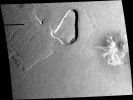
Io-Volcanic_Depression-PIA03532_modest1.jpgVolcanic Depression near the Equator (Original NASA/Galileo b/w Frame)56 visiteThis image taken by NASA's Galileo spacecraft on Oct. 16, 2001, near the equator of Jupiter's moon Io shows the contrast in volcanism styles found on Io.
The central feature is a large patera, or volcanic depression, almost 100 kilometers (60 miles) long. It may have formed after eruptions of lava emptied a subsurface magma chamber and left an empty space into which the crust collapsed. Evidence of lava flows associated with this patera, however, is difficult to find. Either the flows have been buried, or perhaps they never erupted and simply drained back deep into the crust.
On the right of the image is a small shield volcano, similar to volcanoes in Hawaii. It is rare for lavas on Io to be thick enough to pile up into shields around vents. They usually run out in thin, long flows instead. This shield abuts some very pale lava flows that emerged from a small vent to the west. These flows could be made of sulfur, like flows at Io's Emakong Patera. The vent is also surrounded by dark, diffuse material, which may be the result of lava erupted in an explosive, gas-rich eruption, similar to the 1980 eruption of Mount Saint Helens in Washington.
North is to the top of the image and the illumination is from the right. The image has a resolution of 330 meters (1,080 feet) per picture element and is 340 (211 miles) kilometers across.
(13 voti)
|
|

Io-Pele plume-PIA02546_modest.jpgThe "sulphuric plume" of Pele61 visiteThis image depicts the discovery of sulfur gas in the plume of the Pele volcano on Jupiter's moon Io, as seen by the Hubble Space Telescope in October 1999, during a flyby of Io by NASA's Galileo spacecraft. The main image shows Io passing in front of Jupiter as seen by Hubble's Wide-Field Planetary Camera (WFPC2) in near-ultraviolet light. The small inset shows that when a WFPC2 image at shorter ultraviolet wavelengths is included in a color composite with the near-ultraviolet image, Io's Pele plume appears as a dark smudge off the edge of Io's disk, silhouetted against Jupiter. The larger inset shows data from Hubble's Space Telescope Imaging Spectrograph, which mapped the composition of Pele's plume by analyzing the ultraviolet light from Jupiter which had passed through the plume. The regions shown in yellow were rich in sulfur gas, which was precisely centered over the Pele volcano, whose position is shown along with the edge of Io's disk.
(15 voti)
|
|
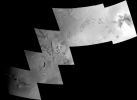
Io-Zamama Plume-PIA03531_modest.jpgThe "Zamama" flow field54 visiteThe source area of what had been a towering volcanic plume two months earlier lies in the far-right frame of this mosaic of images taken of Jupiter's moon Io by NASA's Galileo spacecraft on Oct. 16, 2001.
The region in the images includes the Zamama lava flow in Jupiter's northern hemisphere. The Zamama flow field emanates from the northernmost of two small volcanoes in the far left frame. These lava flows were not present in Voyager images of Io, so they formed some time between the Voyager 1 flyby in 1979 and the first Galileo observations of Io in 1996. Galileo also observed Zamama during Io encounters in 1999, and scientists identified narrow, long, dark lava flows thought to be similar to lava flows in Hawaii.
Moving northeast, the second and third frames of this mosaic contain lava flow fields and several unnamed volcanic depressions, called "paterae." It is unclear whether the broad, shield-like features or plateaus on which the paterae rest were created by eruptions from the paterae, or if they were preexisting features. Some fractures and dark lines suggest that the crust here is breaking up, creating cracks that magma can use to rise to the surface.
The far-right frame of this mosaic shows dark lava flows and bright spots. The bright spots are probably sulfur-bearing plume deposits, which are thought to be associated with the source of a plume eruption 500 kilometers (310 miles) high that was observed by the Galileo spacecraft in August, 2001. It was the largest plume eruption ever observed on Io.
(15 voti)
|
|

Ganymede-PIA01618.jpgGanymede's surface (detail mgnf)59 visiteView of the Marius Regio and Nippur Sulcus area of Jupiter's moon, Ganymede showing the dark and bright grooved terrain which is typical of this satellite. This regional scale view was imaged near the terminator (the line between day and night) and provides geologic context for small areas that were imaged at much higher resolution earlier in the tour of NASA's Galileo spacecraft through the Jovian system. The older, more heavily cratered dark terrain of Marius Regio is rutted with furrows, shallow troughs perhaps formed as a result of ancient giant impacts. Bright grooved terrain is younger and is formed through tectonism probably combined with icy volcanism. The lane of grooved terrain in the lower left, Byblus Sulcus, was imaged during the spacecraft's second orbit, as were Philus Sulcus and Nippur Sulcus, seen here in the upper left. Placing the small higher resolution targets of Galileo's second orbit into the context of more distant, lower resolution views of the areas surrounding and connecting them, and imaging them along Ganymede's terminator, allows for an integrated understanding of Ganymede' s geology.
North is to the top left of the picture and the sun illuminates the surface from the lower right. The image, centered at 43 degrees latitude and 194 degrees longitude, covers an area approximately 664 by 518 kilometers. The resolution is 940 meters per picture element. The image was taken on May 7, 1997 at 12 hours, 50 minutes, 11 seconds Universal Time at a range of 92,402 kilometers by the Solid State Imaging (SSI) system on NASA's Galileo spacecraft.
(15 voti)
|
|

Amalthea-PIA01074.jpgFour views of Amalthea74 visiteThese 4 images of Amalthea were taken by Galileo's Solid State Imaging System at various times between February and June 1997. North is approx. up in all cases. Amalthea, whose longest dimension is about 247 Km (154 miles) across, is tidally locked (like Thebe) so that the same side of the moon always points towards Jupiter. In such a tidally locked state, one side of Amalthea always points in the direction in which Amalthea moves as it orbits about Jupiter. This is called the "leading side" of the moon and is shown in the top 2 images. The opposite side of Amalthea, such as the "trailing side," is shown in the bottom pair of images. The Sun illuminates the surface from the left in the top left image and from the right in the bottom left image. Such lighting geometries, similar to taking a picture from a high altitude at sunrise or sunset, are excellent for viewing the topography of the satellite's surface such as impact craters and hills. In the two images on the right, however, the Sun is almost directly behind the spacecraft. This latter geometry, similar to taking a picture from a high altitude at noon, washes out topographic features and emphasizes Amalthea's albedo (light/dark) patterns. It emphasizes the presence of surface materials that are intrinsically brighter or darker than their surroundings. The bright albedo spot that dominates the top right image is located inside a large south polar crater named Gaea.
(12 voti)
|
|
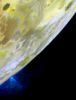
Io-Masubi plume-GAL-PIA02502_modest.jpgThe "Masubi" plume74 visiteA plume of gas and particles is ejected some 100 kilometers (about 60 miles) above the surface of Jupiter's volcanic moon Io in this color image, recently taken by NASA¹s Galileo spacecraft.
The plume is erupting from near the location of a plume first observed by the Voyager spacecraft in 1979 and named Masubi. However, during the course of the Galileo tour of Jupiter and its moons, a plume has appeared at different locations within the Masubi region.
This color image is the same as the previously released false color mosaic of Io, but with special processing to enhance the visibility of the plume. The plume appears blue because of the way small particles in the plume scatter light.
North is to the top of the picture, and the Sun illuminates the surface from almost directly behind the spacecraft. The resolution is 1.3 kilometers (0.8 miles) per picture element. The images were taken on July 3, 1999 at a distance of about 130,000 kilometers (81,000 miles) by the Galileo¹s camera.
(12 voti)
|
|

Amalthea-PIA01072.jpgFirst look at Amalthea69 visiteOriginal caption:"Galileo's first view of Amalthea, a small inner moon of Jupiter, showing the end of the elongated satellite that faces permanently toward the Giant Planet. North is to the top of the picture and the Sun illuminates the surface from the left. The circular feature that dominates the upper-right portion of the disk is Pan, the largest crater on Amalthea. This crater is about 90 Km wide. The bright spot at the South Pole is associated with another, slightly smaller crater named Gaea. (...) ".
(6 voti)
|
|

Jupiter - HST.jpgTriple eclypse on Jupiter (false colors - HST)63 visiteDa "NASA - Picture of the Day" dell'11.11.2004: "This false-color image of banded gas giant Jupiter shows a triple eclipse in progress on March 28 - a relatively rare event, even for a large planet with many moons. Captured by the Hubble Space Telescope's near-infrared camera are shadows of Jupiter's moons Ganymede (left edge), Callisto (right edge) and Io, three black spots crossing the sunlit Jovian cloud tops. In fact, Io itself is visible as a white spot near picture center with a bluish Ganymede above and to the right, but Callisto is off the right hand edge of the scene. Viewed from Jupiter's perspective, these shadow crossings would be seen as solar eclipses, analogous to the Moon's shadow crossing the sunlit face of planet Earth. Historically, timing the eclipses of Jupiter's moons allowed astronomer Ole Roemer to make the first accurate measurement of the speed of light in 1676".
(14 voti)
|
|

Jupiter_s Aurora-HST-PIA03155_modest.jpgJupiter's Aurora - HST77 visiteCaption NASA originale:"Auroras are curtains of light resulting from high-energy electrons racing along the planet's magnetic field into the upper atmosphere.
The electrons excite atmospheric gases, causing them to glow.
The image shows the main oval of the aurora, which is centered on the magnetic north pole, plus more diffuse emissions inside the polar cap. The HST image shows also unique emissions from the magnetic "footprints" of 3 of Jupiter's largest moons.
Auroral footprints can be seen in this image from Io (along the lefthand limb), Ganymede (near the center), and Europa (just below and to the right of Ganymede's auroral footprint).
These emissions, produced by electric currents generated by the satellites, flow along Jupiter's magnetic field, bouncing in and out of the upper atmosphere".
(14 voti)
|
|

Io-sulphur_s role-PIA02547_modest.jpgThe Role of Sulphur in Io's Volcanoes69 visiteCaption NASA originale:"Sulphur gas, consisting of pairs of sulphur atoms (S2) - as detected above Io's volcano Pele by the HST in October 1999 - is ejected from the hot vents of Io's volcanoes (green arrow). Such sulphur gas lands on the cold surface where the sulphur atoms rearrange into molecules of 3 or 4 atoms (S3 and S4) which give the surface a reddish color. In time, the atoms rearrange into their most stable configuration (S8) that forms ordinary pale-yellow sulphur".
(14 voti)
|
|
| 324 immagini su 27 pagina(e) |
|
|
|
|
|
|
|
|
|
26 |
|
|
|





