| |

| Piú votate - Jupiter: the "King" and His Moons |
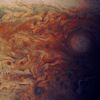
Jupiter-Juno-2024-4-Deutsch.jpgAtmosphärische Turbulenzen139 visiteZur Vorgeschichte: nach einer über fünfjährigen Reise erreichte die Raumsonde Juno am 4. Juli 2016 die Umlaufbahn um Jupiter. Entfernung zur Erde: 1,74 Milliarden Meilen. Am 24. Oktober absolvierte sie ihren achten nahen Vorbeiflug, durchquerte die Wolkendecke des Planeten und näherte sich Jupiters Oberfläche bis auf 3.400 Kilometer. Ihre Mission? Daten und Bilder des größten Planeten unseres Sonnensystems zu sammeln und zur Erde zu übermitteln.
Nach einer Verzögerung (Anfangsphase) bei der Datenübertragung aufgrund einer Sonnenkonjunktion, bei der die Kommunikation zwischen Jupiter und Erde durch die extreme Nähe zur Sonne unterbrochen wurde, erreichten die in der Juno-Sonde gespeicherten Daten die NASA – und die Ergebnisse sind verblüffend. Die Bilder zeigen die geheimnisvollen Nord- und Südpole des Planeten sowie gigantische Gasstürme. Während wir auf weitere nahe Vorbeiflüge warten, präsentieren wir Ihnen einige beeindruckende Bilder, die die Sonde vom Gasriesen, dem fünften Planeten unseres Sonnensystem.MareKromium
(1 voti)
|
|
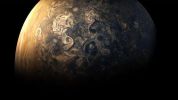
Jupiter-Juno-2024-Fra-5.jpgTurbulence Atmosphérique93 visiteQuelques informations de base : après un voyage de plus de cinq ans, la sonde Juno s'est mise en orbite autour de Jupiter le 4 juillet 2016. Distance de la Terre : 2,8 milliards de kilomètres. Le 24 octobre, elle a effectué son huitième survol rapproché, traversant la couche nuageuse de la planète et s'approchant à seulement 3 400 kilomètres de sa surface. Sa mission ? Collecter des données et des images de la plus grande planète de notre système solaire afin de les transmettre à la Terre.
Après un retard (phase initiale) dans la transmission des données, dû à une conjonction solaire durant laquelle les communications entre Jupiter et la Terre ont été interrompues par la proximité excessive de la planète avec le Soleil, les informations, stockées à bord de la sonde Juno, sont parvenues à la NASA, et les résultats sont stupéfiants. Les images révèlent les mystérieux pôles Nord et Sud de la planète, ainsi que d'immenses tempêtes de gaz.
En attendant de nouvelles images, nous vous présentons quelques magnifiques clichés transmis par la sonde, concernant cette géante gazeuse, la cinquième planète du système solaire.MareKromium
(1 voti)
|
|
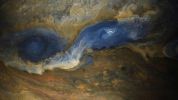
Jupiter-Juno-2024-6.jpgGas Storms87 visiteSome background information: after a journey lasting more than five years, the Juno spacecraft arrived in orbit around Jupiter on July 4, 2016. Distance from Earth: 1.74 billion miles. On October 24, it performed its eighth close flyby, passing through the planet's cloud cover and approaching to within just 3,400 kilometers of Jupiter's surface. Its mission? To collect data and images of the largest planet in our Solar System to transmit to Earth.
After a delay (Initial Phase) in data transmission, due to a solar conjunction in which communications between Jupiter and Earth were interrupted by its excessive proximity to the sun, the information, stored within the Juno probe, arrived at NASA, and the results are astonishing. The images show the planet's mysterious North and South Poles, as well as gigantic gas storms.
While we wait for new Fly-Vyes, we show you some beautiful images transmitted by the probe relating to the gas giant, the fifth planet of the Solar System.MareKromium
(1 voti)
|
|

JUPITER_S_RINGS-00.jpgJupiter's rings133 visiteIl profilo di Giove non ci mostra i suoi colori così come invece era avvenuto nell'immagine precedente, ma l'immagine è comunque bella e spettacolare, nonchè interessante: lo vedete il "gap" negli Anelli di Giove che spicca a ridosso del disco del Pianeta, sulla Sx dell'Osservatore?
Si tratta, come ovvio, di un semplice effetto ottico causato dalla particolare prospettiva dalla quale la ripresa è stata effettuata: è l'ombra stessa di Giove, infatti, a "cancellare" una porzione del sottile filo di detriti cosmici che forma il Sistema Anulare del Gigante Gassoso.
(24 voti)
|
|

Ganymede-PIA01610.jpgGanymede's surface detail: a comet fell over there?143 visiteView of a chain of craters named Enki Catena on Jupiter's moon, Ganymede. This chain of 13 craters probably formed by a comet which was pulled into pieces by Jupiter's gravity as it passed too close to the planet. Soon after this breakup, the 13 fragments crashed onto Ganymede in rapid succession. The Enki craters formed across the sharp boundary between areas of bright terrain and dark terrain, delimited by a thin trough running diagonally across the center of this image. The ejecta deposit surrounding the craters appears very bright on the bright terrain. Even though all the craters formed nearly simultaneously, it is difficult to discern any ejecta deposit on the dark terrain. This may be because the impacts excavated and mixed dark material into the ejecta and the resulting mix is not apparent against the dark background.
North is to the bottom of the picture and the sun illuminates the surface from the left. The image, centered at 39 degrees latitude and 13 degrees longitude, covers an area approximately 214 by 217 kilometers. The resolution is 545 meters per picture element. The image was taken on April 5, 1997 at 6 hours, 12 minutes, 22 seconds Universal Time at a range of 27282 kilometers by the Solid State Imaging (SSI) system on NASA's Galileo spacecraft.
(19 voti)
|
|

Jupiter-V2-PIA00343_modest.jpgJupiter in full detail, by Voyager 257 visiteCaption NASA originale:"The colors have been enhanced to bring out detail. Zones of light-colored, ascending clouds alternate with bands of dark, descending clouds. The clouds travel around the planet in alternating eastward and westward belts at speeds of up to 540 Km p/h. Tremendous storms as big as Earthly continents surge around the planet. The Great Red Spot is an enormous anticyclonic storm that drifts along its belt, eventually circling the entire planet".
(12 voti)
|
|

Io-Tupan Patera-fullcolor-PIA02599_modest.jpgIo: Tupan Patera72 visiteWonderful colors in a volcanic crater named Tupan Patera on Jupiter's moon Io, as seen in this image from NASA's Galileo spacecraft, show varied results of lava interacting with sulfur-rich materials.
The colorfulness of the image is only slightly enhanced from what the human eye would see on the scene. The red in the image includes a small amount of infrared energy. Tupan Patera, named after a Brazilian thunder god, was seen as an active hot spot in earlier Galileo observations, but those low-resolution views did not show details of volcanic activity. This image taken in October 2001 at a resolution of 135 meters (443 feet) per picture element reveals the complex nature of the crater.
Tupan is now clearly shown to be a volcanic depression, about 75 kilometers (47 miles) across, surrounded by cliffs about 900 meters (3000 feet) tall. In the center is a large area that must be higher than the rest of the crater floor because it has not been covered by the dark lavas. Much of the area is coated with a diffuse red deposit that Galileo scientists believe has condensed from sulfur gas escaping from volcanic vents. The floor of Tupan is covered with a surreal pattern of dark black, green, red, and yellow materials. The black material is recent, still-warm lava. The yellow is presumed to be a mix of sulfurous compounds, and the green appears to form where red sulfur has interacted with the dark lavas. While Galileo scientists have found previous evidence for both molten sulfur and molten rock on Io, this image shows the best evidence to date of chemical reactions taking place between the two.
The intermingled patches of sulfur and lava are difficult to explain. The yellowish sulfur may be melting from within the crater walls over solidified but warm lava. The sulfur may boil away from the areas too hot for liquid sulfur to sit on, leaving patches where the dark lava is still visible.
North is to the top of the image and the Sun illuminates the surface from the upper right.
(12 voti)
|
|
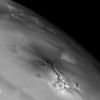
Io-PIA02232-1.jpgIo's Limb (RAW b/w NASA-Galileo Spacecraft Original Frame)56 visiteCaption NASA:"This picture of Io was taken on the morning of March 5 at a range of 75.445 Km. The area shown is at approx. 15° South Latitude and 244° East Longitude. Many depressions and elevations are shown. The light is coming from the left, so a depression has a bright right wall and shadow on the left wall. The depressions are complex in shape and do not resemble impact craters. Two of the depressions are joined by a shallow trough. The elevations are irregular and comical. They are cut by linear and irregular troughs. The surface is smooth and plain-like, that is, the surface is not pockmarked by abundant impact craters so are probably geologically young.
(11 voti)
|
|

Io-Eruption-PIA02545.jpgEruption on Tvashtar Catena66 visiteAn active volcanic eruption on Jupiter's moon Io was captured in this image taken on February 22, 2000 by NASA's Galileo spacecraft. Tvashtar Catena, a chain of giant volcanic calderas centered at 60 degrees north, 120 degrees west, was the location of an energetic eruption caught in action in November 1999. A dark, "L"-shaped lava flow to the left of the center in this more recent image marks the location of the November eruption. White and orange areas on the left side of the picture show newly erupted hot lava, seen in this false color image because of infrared emission. The two small bright spots are sites where molten rock is exposed to the surface at the toes of lava flows. The larger orange and yellow ribbon is a cooling lava flow that is more than more than 60 kilometers (37 miles) long. Dark, diffuse deposits surrounding the active lava flows were not there during the November 1999 flyby of Io.
This color mosaic was created by combining images taken in the near-infrared, clear, and violet filters from Galileo's camera. The range of wavelengths is slightly more than that of the human eye. The mosaic has been processed to enhance subtle color variations. The bright orange, yellow, and white areas at the left of the mosaic use images in two more infrared filters to show temperature variations, orange being the coolest and white the hottest material. This picture is about 250 kilometers (about 155 miles) across. North is toward the top and illumination from the Sun is from the west (left).
(11 voti)
|
|

Io-Surface deposits and craters-PIA01514.jpgIo: surface deposits and craters59 visiteThis picture of Io, the innermost Galilean satellite, was taken by Voyager 1 on the morning of March 5, 1979 at a range of 377,000 kilometers (226,200 miles). The smallest features visible are about 10 kilometers (6 miles) across. The reddish, white and black areas are probably surface deposits, possibly consisting of mixtures of salts, sulfur and sublimate deposits of possible volcanic origin. Many of the black spots in these pictures are associated with craters of possible volcanic origin. The lack of impact craters on Io suggests that the surface is relatively young compared to the other Galilean satellites and some of the terrestrial planets such as Mercury and the Moon.
(10 voti)
|
|
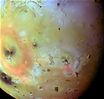
Io-Pele-PIA01112.jpgPele's deposits on Io56 visiteThe varied effects of Ionian volcanism can be seen in this false color infrared composite image of Io's Trailing Hemisphere. LR color data from Galileo's first orbit (June, 1996) have been combined with a HR clear filter picture taken on the third orbit (November, 1996) of the spacecraft around Jupiter. A diffuse ring of bright red material encircles Pele, the site of an ongoing, high velocity volcanic eruption. Pele's plume is nearly invisible, except in back-lit photographs, but its deposits indicate energetic ejection of sulfurous materials out to distances more than 600 Km from the central vent. Another bright red deposit lies adjacent to Marduk, also a currently active ediface. High temperature hot spots have been detected at both these locations, due to the eruption of molten material in lava flows or lava lakes. Bright red deposits on Io darken and disappear within years or decades of deposition, so the presence of bright red materials marks the sites of recent volcanism.
(8 voti)
|
|

Europa-V1-PIA00016-0.jpgEuropa56 visite"TUTTI QUESTI MONDI VI APPARTENGONO, TRANNE EUROPA: NON TENTATE DI ATTERRARVI.
VIVETECI INSIEME.
VICETECI IN PACE".
Ricordate questa "famosissima" trasmissione (diretta alla Terra ed all'equipaggio dell'astronave Sovietica "Leonov") proveniente dall'astronave Americana "Discovery", in quel momento guidata dall'Elaboratore HAL 9000?
Naturalmente stiamo parlando di "2010 - Odissea 2", il prosieguo cinematografico dell'immortale capolavoro di Sir Stanley Kubrick "2001 - A Space Odyssey".
Europa: la culla di una Nuova Civiltà, da studiare "restando lontani", così da non contaminarla con la nostra arroganza e supponenza.
Due film da rivedere e, dopo aver visto queste immagini, su cui provare a meditare...
(8 voti)
|
|
| 324 immagini su 27 pagina(e) |
|
|
|
|
|
|
|
24 | |
|
|
|
|





