| Piú votate - Jupiter: the "King" and His Moons |

Jupiter_Storm.jpgThe Dark S.E.B. of Jupiter is back!83 visiteDalla Rubrica "NASA - Picture of the Day" del giorno 29 Npvembre 2010:"Why are planet-circling clouds disappearing and reappearing on Jupiter?
Although the ultimate cause remains unknown, planetary meteorologists are beginning to better understand what is happening. Earlier this year, unexpectedly, Jupiter's Dark Southern Equatorial Belt (SEB) disappeared. The changes were first noted by amateurs dedicated to watching Jupiter full time. The South Equatorial Band has been seen to change colors before, although the change has never been recorded in such detail. Detailed professional observations revealed that high-flying light-colored Ammonia-based clouds formed over the planet-circling Dark Belt. Now those Light Clouds are dissipating, again unveiling the lower Dark Clouds.
Pictured above two weeks ago, far InfraRed images - depicted in false-color red - show a powerful storm system active above the returning Dark Belt. Continued observations of Jupiter's current cloud opera, and our understanding of it, is sure to continue".MareKromium
(2 voti)
|
|

Jupiter-Impact-2010-006.jpgAnother Impact on Jupiter?77 visiteAlcune immagini ad Alta Risoluzione scattate prima e dopo l'Evento Anomalo (impatto?) che ha coinvolto il Pianeta Giove.
Così come commentano gli Osservatori (che, come potete vedere, hanno ripreso il Gigante da svariate località), non c'era nessun segno visibile sul Gigante (nè in RGB, né UV, né Metano) il quale facesse da "testimone" della verificazione di un impatto.
Infatti, a parte le ben visibili turbolenze che usualmente caratterizzano l'Alta Atmosfera Gioviana e la chiara di una macchia scura circolare (si tratta dell'ombra di uno dei Satelliti Galileiani - probabilmente Ganimede), non vi è traccia alcuna di "cicatrici atmosferiche" le quali possano far supporre l'avvenuta verificazione di un Evento d'Impatto.MareKromium
(2 voti)
|
|

Jupiter-Impact-2010-007.jpgAnother Impact on Jupiter?70 visiteUn'altra immagine della "Fireball" che ha impattato Giove il giorno 20 Agosto u.s.
In questo caso si tratta di una ripresa effettuata dall'Astrofilo Giapponese Aoki Kazuo, da Tokio, il quale ha registrato un flash che, per coordinate spazio-temporali, coincide con quello rilevato e ripreso dall'altro Astrofilo del Sol Levante, Masayuki Tachikawa, che osservava il Gigante Gassoso dalla città di Kumamoto (la quale è distante circa 800 Km da Tokio).MareKromium
(2 voti)
|
|
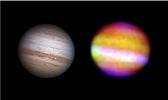
Jupiter_sofiawesley.jpgJupiter from the Stratosphere145 visiteDalla Rubruica "NASA - Picture of the Day", del giorno 3 Giugno 2010:"SOFIA, the Stratospheric Observatory for InfraRed Astronomy, captured its "first light" images on May 26, from an altitude of 35.000 feet.
While flying above most of planet Earth's InfraRed-absorbing water vapor, SOFIA's premier IR views of the cosmos included this remarkable false-color image (right panel) of Jupiter.
For comparison, on the left is a recent, ground-based visible light image. Both show our Solar System's ruling gas giant without its dark Southern Equatorial Belt (normally seen in the upper Hemisphere in this orientation). That familiar feature faded from view early in May. But the bright white stripe in SOFIA's image is a region of Jupiter's clouds transparent to IR Light, offering a glimpse below the cloud tops".MareKromium
(2 voti)
|
|

Amalthea-Galileo.jpgAmalthea, from Galileo62 visiteOn its way in and out, Galileo took these two snapshots of Amalthea. The purpose was to improve navigation for the upcoming flyby of this little moonlet, but such images also help in the study of the shape of irregular worlds.MareKromium
(2 voti)
|
|

Jupiter-lor_0035089864_0x630_sci_1.jpgJupiter's Ring56 visiteDescription: Jupiter's Ring - Main Ring vertical structure including ripples
Time: 2007-03-01 21:19:04 UTC
Exposure: 3000 msec
Target: Jupiter
Range: 3,6 MKM
(2 voti)
|
|

Jupiter_from_New_Horizons-092606_1_hr.jpgJupiter, from New Horizons71 visiteBlazing along its path to Pluto, NASA's New Horizons has come within hailing distance of Jupiter. The first picture of the Giant Planet from the spacecraft's Long Range Reconnaissance Imager (LORRI), taken Sept. 4, 2006, is a tantalizing promise of what's to come when New Horizons flies through the Jupiter system early next year.
New Horizons was still 291 MKM (nearly 181 MMs) away from Jupiter when LORRI took the photo.
As New Horizons comes much closer, next January and February 2007, LORRI will take more-detailed images.
"These first LORRI images of Jupiter are awe-inspiring," says New Horizons Project Scientist Hal Weaver, of the Johns Hopkins University Applied Physics Laboratory (APL), where LORRI was designed and built. "New Horizons is speeding toward this majestic planet at 45,000 miles per hour, right on target for a close encounter on February 28 of next year. LORRI's resolution at Jupiter will be 125 times better than now, and we're really looking forward to getting the most detailed views of the Jovian system since Cassini's flyby in late 2000 and Galileo's final images in 2003."
Now on the outskirts of the asteroid belt, LORRI snapped this image during a test sequence to help prepare for the Jupiter encounter observations. It was taken close to solar opposition, meaning that the Sun was almost directly behind the camera when it spied Jupiter. This makes Jupiter appear blindingly bright, about 40 times brighter than Pluto will be for LORRI's primary observations when New Horizons encounters the Pluto system in 2015. To avoid saturation, the camera's exposure time was kept to 6 milliseconds. This image was, in part, a test to see how well LORRI would operate with such a short exposure time.
"LORRI's first Jupiter image is all we could have expected," says LORRI Principal Investigator Andy Cheng, of APL. "We see belts, zones and large storms in Jupiter's atmosphere. We see the Jovian moons Io and Europa, as well as the shadows they cast on Jupiter. It is most gratifying to detect these moons against the glare from Jupiter."
LORRI wasn't the only New Horizons instrument peeking at Jupiter on Sept. 4; the Ralph imager also performed some important calibrations. "We rapidly scanned Ralph's Multispectral Visible Imaging Camera [MVIC] across Jupiter to test a technique we plan to employ near closest approach next February. We also observed Jupiter in the infrared using Ralph's Linear Etalon Imaging Spectral Array [LEISA]," says Ralph Program Manager Cathy Olkin, of the Southwest Research Institute. "Everything worked great."
New Horizons won't observe Jupiter again until early January 2007, when periodic monitoring will begin, followed by intensive observations at the end of February. The spacecraft will also continue to look at the Jovian magnetosphere for several months after closest approach.
"New Horizons is headed to a spectacular science encounter with the Jupiter system early next year," says mission Principal Investigator Alan Stern, of the Southwest Research Institute. "The first LORRI images of Jupiter just whet our appetite for the observations to come."
(2 voti)
|
|

Europa-PIA01126.jpgEuropa's Lanscape (HR)56 visiteThis mosaic shows some of the highest resolution images obtained by the Solid State Imaging (SSI) System on NASA's Galileo spacecraft during its 11th orbit around Jupiter. North is to the top of the image. The Sun illuminates the scene from the left, showing hundreds of ridges that cut across each other, indicating multiple episodes of ridge formation either by volcanic or tectonic activity within the ice. Also visible in the image are numerous isolated mountains or "massifs". The highest of these, located in the upper right corner and lower center of the mosaic, are approx. 500 mt (about 1.640 feet) high. Irregularly shaped areas where the ice surface appears to be lower than the surrounding plains (e.g., in the left-center and lower left corner of the mosaic) may be related to the "chaos" areas of iceberg-like features seen in earlier SSI images of Europa.
The mosaic, centered at 35,4° North Lat. and 86,8° West Long., covers an area of 108 by 90 Km (about 66 x 55 miles).
The smallest distinguishable features in the image are about 68 meters (223 feet) across. These images were obtained on November 6, 1997, when the Galileo spacecraft was approximately 3,250 kilometers (1,983 miles) from Europa.
(2 voti)
|
|
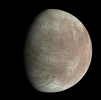
Europa_-_PIA26331-_JunoCam_6solgdm_width-1320.pngEuropa from Juno (Credits: Image data: NASA/JPL-Caltech/SwRI/MSSS; Image processing: Björn Jónsson)141 visiteJupiter’s moon Europa was captured by the JunoCam Instrument aboard NASA’s Juno Spacecraft during the Mission’s close flyby on Sept. 29, 2022. Data from NASA’s Juno mission has provided new insights into the thickness and subsurface structure of the icy shell encasing Jupiter’s moon Europa. Using the spacecraft’s Microwave Radiometer (MWR), mission scientists determined that the shell averages about 18 miles (29 kilometers) thick in the region observed during Juno’s 2022 flyby of Europa. The Juno measurement is the first to discriminate between thin and thick shell models that have suggested the ice shell is anywhere from less than half a mile to tens of miles thick.
Slightly smaller than Earth’s moon, Europa is one of the solar system’s highest-priority science targets for investigating habitability. Evidence suggests that the ingredients for life may exist in the saltwater ocean that lies beneath its ice shell. Uncovering a variety of characteristics of the ice shell, including its thickness, provides crucial pieces of the puzzle for understanding the moon’s internal workings and the potential for the existence of a habitable environment.MareKromium
(1 voti)
|
|
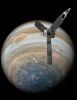
Jupiter-Juno-2024-1-Ita.jpgJ & J103 visiteAlcune informazioni di base: dopo un viaggio durato più di cinque anni, la sonda Juno è entrata in orbita attorno a Giove il 4 luglio 2016. Distanza dalla Terra: 1,74 miliardi di miglia. Il 24 ottobre ha effettuato il suo ottavo sorvolo ravvicinato, attraversando la coltre nuvolosa del pianeta e avvicinandosi a soli 3.400 chilometri dalla superficie di Giove. La sua missione? Raccogliere dati e immagini del pianeta più grande del nostro Sistema Solare da trasmettere sulla Terra.
Dopo un ritardo (Fase Iniziale) nella trasmissione dei dati, dovuto a una congiunzione solare che ha interrotto le comunicazioni tra Giove e la Terra a causa dell'eccessiva vicinanza al Sole, le informazioni, memorizzate nella sonda Juno, sono arrivate alla NASA e i risultati sono sorprendenti. Le immagini mostrano i misteriosi Poli Nord e Sud del pianeta, così come gigantesche tempeste di gas.
In attesa di nuovi sorvoli, vi mostriamo alcune splendide immagini trasmesse dalla sonda relative al gigante gassoso, il quinto pianeta del Sistema Solare.MareKromium
(1 voti)
|
|
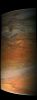
Jupiter-Juno-2024-Intro.jpgатмосферная турбулентность128 visiteНесколько слов о предыстории: После более чем пятилетнего путешествия космический аппарат Juno вышел на орбиту вокруг Юпитера 4 июля 2016 года. Расстояние от Земли: 1,74 миллиарда миль. 24 октября он совершил свой восьмой близкий пролёт, пройдя сквозь облачный покров планеты и приблизившись к поверхности Юпитера на расстояние всего 3400 километров. Его миссия? Собрать данные и изображения крупнейшей планеты нашей Солнечной системы для передачи на Землю.
После задержки (начальная фаза) в передаче данных, вызванной солнечным соединением, во время которого связь между Юпитером и Землёй была прервана из-за его чрезмерной близости к Солнцу, информация, хранящаяся в зонде Juno, поступила в НАСА, и результаты поразительны. На изображениях видны загадочные Северный и Южный полюса планеты, а также гигантские газовые бури.
В ожидании новых близких пролётов мы покажем вам несколько прекрасных изображений, переданных зондом, относящихся к газовому гиганту, пятой планете Солнечной системы.MareKromium
(1 voti)
|
|
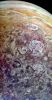
Jupiter-Juno-2024-Arabic-3.jpgتلاطم جوی110 visiteپس از سفری بیش از پنج سال، فضاپیمای جونو در ۴ ژوئیه ۲۰۱۶ به مدار مشتری رسید. فاصله از زمین: ۱.۷۴ میلیارد مایل. در ۲۴ اکتبر، هشتمین پرواز نزدیک خود را انجام داد و از میان پوشش ابری سیاره عبور کرد و به فاصله تنها ۳۴۰۰ کیلومتری سطح مشتری رسید. ماموریت آن؟ جمعآوری دادهها و تصاویر از بزرگترین سیاره منظومه شمسی برای ارسال به زمین.
پس از تأخیر (مرحله اولیه) در انتقال دادهها، به دلیل یک مقارنه خورشیدی که در آن ارتباطات بین مشتری و زمین به دلیل نزدیکی بیش از حد آن به خورشید قطع شد، اطلاعات ذخیره شده در کاوشگر جونو به ناسا رسید و نتایج شگفتانگیز است. تصاویر، قطبهای شمالی و جنوبی مرموز سیاره و همچنین طوفانهای گازی غولپیکر را نشان میدهند.
در حالی که منتظر عبورهای نزدیک جدید هستیم، تصاویر زیبایی را که توسط کاوشگر در رابطه با غول گازی، پنجمین سیاره منظومه شمسی، ارسال شده است، به شما نشان میدهیم.MareKromium
(1 voti)
|
|
| 324 immagini su 27 pagina(e) |
 |
|
|
|
|
|
23 | |
|
|
|





