| |

| Piú votate - Jupiter: the "King" and His Moons |

Io_Europa-040207.jpgIo and Europa, from New Horizons83 visiteThis beautiful image of the crescents of volcanic Io and more sedate Europa was snapped by New Horizons' color Multispectral Visual Imaging Camera (MVIC) at 10:34 UT on March 2, 2007, about two days after New Horizons made its closest approach to Jupiter.
The picture was one of a handful of the Jupiter System that New Horizons took primarily for their artistic, rather than scientific value. This particular scene was suggested by space enthusiast Richard Hendricks of Austin, Texas, in response to an Internet request by New Horizons scientists for evocative, artistic imaging opportunities at Jupiter.
This image was taken from a range of 4,6 MKM (about 2,8 MMs) from Io and 3,8 MKM (about 2,4 MMs) from Europa. Although the moons appear close in this view, a gulf of 790.000 Km (490.000 miles) separates them. The night side of Io is illuminated here by light reflected from Jupiter, which is out of the frame to the right. Europa's night side is completely dark, in contrast to Io, because that side of Europa faces away from Jupiter.
Here, Io steals the show with its beautiful display of volcanic activity. Three volcanic plumes are visible. Most conspicuous is the enormous 300-Km(190-mile) -high plume from the Tvashtar volcano at the 11 o'clock position on Io's disk. Two much smaller plumes are barely visible: one from the volcano Prometheus, at the 9 o'clock position on the edge of Io's disk, and one from the volcano Amirani, seen between Prometheus and Tvashtar along Io's Terminator (the line dividing day and night). The plumes appear blue because of the scattering of light by tiny dust particles ejected by the volcanoes, similar to the blue appearance of smoke. In addition, the contrasting red glow of hot lava can be seen at the source of the Tvashtar plume.
The images are centered at 1° North, 60° West on Io, and 0° North and 149° West on Europa.
The color in this image was generated using individual MVIC images at wavelengths of 480, 620 and 850 nanometers. The human eye is sensitive to slightly shorter wavelengths, from 400 to 700 nanometers, and thus would see the scene slightly differently. For instance, while the eye would notice the difference between the yellow and reddish brown colors of Io's surface and the paler color of Europa, the two worlds appear very similar in color to MVIC's longer-wavelength vision.
The night side of Io appears greenish compared to the day side, because methane in Jupiter's atmosphere absorbs 850-nanometer light and makes Jupiter-light green to MVIC's "eyes."
MVIC is a component of the Ralph imaging instrument. MareKromium
(3 voti)
|
|

Callisto-040507.jpgCallistus, from New Horizons55 visiteThe New Horizons Long Range Reconnaissance Imager (LORRI) captured these two images of Jupiter's outermost large moon, Callisto, as the spacecraft flew past Jupiter in late February.
New Horizons' closest approach distance to Jupiter was 2,3 MKM (about 1,4 MMs), not far outside Callisto's orbit, which has a radius of 1,9 MKM (about 1,2 MMs). However, Callisto happened to be on the opposite side of Jupiter during the spacecraft's pass through the Jupiter System, so these images, taken from 4,7 MKM (about 3 MMs) and 4,2 MKM (about 2,6 MMs) away, are the closest of Callisto that New Horizons obtained.
Callisto's ancient, crater-scarred surface makes it very different from its three more active sibling satellites, Io, Europa and Ganymede. Callisto, 4800 Km (about 3000 miles) in diameter, displays no large-scale geological features other than impact craters and every bright spot in these images is a crater. The largest impact feature on Callisto, the huge basin Valhalla, is visible as a bright patch at the 10 o'clock position. The craters are bright because they have excavated material relatively rich in water ice from beneath the dark, dusty material that coats most of the surface.
The two images show essentially the same side of Callisto - the side that faces Jupiter - under different illumination conditions. The images accompanied scans of Callisto's infrared spectrum with New Horizons' Linear Etalon Imaging Spectral Array (LEISA).
The New Horizons Science Team designed these scans to study how the infrared spectrum of Callisto's water ice changes as lighting and viewing conditions change, and as the ice cools through Callisto's late afternoon.
The infrared spectrum of water ice depends slightly on its temperature, and a goal of New Horizons when it reaches the Pluto system (in 2015) is to use the water ice features in the spectrum of Pluto's moon Charon, and perhaps on Pluto itself, to measure surface temperature.
Callisto provided an ideal opportunity to test this technique on a much better-known body.
The left image, taken at 05:03 Universal Time on February 27, 2007, is centered at 5° South, 5° West, and has a Solar Phase Angle of 46°. The right image was taken at 03:25 Universal Time on February 28, 2007. It is centered at 4° South, 356° West, and has a Solar Phase Angle of 76°.MareKromium
(3 voti)
|
|

Europa-HR.jpgEuropa (full disk - HR)63 visitenessun commento
(3 voti)
|
|

Callisto-HR-02.jpgCallisto: South Pole and Southern Hemisphere (HR) - detail mgnf54 visitenessun commento
(3 voti)
|
|

Callisto-HR-01.jpgCallisto: North Pole and Northern Hemisphere (HR) - detail mgnf116 visitenessun commento
(3 voti)
|
|
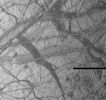
Europa-Ridges-PIA00518.jpgRidges on Europa54 visiteThis view of Jupiter's moon Europa shows a portion of the surface that has been highly disrupted by fractures and ridges. This picture covers an area about 238 Km (approx. 150 miles) wide by 225 Km (about 140 miles); in other words, the distance between Los Angeles and San Diego. Symmetric ridges in the dark bands suggest that the surface crust was separated and filled with darker material, somewhat analogous to spreading centers in the ocean basins of Earth. Although some impact craters are visible, their general absence indicates a youthful surface. The youngest ridges, such as the two features that cross the center of the picture, have central fractures, aligned knobs, and irregular dark patches. These and other features could indicate cryovolcanism, or processes related to eruption of ice and gases.
This picture, centered at 16° South Lat. and 196° West Long., was taken at a distance of 40.973 Km (about 25.290 mi) on November 6, 1996, by the Galileo spacecraft Solid State Imaging Television Camera.
(3 voti)
|
|

Europa-PIA01401.jpgThe frozen Ocean of Europa55 visiteThis complex area on the side of Europa which faces away from Jupiter shows several types of features that are formed by disruptions of Europa's icy crust. North is to the top of the image, taken by NASA's Galileo spacecraft, and the Sun illuminates the surface from the left. The prominent wide, dark bands are up to 20 Km (about 12 miles) wide and over 50 Km (appx. 30 miles) long. They are believed to have formed when Europa's icy crust fractured, separated and filled in with darker, "dirtier" ice or slush from below. A relatively rare type of feature on Europa is the 15-Km-diameter (about 9,3-mile) impact crater in the lower left corner. The small number of impact craters on Europa's surface is an indication of its relatively young age. A region of chaotic terrain south of this impact crater contains crustal plates which have broken apart and rafted into new positions. Some of these "ice rafts" are nearly 1 Km (about 1/2 a mile) across.
Other regions of chaotic terrain are visible and indicate heating and disruption of Europa's icy crust from below. The youngest features in this scene are the long, narrow cracks in the ice which cut across all other features. One of these cracks is about 30 kilometers (18 miles) to the right of the impact crater and extends for hundreds of miles from the top to the bottom of the image.
(3 voti)
|
|
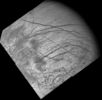
Europa-PIA00295.jpgEuropa: a splendid frame (in Super HD)54 visiteDark crisscrossing bands on Jupiter's moon Europa represent widespread disruption from fracturing and the possible eruption of gases and rocky material from the moon's interior in this four-frame mosaic of images from NASA's Galileo spacecraft. These and other features suggest that soft ice or liquid water was present below the ice crust at the time of disruption. The data do not rule out the possibility that such conditions exist on Europa today. The pictures were taken from a distance of 156,000 kilometers (about 96,300 miles) on June 27, 1996. Many of the dark bands are more than 1,600 kilometers (1,000 miles) long, exceeding the length of the San Andreas fault of California. Some of the features seen on the mosaic resulted from meteoritic impact, including a 30- kilometer (18.5 mile) diameter crater visible as a bright scar in the lower third of the picture. In addition, dozens of shallow craters seen in some terrains along the sunset terminator zone (upper right shadowed area of the image) are probably impact craters. Other areas along the terminator lack craters, indicating relatively youthful surfaces, suggestive of recent eruptions of icy slush from the interior. The lower quarter of the mosaic includes highly fractured terrain where the icy crust has been broken into slabs as large as 30 kilometers (18.5 miles) across. The mosaic covers a large part of the northern hemisphere and includes the north pole at the top of the image. The sun illuminates the surface from the left. The area shown is centered on 20 degrees north latitude and 220 degrees west longitude and is about as wide as the United States west of the Mississippi River.
(3 voti)
|
|

Europa,_Io_and_Jupiter.jpgOver the "Eye"102 visiteNice frame.MareKromium
(2 voti)
|
|

Ganymede-P-51236218280_1b20779992_o.pngGanymede96 visitenessun commentoMareKromium
(2 voti)
|
|

Callisto-PIA00080-PCF-LXTT-IPF.jpgClosing-up on Valhalla (Absokute Natural Colors; credits for the additional process. and color.: Dr Paolo C. Fienga/Lunar Explorer Italia/Italian Planetary Foundation)69 visiteCallisto was revealed by the NASA - Voyager 1 cameras to be a heavily cratered and - most likely (as it was thought at that time) - geologically inactive Celestial Body. This mosaic of Voyager 1 images, obtained at a distance of about 400,000 Km (about 248.000 miles) from Callisto, shows Surface details as small as 10 Km (such as 6,2 miles) across. The largest Impact Features on the Callistoan Surface are the so-called "Multi-Ring Impact Basins"; two of them are enormous and Valhalla - the prominent Impact Feature visible here, in today's APOD - is the largest one, with a Bright Central Region approx. 600 Km (a little more than 372 miles) in diameter, and Rings extending as far as about 1800 Km (approx. 1118 miles) from the center. The second largest Impact Multi-Ring Basin is named Asgard, and it measures about 1600 Km (a little more than 993 miles) in diameter.
Multi-Ring Impact Structures probably originated as a result of a Post-Impact Concentric Fracturing of the Lithosphere lying on a layer of soft or - maybe - even Liquid Material: possibly, an Ocean. Last, but not least, in our opinion, as IPF, the remarkable resemblances existing between the Callistoan Valhalla Crater and the Tyre Crater, located on the other Jovian moon Europa, (*) may tell us, in the end, VERY similar stories about these two mysterious Celestial Bodies. Stories that may talk about worlds that, certainly a long, long time ago, were completely (or almost completely) covered by water. Stories that should also tell us something about what could still be happening, even now, up there: in the depths of Callisto, Europa and, maybe, of a few other Celestial Objects orbiting around the four Gas-Giant Planets of the Solar System...
(*) note: if you want to take a look at Tyre Crater, please refer to the APOD of January, 29, 2013
The Catenae, on the other hand (for example the Gomul Catena), are long Chains of Impact Craters lined up in straight lines across the Surface of Callisto. They were probably created by objects that were tidally disrupted as they passed close to Jupiter prior to the impact on Callisto, or by very oblique Impacts.
This frame (which is an Original NASA - Voyager 1 Spacecraft false color image mosaic published on the NASA - Planetary Photojournal with the ID n. PIA 00080) has been additionally processed and then re-colorized, according to an educated guess, by Dr Paolo C. Fienga (LXTT-IPF), in Absolute Natural Colors (such as the colors that a human eye would actually perceive if someone were onboard the NASA - Voyager 1 Spacecraft and then looked outside, towards the Jovian moon Callisto), by using an original technique created - and, in time, dramatically improved - by the Lunar Explorer Italia Team. Different colors, as well as different shades of the same color, mean, among others, the existence of different Elements present on the Surface of Callisto, each having a different Albedo (---> Reflectivity) and Chemical Composition.MareKromium
(2 voti)
|
|
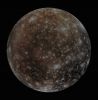
Callisto-PIA03456-PCF-LXTT-IPF.jpgApproaching Callisto (Absolute Natural Colors; credits for the additional process. and color.: Dr Paolo C. Fienga/Lunar Explorer Italia/Italian Planetary Foundation)73 visiteBright scars on a darker Surface testify to a long history of impacts on the Jovian moon Callisto, as it can be seen in this image obtained by the NASA - Galileo Spacecraft. The picture, taken in May 2001, is the only complete global Absolute Natural Color image of Callisto ever obtained by the NASA - Galileo Spacecraft, which orbited around Jupiter from December, 7, of the AD 1995 and until September 21, of the AD 2003, when the Spacecraft was destroyed during a controlled impact with Jupiter itself.
Of Jupiter's 4 (four) largest moons (also known as the "Galilean Moons"), Callisto orbits farthest from the Giant Gas Planet. Furthermore, Callisto's Surface is uniformly cratered but, as you can see for yourself, is not uniform in color or brightness at all. At present day, Planetary Scientists believe that the brighter areas are mainly Ice while the darker ones should be made of highly eroded (and Ice-poor) Rocky Materials.
This frame (which is an Original NASA - Galileo Spacecraft color frame published on the NASA - Planetary Photojournal with the ID n. PIA 03456) has been additionally processed and then re-colorized, according to an educated guess, by Dr Paolo C. Fienga (LXTT-IPF), in Absolute Natural Colors (such as the colors that a human eye would actually perceive if someone were onboard the NASA - Galileo Spacecraft and then looked outside, towards the Jovian moon Callisto), by using an original technique created - and, in time, dramatically improved - by the Lunar Explorer Italia Team. Different colors, as well as different shades of the same color, mean, among others, the existence of different Elements present on the Surface of Callisto, each having a different Albedo (---> Reflectivity) and Chemical Composition.MareKromium
(2 voti)
|
|
| 324 immagini su 27 pagina(e) |
|
|
|
|
|
22 | |
|
|
|
|
|
|





