| Piú votate - Jupiter: the "King" and His Moons |

Jupiter-Impact04-PIA12147.jpgImpact on Jupiter!57 visitenessun commentoMareKromium
(3 voti)
|
|

Jupiter-HST-2008-42-a-ful-003_jpg.jpgHiding... (natural colors; credits: NASA)58 visitenessun commentoMareKromium
(3 voti)
|
|

Jupiter-HST-2008-42-a-ful-002_jpg.jpgHiding... (natural colors; credits: NASA)56 visitenessun commentoMareKromium
(3 voti)
|
|
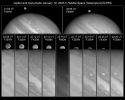
Jupiter-HST-2008-42-a-ful-004_jpg.jpgHiding: the whole sequence56 visiteThis series of images taken with NASA's Hubble Space Telescope shows Jupiter's largest moon, Ganymede, disappearing behind the Planet.
The top images show Ganymede next to Jupiter. The images were taken in blue and red light on Jan. 19, 2005 with Hubble's Advanced Camera for Surveys. The close-up images at bottom follow Ganymede as it ducks behind Jupiter a few minutes later.MareKromium
(3 voti)
|
|

Europa-PIA10131.jpgThe Inner Ocean of Europa55 visiteCaption NASA:"Scientists are all but certain that Europa has an ocean underneath its icy surface, but they do not know how thick this ice might be. This artist concept illustrates 2 possible cut-away views through Europa's ice shell. In both, heat escapes, possibly volcanically, from Europa's rocky mantle and is carried upward by buoyant oceanic currents. If the heat from below is intense and the ice shell is thin enough (left), the ice shell can directly melt, causing what are called "chaos" on Europa, regions of what appear to be broken, rotated and tilted ice blocks. On the other hand, if the ice shell is sufficiently thick (right), the less intense interior heat will be transferred to the warmer ice at the bottom of the shell, and additional heat is generated by tidal squeezing of the warmer ice. This warmer ice will slowly rise, flowing as glaciers do on Earth, and the slow but steady motion may also disrupt the extremely cold, brittle ice at the surface.
Europa is no larger than Earth's moon, and its internal heating stems from its eccentric orbit about Jupiter, seen in the distance. As tides raised by Jupiter in Europa's ocean rise and fall, they may cause cracking, additional heating and even venting of water vapor into the airless sky above Europa's icy surface".MareKromium
(3 voti)
|
|

Europa-PIA10149.jpgThe Inner Ocean of Europa54 visiteCaption NASA:"Like Earth, Europa is thought to have an iron core, a rocky mantle and a surface ocean of salty water. Unlike on Earth, however, this ocean is deep enough to cover the whole moon, and being far from the Sun, the ocean surface is globally frozen over.
Europa's orbit is eccentric, which means as it travels around Jupiter, large tides, raised by Jupiter, rise and fall. Jupiter's position relative to Europa is also seen to librate, or wobble, with the same period. This tidal kneading causes frictional heating within Europa, much in the same way a paper clip bent back and forth can get hot to the touch, as illustrated by the red glow in the interior of Europa's rocky mantle and in the lower, warmer part of its ice shell. This tidal heating is what keeps Europa's ocean liquid and could prove critical to the survival of simple organisms within the ocean, if they exist".MareKromium
(3 voti)
|
|

Jupiter_Io-PIA10102.jpgLike Father and Son... (approx. true colors; credits: NASA)80 visiteCaption NASA:"This is a montage of New Horizons images of Jupiter and its volcanic moon Io, taken during the Spacecraft's Jupiter flyby in early 2007. The Jupiter image is an infrared color composite taken by the spacecraft's near-infrared imaging spectrometer, the Linear Etalon Imaging Spectral Array (LEISA) at 1:40 UT on Feb. 28, 2007. The infrared wavelengths used (red: 1.59 µm, green: 1.94 µm, blue: 1.85 µm) highlight variations in the altitude of the Jovian cloud tops, with blue denoting high-altitude clouds and hazes, and red indicating deeper clouds. The prominent bluish-white oval is the Great Red Spot. The observation was made at a solar phase angle of 75° but has been projected onto a crescent to remove distortion caused by Jupiter's rotation during the scan.
The Io image, taken at 00:25 UT on March 1st 2007, is an approx. true-color composite taken by the panchromatic Long-Range Reconnaissance Imager (LORRI), with color information provided by the 0.5 µm ("blue") and 0.9 µm ("methane") channelsof the Multispectral Visible Imaging Camera (MVIC). The image shows a major eruption in progress on Io's night side, at the northern volcano Tvashtar. Incandescent lava glows red beneath a 330-kilometer high volcanic plume, whose uppermost portions are illuminated by sunlight. The plume appears blue due to scattering of light by small particles in the plume ".MareKromium
(3 voti)
|
|

Jupiter-PIA10096.jpgPolar Lightning on Jupiter57 visiteCaption NASA:"Images taken by the New Horizons Long-Range Reconnaissance Imager (LORRI) of Jupiter's night side showed lightning strikes.
Each "strike" is probably the cumulative brightness of multiple strikes. This is the first lightning seen at High Latitudes on Jupiter; it demonstrates that convection is not confined to lower latitudes, implying an internal driving heat source.
Their power is consistent with previous lightning measurements at Jupiter's Lower Latitudes, equivalent to extremely bright terrestrial "super bolts".MareKromium
(3 voti)
|
|

Io-lor_0035102969_0x630_sci_1.jpgMoments of Tvashtar (1)78 visitenessun commentoMareKromium
(3 voti)
|
|

Io-lor_0035116949_0x630_sci_1.jpgMoments of Tvashtar (2)94 visitenessun commentoMareKromium
(3 voti)
|
|

Io-lor_0035222842_0x630_sci_2.jpgMoments of Tvashtar (3)71 visitenessun commentoMareKromium
(3 voti)
|
|

Io-050107_03.jpgTvashtar's Rainbow...56 visiteVariations in the appearance of the giant plume from the Tvashtar volcano on Jupiter's moon Io are seen in this composite of the best photos taken by the New Horizons Long Range Reconnaissance Imager (LORRI) during its Jupiter flyby in late February-early March 2007.
New Horizons was fortunate to witness this unusually large plume during its brief Jupiter flyby; the Galileo Jupiter orbiter spent more than five years imaging the volcanic moon (between 1996 and 2001) without ever capturing such detailed pictures of a large Io plume. The plume is roughly 330 Km (about 200 miles) high. The cause of the fine wispy structure in the plume, which varies strikingly from image to image, is unknown, but these pictures may help scientists to understand the phenomenon.
The pictures were taken at distances ranging from 3,1 to 2,3 MKM (such as from 1,9 to 1,4 MMs), but they have been scaled to show the plume at the same relative size in every frame. Illumination conditions also vary: in the final image, Io's shadow cuts across the plume and hides all but its topmost regions, and the glow of hot lava can be seen on the nightside at the source of the plume.
The times of the images, from top to bottom, are: February 26, 18:38 (Universal Time); February 26, 21:01; February 28, 03:50; February 28, 04:40; February 28, 11:04 and March 1, 00:35.MareKromium
(3 voti)
|
|
| 324 immagini su 27 pagina(e) |
 |
|
|
|
|
21 | |
|
|
|
|





