| Piú votate - Jupiter: the "King" and His Moons |

Jupiter-WO-PIA01513_modest.jpgWhite Ovals on Jupiter53 visiteCaption NASA originale:"This photo of Jupiter was taken by Voyager 1 on March 1st, 1979, from a distance of 4.300.000 Km. The region shown is just to the southeast of the Great Red Spot. A small section of the spot can be seen at upper left. One of the 40-year-old white ovals in Jupiter's atmosphere can also be seen at middle left, as well as a wealth of other atmospheric features, including the flow lines in and around the ovals.
The smallest details that can be seen in this photo are about 80 Km across".
(12 voti)
|
|
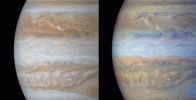
Jupiter-CH-PIA02877_modest.jpgReal Colors and False Colors of Jupiter54 visiteCaption NASA originale:"These color composite frames of the mid-section of Jupiter were of narrow angle images acquired on December 31, 2000, a day after Cassini's closest approach to the planet. The smallest features in these frames are roughly ~ 60 kilometers. The left is natural color, composited to yield the color that Jupiter would have if seen by the naked eye. The right frame is composed of 3 images: two were taken through narrow band filters centered on regions of the spectrum where the gaseous methane in Jupiter's atmosphere absorbs light, and the third was taken in a red continuum region of the spectrum, where Jupiter has no absorptions".
(12 voti)
|
|

Io-Sodium cloud-3-PIA00593.jpgA sodium cloud from Io (2)55 visiteE' una tecnica davvero molto antica, a quanto ne sappiamo, risalente addirittura ai tempi delle Sonde Sovietiche "Lunik" (nei loro viaggi del 2 gennaio 1959 e del 12 dicembre dello stesso anno). Queste due Sonde, infatti, furono programmate per emettere, dopo aver percorso all'incirca 100.000 Km, una "nube di vapori di Sodio" così densa da far si che gli Scienziati potessero, individuandola nel cielo, stabilire anche visivamente (oltre che grazie ai segnali radio) se la traiettoria effettivamente percorsa coincideva con quella stimata e progettata a tavolino.
(12 voti)
|
|

Io-Southern Polar Region-PIA00327.jpgThe Southern Polar Region of Io54 visitenessun commento
(12 voti)
|
|

Io-The eruption of Pele-PIA00323.jpgThe eruption of "Pele" on Io55 visitenessun commento
(12 voti)
|
|

Io-Southern Limb and light-PIA02250.jpgThe Southern Limb of Io and a possible "Transient Phoenomenon"65 visiteUn'immagine interessantissima del bordo dell'emisfero sud di Io. Elevatissimo dettaglio e grande suggestione del paesaggio. Io è un mondo violento ed in costante tumulto: il numero di vulcani attivi su questo Pianeta è elevatissimo (gli ultimi dati in nostro possesso parlavano di 6 vulcani attivi contemporaneamente), dunque non ci meravigliamo se vediamo delle flares, come quella alla Dx di questo frame, splendere nel buio. Potrebbe trattarsi di un outgassing: un classico fenomeno transitorio.
Original caption:"NASA's Galileo spacecraft captured this dramatic image of mountains on Io in February 2000. The image was taken when the Sun was low in the sky, illuminating the scene from the left, so it reveals topographic details of Io's surface. A low scarp, roughly 250 meters (820 feet) high, runs from the upper left toward the center of the image. Mongibello Mons, the jagged ridge at the left of the image, rises 7 kilometers (23,000 feet) above the plains of Io, higher than any mountain in North America. Few of Io's mountains (see also PIA02526) resemble volcanoes. Instead, Galileo scientists believe that the mountains are formed when blocks of Io's crust are uplifted along thrust faults. Angular mountains are thought to be younger, while older mountains have more subdued topography, such as the rise near the top center of this image.
The image has a resolution of 335 meters (1,100 feet) per picture element. North is to the top of the image.
(12 voti)
|
|

Io-Ionian Mountains and calderas-PIA02526.jpgIonian Mountains and Calderas on Io (real colors)73 visitenessun commento
(12 voti)
|
|

Jupitercrescent_cassini_big.jpgJupiter from Cassini65 visiteLa "falce" di un Giove crescente, ripresa dalla Sonda Cassini mentre si avvicinava e si apprestava ad effettuare il "fly-by" del Gigante Gassoso.
Una splendida immagine che ci ricorda alcune sequenze del capolavoro di Stanley Kubrick, "2001 - A Space Odyssey" in cui Giove appariva agli occhi di Dave Bowman proprio come lo vediamo in questo frame.
(12 voti)
|
|
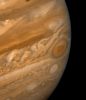
Jupiter-V2-LAFT-PIA01370_modest.jpgLate afternoon on Jupiter...55 visiteCaption NASA originale:"This color composite made from Voyager 2 narrow-angle camera frames shows the Great Red Spot during the late Jovian afternoon. North of the Red Spot lies a curious darker section of the South Equatorial Belt (SEB), the belt in which the Red Spot is located. A bright eruption of material passing from the SEB northward into the diffuse equatorial clouds has been observed on all occasions when this feature passes north of the Red Spot. The remnants of one such eruption are apparent in this photograph".
(11 voti)
|
|

Jupiter_s limb-Gal-PIA00896_modest.jpgJupiter's limb, from Galileo68 visiteCaption NASA originale:"North is at the top. The images are projected on a sphere, with features being foreshortened towards the north. The planetary limb runs along the right edge of the mosaic. Cloud patterns appear foreshortened as they approach the limb. The smallest resolved features are tens of kilometers in size. These images were taken on April 3, 1997, at a range of 1.4 MKM by the Solid State Imaging system (CCD) on NASA's Galileo spacecraft".
(11 voti)
|
|

Jupiter-V1-PIA01324_modest.jpgCrescent Jupiter (from Voyager 1)54 visiteCaption NASA originale:"This crescent view of Jupiter was taken by Voyager 1 on March 24, 1979. This image was taken through three color filters and recombined to produce the color image. This photo was assembled from three black and white negatives by the Image Processing Lab at Jet Propulsion Laboratory".
(11 voti)
|
|

Jupiter-HW-PIA00360_modest.jpgHigh Winds on Jupiter (from appx. 4.000.000 Km)55 visiteCaption NASA originale:"A high resolution image of the Jovian mid-latitudes taken by Voyager 1 on March 2, 1979, shows distinctly differing characteristics of the planet's meteorology. The well defined pale orange line running from southwest to northeast (North is at the top) marks the high speed north temperate current with wind speeds of about 120 meters p/s. These high winds produce a cleaner flow pattern in the surrounding clouds whose average lifetime is of about 2 years".
(11 voti)
|
|
| 324 immagini su 27 pagina(e) |
2 |  |
|
|
|
|
|
|
|
|
|





