| Piú votate - Jupiter: the "King" and His Moons |

Europa-PIA00723.jpgBeautiful Europa...54 visiteThis global view of Europa shows the location of a four-frame mosaic of images taken by NASA's Galileo spacecraft, set into low-resolution data obtained by the Voyager spacecraft in 1979. Putting new data into its surrounding context is a technique that allows scientists to better understand features observed on planetary surfaces. The Galileo spacecraft obtained these images during its first orbit of Jupiter at a distance of about 156.000 km (such approx. 96.300 miles) on June 27, 1996. The finest details that can discerned in this picture are about 1,6 Km (1 mile) across. North is to the top.
(4 voti)
|
|

Ganymede-PIA02580.jpgCalderas on Ganymede?64 visiteThe shallow, scalloped depression in the center of this picture from NASA's Galileo spacecraft is a caldera-like feature 5 to 20 Km (3 to 12 miles) wide on Jupiter's largest moon, Ganymede.
Calderas are surface depressions formed by collapse above a subsurface concentration of molten material. Some shallow depressions in bright, smooth areas of Ganymede have some overall similarities to calderas on Earth and on Jupiter's moon Io. On Ganymede, caldera-like depressions may serve as sources of bright, volcanic flows of liquid water and slush - an idea supported by a Ganymede photo obtained by Galileo during its seventh orbit (PIA01614). In the more recent image here, from Galileo's 28th orbit, a tall scarp marks the western boundary of a caldera-like feature. The western scarp is aligned similarly to older tectonic grooves visible in the image, suggesting the feature has collapsed along older lines of weakness. The interior is mottled in appearance, yet smooth compared to most of Ganymede's bright terrain seen at high resolution. The eastern boundary of the caldera-like feature is cut by younger, grooved terrain. Small impact craters pepper the scene, but the lack of a raised rim argues against an impact origin for the caldera-like feature itself. Instead, water-rich icy lava may have once flowed out of it toward the east. If so, later tectonism could have erased any telltale evidence of volcanic flow fronts. Direct evidence for icy volcanism on Ganymede continues to be elusive.
North is to the top of the picture and the Sun illuminates the surface from the left. The image, centered at -24 degrees latitude and 318degrees longitude, covers an area approximately 162 by 119 kilometers(101 by 74 miles). The resolution is 43 meters (141 feet) per picture element.
(4 voti)
|
|

Io-Tohill Volcanoes-dtlmgnf-PIA03527_modest.jpgTohill Mons: Volcanoes and Craters55 visitenessun commento
(4 voti)
|
|

Callisto-V1-PIA00362_modest.jpgCallisto from 1.200.000 Km (Voyager 1)57 visiteCaption NASA originale:"This color photo of Jupiter's satellite Callisto was made from three black-and-white images taken March 5 from a distance of 746.000 miles (1,2 MKMs).
It shows the entire hemisphere of Callisto that was photographed at HR by Voyager 1 during the close encounter with the satellite. Visible near the upper left limb is the large basin-like structure discovered by Voyager 1. The central region of the basin is much brighter than the average surface of the satellite. Near the south polar region are two bright areas associated with smaller basin-like structures. These bright areas are believed to contain more clean ice than the rest of Callisto's generally 'dirty-ice' surface".
(4 voti)
|
|
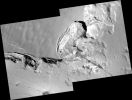
Io-Telegonus Mensa-PIA03528_modest.jpgIo: Telegonus Mensa55 visitenessun commento
(4 voti)
|
|

JUPITER LIGHTNINGS.jpgJupiter's lightninghs87 visitenessun commento
(4 voti)
|
|

Jupiter.jpgA "Hole" in the King!110 visiteNaturalmente non è un "buco": solo l'ambra di Ganymede, che oscura una piccola Regione del Gigante Gassoso. Un raffronto fra questa immagine e quella che propone l'ombra di Io (PIA23437) potrebbe risultare interessante...MareKromium
(3 voti)
|
|

Jupiter-PIA22936.jpgThe "Giant" from Earth152 visiteThis Earth-based observation of Jupiter and the South Tropical Disturbance approaching the Great Red Spot was captured on January, 26, 2018 by the Amateur Astronomer Christopher Go, who also processed the image.MareKromium
(3 voti)
|
|

Jupiter-PIA22948.jpgJupiter Abyss...185 visiteCaption NASA Originale:"NASA's Juno spacecraft captured this view of an area within a Jovian jet stream showing a vortex that has an intensely dark center. Nearby, other features display bright, high altitude clouds that have puffed up into the sunlight.
The color-enhanced image was taken at 12:55 a.m. PDT (3:55 a.m. EDT) on May 29, 2019, as the spacecraft performed its 20th science fly-by of Jupiter. At the time, Juno was about 9.200 miles (approx. 14.805,96 Km) from the Planet's cloud tops, above approximately 52° North Latitude.
Citizen scientists Gerald Eichstädt and Seán Doran created and named this image using data from the spacecraft's JunoCam imager".MareKromium
(3 voti)
|
|

Jupiter-White_Storm-PIA23445.jpgWhite Storm on Jupiter147 visiteCaption NASA Originale:"This view of Jupiter's Upper Atmosphere from NASA's Juno Spacecraft includes something remarkable: two storms caught in the act of merging.
The two white ovals seen within the orange-colored band left of center are Anticyclonic Storms — that is, storms that rotate counter-clockwise. The larger of the two ovals has been tracked for many years, as it grew in size through mergers with other Anticyclonic white ovals.
JunoCam was fortunate to capture this new merger, which typically takes place over the course of only a few days.
The event interests scientists because the ovals had approached each other months earlier, only to move apart again.
This merger may be the result of perturbations due to the proximity of Oval BA, which is the larger storm just to the North of the two merging, white ovals. Oval BA is the second largest Anticyclonic Vortex in Jupiter's Atmosphere (second only to the famous Great Red Spot). During this pass over Jupiter, Juno gave scientists their best views of Oval BA to date.
Citizen scientist Tanya Oleksuik created this color-enhanced image using data from the JunoCam camera. The original image was taken on December, 26, 2019, at 10:28 a.m. PST (1:28 p.m. EST) as the Juno Spacecraft performed its 24th close fly-by of the Planet. At the time, the Spacecraft was about 44.900 miles (such as approx. 72.259,54 Km) from the tops of Jupiter's clouds, at a latitude of about 60° South".MareKromium
(3 voti)
|
|

Jupiter-PIA21974.jpgWhat a View!176 visitenessun commentoMareKromium
(3 voti)
|
|

Jupiter-PIA23442.jpgOn the Limb...152 visiteCaption NASA Originale:"NASA's Juno spacecraft captured this impressive image revealing a band of swirling clouds in Jupiter's Northern Latitudes during Juno's close fly-by occurred on November, 3, 2019. Small pop-up storms can also be seen rising above the lighter areas of the clouds, most noticeably on the right side of the image.
This view provides scientists with high-resolution details — the spacecraft skimmed approximately 3.200 miles (such as about 5.149,9 Km) above Jupiter's cloud tops at the time it was taken.
Citizen scientist Björn Jónsson created this enhanced color image using data from the JunoCam camera. The picture, as we wrote above, was taken on November, 3, 2019 at 2:13 p.m. PST (5:13 p.m. EST) at a Latitude of about 38° North".MareKromium
(3 voti)
|
|
| 324 immagini su 27 pagina(e) |
 |
|
|
|
|
19 | |
|
|
|
|





