| Piú votate - Jupiter: the "King" and His Moons |

Jupiter-HST~0.jpgThree "Red Spots" Mix it Up on Jupiter57 visiteThis sequence of Hubble Space Telescope images offers an unprecedented view of a planetary game of Pac-Man among 3 "Red Spots" clustered together in Jupiter's Atmosphere. The time series shows the passage of the "Red Spot Jr." in a band of clouds below (South) of the Great Red Spot (GRS). "Red Spot Jr." first appeared on Jupiter in early 2006 when a previously white storm turned red. This is the second time, since turning red, it has skirted past its big brother apparently unscathed. But this is not the fate of "Baby Red Spot", which is in the same latitudinal band as the GRS. This new red spot first appeared earlier this year. The Baby Red Spot gets ever closer to the GRS in this picture sequence until it is caught up in the anticyclonic spin of the GRS. In the final image the Baby Spot is deformed and pale in color and has been spun to the right (East) of the GRS.
These three natural-color Jupiter images were made from data acquired on May 15, June 28, and July 8, 2008, by the Wide Field Planetary Camera 2 (WFPC2).MareKromium
(4 voti)
|
|

JupiterSpots-HST.jpgThe "Eyes" of Jupiter87 visiteFor about 300 years Jupiter's "Banded" Atmosphere has shown a remarkable feature to telescopic viewers, a large swirling storm system known as "The Great Red Spot". In 2006, another red storm system appeared, actually seen to form as smaller whitish oval-shaped storms merged and then developed the curious reddish hue. Now, Jupiter has a third red spot, again produced from a smaller whitish storm. All three are seen in this image made from data recorded on May 9 and 10 with the Hubble Space Telescope's Wide Field and Planetary Camera 2. The spots extend above the surrounding clouds and their red color may be due to deeper material dredged up by the storms and exposed to ultraviolet light, but the exact chemical process is still unknown. For scale, the Great Red Spot has almost twice the diameter of planet Earth, making both new spots less than one Earth-diameter across. The newest red spot is on the far left (West), along the same band of clouds as the Great Red Spot and is drifting toward it. If the motion continues, the new spot will encounter the much larger storm system in August. Jupiter's recent outbreak of red spots is likely related to large scale climate change as the gas Giant Planet is getting warmer near the Equator.MareKromium
(4 voti)
|
|

Jupiter-00.jpgInternal Heat Drives Jupiter's Giant Storm Eruption (VL)55 visiteAn image of Jupiter in Visible-Light (VL) from NASA's Hubble Space Telescope (HST) on May 11, 2007 showing the turbulent pattern generated by the two plumes at the upper left part of Jupiter.
MareKromium
(4 voti)
|
|
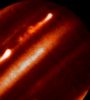
Jupiter-01.jpgInternal Heat Drives Jupiter's Giant Storm Eruption (IR)56 visiteAn image of Jupiter in infrared-light from NASA's Infrared Telescope Facility (IRTF) on April 5, 2007.
MareKromium
(4 voti)
|
|
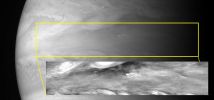
Jupiter-PIA10097.jpgAtmospheric Waves58 visiteWith its Multispectral Visible Imaging Camera (MVIC), half of the Ralph instrument, New Horizons captured several pictures of mesoscale gravity waves in Jupiter's Equatorial Atmosphere. Buoyancy waves of this type are seen frequently on Earth - for example, they can be caused when air flows over a mountain and a regular cloud pattern forms downstream. In Jupiter's case there are no mountains, but if conditions in the atmosphere are just right, it is possible to form long trains of these small waves.
The source of the wave excitation seems to lie deep in Jupiter's atmosphere, below the visible cloud layers at depths corresponding to pressures 10 times that at Earth's surface. The New Horizons measurements showed that the waves move about 100 mt-per-second faster than surrounding clouds; this is about 25% of the speed of sound on Earth and is much greater than current models of these waves predict.
Scientists can "read" the speed and patterns these waves to learn more about activity and stability in the atmospheric layers below".MareKromium
(4 voti)
|
|

Io_Europa-lor_0035136944_0x630_sci_1.jpgEuropa and Io in conjunction (2)91 visitenessun commentoMareKromium
(4 voti)
|
|

Elara-lor_0035239919_0x630_sci_1-01.jpgElara, from New Horizons59 visiteData & Statistics for Elara:
Discovered by: C. Perrine
Date of discovery: 1905
Mass (in Kg): 7,77e+17
Mass (if Earth = 1): 1,3002e-07
Equatorial radius (in Km): 38
Equatorial radius (if Earth = 1): 5,9580e-03
Mean density (grm/cm^3): 3,3
Mean distance from Jupiter (in Km): 11.737.000
Rotational period (in days): 0,5
Orbital period (in days): 259,6528
Mean orbital velocity (Km/sec): 3,29
Orbital eccentricity: 0,2072
Orbital inclination: 24,77°
Escape velocity (Km/sec): 0,0522
Visual geometric albedo: 0,03
Magnitude (Vo): 16,77MareKromium
(4 voti)
|
|

Io_Europa-lor_0035136929_0x630_sci_1.jpgEuropa and Io in conjunction (1)89 visitenessun commentoMareKromium
(4 voti)
|
|

Jupiter-033007.jpgStorm Spectra56 visiteThese images, taken with the LEISA infrared camera on the New Horizons Ralph instrument, show fine details in Jupiter's turbulent atmosphere using light that can only be seen using infrared sensors. These are "false color" pictures made by assigning infrared wavelengths to the colors red, green and blue. LEISA (Linear Etalon Imaging Spectral Array) takes images across 250 IR wavelengths in the range from 1.25 to 2.5 microns, allowing scientists to obtain an infrared spectrum at every location on Jupiter. A micron is one millionth of a meter.
These pictures were taken at 05:58 UT on February 27, 2007, from a distance of 2.9 million kilometers (1.6 million miles). They are centered at 8 degrees south, 32 degrees east in Jupiter "System III" coordinates. The large oval-shaped feature is the well-known Great Red Spot. The resolution of each pixel in these images is about 175 kilometers (110 miles); Jupiter's diameter is approximately 145,000 kilometers (97,000 miles).
The image on the left is an altitude map made by assigning the color red to 1.60 microns, green to 1.89 microns and blue to 2.04 microns. Because Jupiter's atmosphere absorbs light strongly at 2.04 microns, only clouds at very high altitude will reflect light at this wavelength. Light at 1.89 microns can go deeper in the atmosphere and light at 1.6 microns can go deeper still. In this map, bluish colors indicate high clouds and reddish colors indicate lower clouds. This picture shows, for example, that the Great Red Spot extends far up into the atmosphere.
In the image at right, red equals 1.28 microns, green equals 1.30 microns and blue equals 1.36 microns, a range of wavelengths that similarly probes different altitudes in the atmosphere. This choice of wavelengths highlights Jupiter's high-altitude south polar hood of haze. The edge of Jupiter's disk at the bottom of the panel appears slightly non-circular because the left-hand portion is the true edge of the disk, while the right portion is defined by the day/night boundary (known as the terminator).
These two images illustrate only a small fraction of the information contained in a single LEISA scan, highlighting just one aspect of the power of infrared spectra for atmospheric studies.
(4 voti)
|
|

Jupiter-20070323.gifWatch Jupiter and some of His Moons rotate! (GIF-Movie)57 visiteCaption NASA:"South is toward the top in this frame from a stunning movie featuring Jupiter and moons recorded last Thursday from the Central Coast of New South Wales, Australia. In fact, three Jovian Moons and two red spots are ultimately seen in the full video as they glide around the Solar System's ruling gas giant. In the early frame above, Ganymede, the largest moon in the Solar System, is off the lower right limb of the Planet, while intriguing Europa is visible against Jupiter's cloud tops, also near the lower right. Jupiter's new Red Spot junior is just above the broad white band in the Planet's Southern (upper) Hemisphere. In later frames, as Planet and moons rotate (right to left), red spot junior moves behind Jupiter's left edge while the Great Red Spot itself comes into view from the right. Also finally erupting into view at the right, is Jupiter's volcanic moon, Io (...)".
Note: click on the frame to see the movie
(4 voti)
|
|

Io-lor_0034685519_0x630_sci_1.jpgIo: the "Sulphur World" from New Horizons96 visitenessun commentoMareKromium
(4 voti)
|
|

Io-022707_Erupt_on_Io.jpgRestless Tvashtar56 visiteThe first images returned to Earth by New Horizons during its close encounter with Jupiter feature the Galilean moon Io, snapped with the Long Range Reconnaissance Imager (LORRI) at 0840 UTC on February 26, while the moon was 2,5 MMs (about 4 MKM) from the spacecraft.
Io is intensely heated by its tidal interaction with Jupiter and is thus extremely volcanically active. That activity is evident in these images, which reveal an enormous dust plume, more than 150 miles high, erupting from the volcano Tvashtar. The plume appears as an umbrella-shaped feature of the edge of Io's disk in the 11 o'clock position in the right image, which is a long-exposure (20-millisecond) frame designed specifically to look for plumes like this. The bright spots at 2 o'clock are high mountains catching the setting sun; beyond them the night side of Io can be seen, faintly illuminated by light reflected from Jupiter itself.
The left image is a shorter exposure — 3 milliseconds — designed to look at surface features. In this frame, the Tvashtar volcano shows as a dark spot, also at 11 o'clock, surrounded by a large dark ring, where an area larger than Texas has been covered by fallout from the giant eruption.
This is the clearest view yet of a plume from Tvashtar, one of Io's most active volcanoes. Ground-based telescopes and the Galileo Jupiter orbiter first spotted volcanic heat radiation from Tvashtar in November 1999, and the Cassini spacecraft saw a large plume when it flew past Jupiter in December 2000. The Keck telescope in Hawaii picked up renewed heat radiation from Tvashtar in spring 2006, and just two weeks ago the Hubble Space Telescope saw the Tvashtar plume in ultraviolet images designed to support the New Horizons flyby.
The New Horizons images of the plume — which show features as small as 20 Km (12 miles), are 12 times sharper than the HST images and about three times sharper than the Cassini images. "This is the best image of a large volcanic plume on Io since the Voyager flybys in 1979" says John Spencer, deputy leader of the New Horizons Jupiter Encounter Science Team from Southwest Research Institute.
"If the Tvashtar plume remains active, the images we take later in the encounter should be even better".
(4 voti)
|
|
| 324 immagini su 27 pagina(e) |
 |
|
|
|
|
17 | |
|
|
|
|





