| |

| Piú votate - Jupiter: the "King" and His Moons |

Jupiter-PIA23437.jpgIo's Shadow166 visiteCaption NASA Originale:"Jupiter's volcanically active moon Io casts its shadow on the planet in this dramatic image from NASA's Juno Spacecraft. As with solar eclipses on the Earth, within the dark circle racing across Jupiter's cloud tops one would witness a full solar eclipse as Io passes in front of the Sun.
Such events occur frequently on Jupiter because it is a large planet with many moons. In addition, unlike most other planets in our solar system, Jupiter's axis is not highly tilted relative to its orbit, so the Sun never strays far from Jupiter's equatorial plane (+/- 3°). This means Jupiter's moons regularly cast their shadows on the planet throughout its year.
Juno's close proximity to Jupiter provides an exceptional fish-eye view, showing a small fraction near the planet's Equator. The shadow is about 2.200 miles (such as approx. 3.540,55 Km) wide, approximately the same width as Io, but appears much larger relative to Jupiter.
A little larger than Earth's Moon, Io is perhaps most famous for its many active volcanoes, often caught lofting fountains of ejecta well above its thin (?) Atmosphere.
Citizen scientist Kevin M. Gill created this enhanced-color image using data from the spacecraft's JunoCam imager. The raw image was taken on Sept. 11, 2019 at 8:41 p.m. PDT (11:41 p.m. EDT) as the Juno spacecraft performed its 22nd close fly-by of Jupiter. At the time the image was taken, the spacecraft was about 4.885 miles (approx. 7.861,64 Km) from the cloud tops at a Latitude of 21° North".
Nota: e per chi ha visto il famoso "2010 Odissea Due: l'Anno del Contatto", questa immagine dovrà "ricordare" qualcosa...MareKromium
(4 voti)
|
|
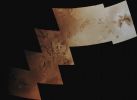
Io-Zamama_Patera-PIA03531-PCF-LXTT-IPF.jpgZamama (Absolute Natural Colors; credits for the additional process. and color.: Dr Paolo C. Fienga/Lunar Explorer Italia/Italian Planetary Foundation)106 visiteThe source area of what had been a towering Volcanic Plume in the middle of August of the AD 2001, lies in the far-right frame of this Image-Mosaic (of pictures taken by the NASA - Galileo Spacecraft on October, 16th, 2001) which shows us a portion of the Northern Latitudes of the Jovian "Volcanic" moon, Io. The Region showed in this Image-Mosaic includes the Zamama Lava Flow-Field, which emanates from the Northernmost of 2 (two) small Volcanoes visible in the far left frame. These Lava Flows were not present in any of the NASA - Voyager 1 Probe's images of Io, so it is logic to assume that they must have formed sometime between the NASA - Voyager 1 Fly-By (that occurred in the AD 1979) and the early observations of Io made by the NASA - Galileo Spacecraft and which took place in the AD 1996 (in addition to that, it has to be said that the NASA - Galileo Spacecraft also observed the Zamama Lava Flow-Field during the Io encounters that occurred in the AD 1999: a time when some NASA scientists identified narrow, long, dark Lava Flows which they thought to be relatively similar to other Lava Flows found on Planet Earth and, to be precise, in the Hawaii Islands).
Moving North/East, the second and third frames of this mosaic show a number of Lava Flow-Fields and several Unnamed Volcanic Depressions, known as "Paterae". It is still unclear whether the broad, shield-like features (or "Plateaux") on which the Paterae rest were created by Eruptions from the Paterae themselves, or if they were just preexisting Volcanic Features. Furthermore, some Fractures and Dark Lines suggest that the Crust of Io, in a few places of this Region, is breaking up, thus creating Cracks that Magma can use to rise up to the Surface. Finally, the far-right frame of this mosaic shows dark Lava Flows and bright "Spots". The bright "Spots" are probably Sulphur-bearing Plume Deposits, which are thought to be associated with the source of a Plume Eruption approx. 500 Km (such as about 310 miles) high, that was observed by the Galileo Spacecraft in August, 2001 (a Plume Eruption that actually was the largest one ever observed on Io).
This Image-Mosaic (which is an NASA - Original Galileo Spacecraft b/w Image-Mosaic published on May, 28th, 2002, on the NASA - Planetary Photojournal and identified by the serial n. PIA 03531) has been additionally processed and then colorized in Absolute Natural Colors (such as the colors that a human eye would actually perceive if someone were onboard the NASA - Galileo Spacecraft and then looked ahead, towards the Jovian moon Io), by using an original technique created - and, in time, dramatically improved - by the Lunar Explorer Italia Team.MareKromium
(4 voti)
|
|

Io-Loki_Patera-PIA00320-PCF-LXTT-IPF.jpgVolcanic Plains and Paterae on Io: Loki Patera (Absolute Natural Colors; credits for the additional process. and color.: Dr Paolo C. Fienga/Lunar Explorer Italia/Italian Planetary Foundation)97 visiteA huge area of Io's Volcanic Plains is well shown in this mosaic of pictures taken by the NASA - Voyager 1 Space Probe. Numerous Volcanic Calderas and Lava Flows are visible here, including the Loki Patera (an active Lava Lake), which is the large shield-shaped and dark red Surface Feature visible in the lower right portion of the mosaic. As a matter of fact, the (sometime) intense light emitted from the Lava that boils inside Loki Patera can even be seen through telescopes, all the way from Earth, and these observations tell us that Loki has been active continuously (or at least every time an astronomer took a good look at it...) since the Voyager 1 Fly-By, which occurred in the month of March of the AD 1979.
The composition of Io's Volcanic Plains and Lava Flows has not been completely determined yet but, in the light of the information that we already possess (and, in particular, once we duly consider the orange-yellow color that can be seen over most of the Surface of Io), it is reasonable to say that they could dominantly consist of Sulphur, with Surface Frosts made of Sulphur Dioxide, Silicates (such as Basalts) encrusted with Sulphur and Sulphur Dioxide Condensates. The bright whitish patches, on the other hand, could probably consist of freshly deposited Sulphur Dioxide Frost. The dark red (and, sometime, almost black) spots, including Loki, are hot Sulphur Lava Lakes, which may remain molten even for a long time, thanks to the intrusions of molten Silicate Magma that (probably in an almost continuous way) comes up from deep inside Io. However, the very ultimate source of heat that keeps Io active, must be the Tidal (Frictional) Heating, due to the perpetual flexure of Io that is caused by the powerful Gravitational Influence of both Jupiter and Europa.
This picture (which is an Original NASA - Voyager 1 Space Proble color image mosaic published on the NASA - Planetary Photojournal with the n. PIA 00320) has been additionally processed and then re-colorized in Absolute Natural Colors (such as the colors that a human eye would actually perceive if someone were onboard the NASA - Voyager 1 Space Probe and then looked outside, towards the limb of the Jovian moon Io), by using an original technique created - and, in time, dramatically improved - by the Lunar Explorer Italia Team. Different colors, as well as different shades of the same color, mean, among others, the existence of different Elements present on the Surface of Io, each having a different Albedo (---> Reflectivity) and Chemical Composition.MareKromium
(4 voti)
|
|
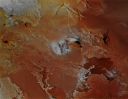
Io-Galai_Patera-PIA00324-PCF-LXTT-IPF.jpgVolcanic Plains and Paterae on Io: Galai Patera (Absolute Natural Colors; credits for the additional process. and color.: Dr Paolo C. Fienga/Lunar Explorer Italia/Italian Planetary Foundation)109 visiteIo's Volcanic Plains and at least 9 (nine) Paterae are shown, once again, in this really beautiful and highly suggestive NASA - Voyager 1 Space Probe image, which spans an area of about 1030 Km (such as approx. 640 miles) from left to right. North is at about the 01:30 o'clock position on the frame. A number of active Volcanic Calderae and huge Lava Flows are visible here: the most important (both for size and activity) is the dark red "teardrop-shaped" Surface Feature visible near the center of the frame, slightly to the right, which is Galai Patera, an approx. 100-Km-long (such as about 62 miles) Lava-flooded Caldera (---> Collapsed Vent). As we have already mentioned in yesterday's APOD, the exact composition of Io's Volcanic Plains and Lava Flows has not been determined yet; however, the prevalent yellow, brown, and orange materials may consist, dominantly, of Sulphur, with Surface Frosts made of Sulphur Dioxide and Silicates (such as Basalt), encrusted with Sulphur and Sulphur Dioxide Condensates. The dark red (and, sometime, almost black) spots visible all around the frame, of course including Galai Patera, are hot Sulphur Lava Lakes, which may remain molten for a long time, thanks to the intrusions of molten Silicate Magma that (probably in an almost continuous way) comes up from deep inside Io. Finally, the whitish patches visible at the upper left corner, in the center and on the lower left side of the picture are, most likely, Fresh Deposits of Sulphur Dioxide Frost.
This picture (which is an Original NASA - Voyager 1 Space Proble color image mosaic published on the NASA - Planetary Photojournal with the n. PIA 00324) has been additionally processed and then re-colorized in Absolute Natural Colors (such as the colors that a human eye would actually perceive if someone were onboard the NASA - Voyager 1 Space Probe and then looked outside, towards the limb of the Jovian moon Io), by using an original technique created - and, in time, dramatically improved - by the Lunar Explorer Italia Team. Different colors, as well as different shades of the same color, mean, among others, the existence of different Elements present on the Surface of Io, each having a different Albedo (---> Reflectivity) and Chemical Composition.MareKromium
(4 voti)
|
|

Ganymede-V1-PIA02278-PCF-LXTT-IPF.jpgFeatures of Ganymede (Absolute Natural Colors; credits for the additional process. and color.: Dr Paolo C. Fienga/Lunar Explorer Italia/Italian Planetary Foundation)84 visiteThis picture of Ganymede was taken by the NASA - Voyager 1 Spacecraft on the afternoon of March 5, 1979, from a range of about 253.000 Km (such as approx. 151.800 miles). The picture, that is centered at about 66° South Latitude and 3° East Longitude, shows a portion of the South Western Limb Region of Ganymede. The smallest visible Surface Features are about 2,5 Km (roughly 1,5 miles) across. The Surface of this moon shows numerous ancient Impact Craters, many of which - like we have recently seen on Planet Mercury , thanks to the NASA - Messenger Spacecraft and Orbiter - have extensive Bright Ray Systems. The light Bands that we can see crossing the whole Surface of Ganymede contain alternating bright and dark lines which, probably, represent deformation of the Icy Material that form them. Despite the NASA - Voyager 1 Spacecraft data, some evidence relevant to the existence of a tenuous Oxygen-based Atmosphere (---> a so-called "Exosphere") on Ganymede (an Exhosphere which, by the way, very similar to the one found on the other Jovian moon Europa), was discovered by the Hubble Space Telescope (HST) in the AD 1995. The HST actually observed an Airglow of Atomic Oxygen in the far-UltraViolet at the wavelengths of 130,4 and 135,6 nanometers. Such an Airglow is excited when Molecular Oxygen gets dissociated by way of Electron Impacts (and that phenomenon is a further evidence about the existence of a significant Neutral Atmosphere around Ganymede, which is predominantly composed of O2 molecules). The Oxygen, however, is not a direct evidence of the presence, on Ganymede, of some possible Earth-like Lifeforms; as a matter of fact, the Oxigen that we find in the Atmosphere of this huge moon, is thought to be produced the when Water Ice that is largely present on the Surface of Ganymede gets split into Hydrogen and Oxygen through the action of Radiation, with the Hydrogen being more rapidly lost in the circum-Ganymedian Space due to its low Atomic Mass. Furthermore, the Airglow observed over Ganymede is not spatially homogeneous like the one existing over Europa. The HST also observed two bright spots located in the Northern and Southern Hemispheres of Ganymede, near ± 50° of Latitude, which is exactly the Boundary Region between the Open and the Closed Field Lines of the Ganymedian Magnetosphere. These bright spots, according to our present day knowledge, could have probably been tWO Ganymedian Polar Auroras, caused by Plasma Precipitation along the Open Field Lines of its Magnetosphere. The NASA - Voyager 1 Spacecraft Original b/w frame has been additionally processed and then colorized, according to an informed speculation carried out by Dr Paolo C. Fienga (LXTT-IPF), in Absolute Natural Colors (such as the colors that a human eye would actually perceive if someone were onboard the NASA - Voyager 1 Spacecraft and then looked outside, towards the Jovian moon Ganymede), by using an original technique created - and, in time, dramatically improved - by the Lunar Explorer Italia Team. Different colors, as well as different shades of the same color, mean, among others, the existence of different Elements present on the Surface of Ganymede, each having a different Albedo (---> Reflectivity) and Chemical Composition.MareKromium
(4 voti)
|
|
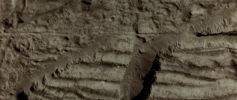
Europa-Icy_Cliffs-PIA01182-PCF-LXTT.jpgThe Icy Cliffs of Europa (Absolute Natural Colors; credits for the additional process. and color.: Dr Paolo C. Fienga - Lunexit Team)257 visitenessun commentoMareKromium
(4 voti)
|
|

Jupiter-Impact-2010-005.jpgAnother Impact on Jupiter?95 visiteUN ALTRO BOLIDE ("FIREBALL") su Giove?
il giorno 20 Agosto 2010, alle ore 18:22 UT, un Astrofilo Giapponese, Masayuki Tachikawa, della città di Kumamoto, ha video-registrato quello che SEMBRA ESSERE l'aftermath di un impatto occorso sul Pianeta Giove.
Se l'ipotesi dell'impatto venisse confermata, questa sarebbe la terza volta in soli 13 mesi che gli Astrofili del Mondo intero rilevano segni di impatti su Giove. Gli eventi precedenti si sono verificati il 19 luglio 2009 ed il 3 Giugno 2010.
La maggiore speculazione che infiamma le più recenti discussioni riguardanti questo fenomeno ritiene che Giove possa essere colpito da bolidi (ed asteroidi?) assai più spesso di quanto si fosse finora ritenuto.
E' (anche) per questo motivo che svariati Ricercatori insistono a chiedere la creazione di una rete mondiale di telescopi destinati a monitorare costantemente il Gigante Gassoso e quindi (laddove possobile) a misurare le velocità d'impatto.
"Come l'evento del 3 giugno u.s., questo bolide non ha prodotto alcun residuo visibile", osserva comunque il Dr John Rogers, Direttore della sezione Giove della British Astronomical Association.MareKromium
(4 voti)
|
|

Jupiter-PIA12869.jpgHow "Hot " is Jupiter?59 visiteCaption NASA:"New thermal images from powerful ground-based telescopes show swirls of warmer air and cooler regions never seen before within Jupiter's Great Red Spot. The images enable scientists to make the first detailed weather map of the inside of the giant storm system. One observation illustrated by this image is the correspondence between a warm core within an otherwise cold storm system and the reddest color of the Great Red Spot.
The image on the top was obtained by the European Southern Observatory's Very Large Telescope in Chile on May 18, 2008. It was taken in the InfraRed wavelength range of 10.8 microns, which is sensitive to Jupiter's Atmospheric Temperatures in the 300 to 600 millibar pressure range. That pressure range is close to the altitude of the white, red and brown aerosols seen in the visible-light image on the bottom, which was obtained by the Hubble Space Telescope on May 15, 2008.
These images show the interaction of three of Jupiter's largest storms -- the Great Red Spot and two smaller storms nicknamed Oval BA and Little Red Spot".MareKromium
(4 voti)
|
|
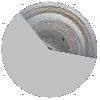
Jupiter-Impact006-ALPO.gifEvolution of the Impact on Jupiter (GIF-Movie)59 visiteDa "NASA - Picture of Day" del giorno 8 Settembre 2009:"Two months ago, something unexpected hit Jupiter.
First discovered by amateur astronomer Anthony Wesley on 2009 July 19, the impact was quickly confirmed and even imaged by the Hubble Space Telescope the very next day. Many of the world's telescopes then zoomed in on our Solar System's largest Planet to see the result.
Some of these images have been complied into the above animation. Over the course of the last month and a half, the above time-lapse sequence shows the Dark Spot - first created when Jupiter was struck - deforming and dissipating as Jupiter's clouds churned and Jupiter rotated.
It is now thought that a small comet -- perhaps less than one kilometer across -- impacted Jupiter on or before 2009 July 19. Although initially expected to be visible for only a week, astronomers continue to track atmospheric remnants of the impact for new information about winds and currents in Jupiter's thick Atmosphere".MareKromium
(4 voti)
|
|

Jupiter-Impact05-PIA12148.jpgImpact on Jupiter!58 visitenessun commentoMareKromium
(4 voti)
|
|

Jupiter-Impact02.jpgImpact on Jupiter!61 visitenessun commentoMareKromium
(4 voti)
|
|
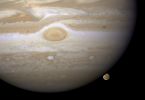
Jupiter-HST-2008-42-a-ful-001_jpg.jpgHiding... (natural colors; credits: NASA)58 visiteNASA's Hubble Space Telescope has caught Jupiter's moon Ganymede playing a game of "peek-a-boo", In this crisp Hubble image, Ganymede is shown just before it ducks behind the giant planet.
Ganymede completes an orbit around Jupiter every 7 days. Because Ganymede's orbit is tilted nearly edge-on to Earth, it routinely can be seen passing in front of and disappearing behind its giant host, only to reemerge later.
Composed of rock and ice, Ganymede is the largest moon in our Solar System. It is even larger than the planet Mercury.
But Ganymede looks like a dirty snowball next to Jupiter, the largest planet in our solar system. Jupiter is so big that only part of its Southern Hemisphere can be seen in this image.
Hubble's view is so sharp that astronomers can see features on Ganymede's surface, most notably the white impact crater, Tros, and its system of rays, bright streaks of material blasted from the crater. Tros and its ray system are roughly the width of Arizona.
The image also shows Jupiter's Great Red Spot, the large eye-shaped feature at upper left. A storm the size of two Earths, the Great Red Spot has been raging for more than 300 years. Hubble's sharp view of the gas giant planet also reveals the texture of the clouds in the Jovian Atmosphere as well as various other storms and vortices.
Astronomers use these images to study Jupiter's Upper Atmosphere. As Ganymede passes behind the giant planet, it reflects sunlight, which then passes through Jupiter's Atmosphere. Imprinted on that light is information about the gas giant's atmosphere, which yields clues about the properties of Jupiter's high-altitude haze above the cloud tops.
This color image was made from three images taken on April 9, 2007, with the Wide Field Planetary Camera 2 in red, green, and blue filters. The image shows Jupiter and Ganymede in close to natural colors.MareKromium
(4 voti)
|
|
| 324 immagini su 27 pagina(e) |
|
|
|
|
|
16 | |
|
|
|
|
|
|





