| Piú votate - Jupiter: the "King" and His Moons |

Europa-PIA01970.jpgApproaching Europa54 visiteCaption NASA originale:"View of Europa taken from a range of 2.869.252 Km (such as about 1,6 MMs). The color composite is made from three black and white images taken through the orange, green and violet filters. The 170° Longitude is at the center of the picture; this is the face away from Jupiter. Irregular dark and bright patches on the surface are different from the patterns on the other satellites of Jupiter and those on the Moon, Mars and Mercury. Dark intersecting lines may be faults that break the crust".
(5 voti)
|
|

The Galileans~0.jpgThe "Galileans"57 visiteIo, the large volcanic satellite of Jupiter, was first shown to the World in images transmitted from the Voyager 1 Spacecraft.
Unfortunately their cameras had no red filters and color pictures often had to be extrapolated substituting orange for red and violet for blue.
In the case of Io, this led to a garish 'pizza' appearance with many reproductions of the released images further wandering toward the red until Io looked like tomato soup!
Io is very bright, and largely a pale yellow with gray green to orange regions. Galileo has greatly refined the color information from Io. The albedo of Io (il primo a Sx) is a bright 0,6, while Europa (the brightest) is 0,64. Ganymede's albedo is just 0,42 and then - last - the dark Callisto is only 0,2.
(5 voti)
|
|

Jupiter_s New Spot.jpgThe "New Red Spot" of Jupiter65 visiteJupiter's "Great Red Spot" is a swirling storm seen for over 300 years, since the begining of telescopic observations of the Solar System's ruling gas giant. But over the last month, the Great Red Spot has been joined by a new one (informally named "Red Spot Jr."). Thought to be similar to the Great Red Spot itself, this smaller Red Spot was actually seen to form as smaller whitish oval-shaped storms merged and then developed the remarkable reddish hue. This webcam image showing the two red tinted Jovian storms was recorded on the morning of March 12, 2006, from the Central Coast of New South Wales, Australia - part of a series showing Jupiter's rotation. Similar in diameter to planet Earth, Red Spot Jr. is expected to last for a while and trails the Great Red Spot by about an hour as the Planet rotates. Astronomers still don't exactly understand why Jupiter's red spots...are red.
(5 voti)
|
|

Jupiter-PIA02865-2.JPGJupiter's clouds - 727 nnmts filter59 visiteAll the already mentined Jovian features have also been seen from ground-based telescopes, from NASA's HST and from NASA's Galileo spacecraft.
Chief among these features is the very dark patch seen in the weak methane image (619 nnmts) near the top-middle of the frame.
It is almost invisible in the next image (890 nnmts) and it appears to be composed of strands of bright clouds in this frame (727 nnmts).
This is a Region similar to the "hot spot" where the Galileo Probe entered Jupiter's atmosphere in 1995.
These images indicate that cloud cover is present at the higher altitudes but absent from the lower altitudes and this is also what the Galileo Probe found when it entered Jupiter's atmosphere.
(5 voti)
|
|
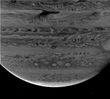
Jupiter-PIA02865-1.JPGJupiter's clouds - 619 nnmts filter57 visiteThe images shown here demonstrate the power of these filters in studies of cloud stratigraphy. The images cover latitudes from about 15° North at the top down to the Southern Polar Region at the bottom. (...)
The most prominent feature seen in all 3 filters is the Polar Stratospheric Haze that makes Jupiter bright near the Pole. The equatorial band is also very bright in the strong 890-nnmts image and to a lesser extent in the 727 band, but is subdued in the weak 619-nnmts image. These are high, thin, haze layers that are nearly transparent at wavelengths outside the methane absorption bands.
Another prominent feature is the Great Red Spot: about a third of it appears at the right-hand edge of the frame.
It is a bright feature in methane absorption because it has extensive cloud cover reaching to high altitude.
A wisp of high thin cloud can be seen trailing off its western rim in the 2nd and 3rd image.
(5 voti)
|
|
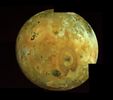
Io-PIA02294.jpgIo: full disk, from about 400.000 Km55 visitePerhaps the most spectacular of all the Voyager photos of Io is this mosaic obtained by Voyager 1 on March 5, 1979, at a range of 400.000 Km (approx.). A great variety of color and albedo is seen on the surface, now thought to be the result of surface deposits of various forms of Sulfur and Sulfur Dioxide. The two great volcanoes Pele and Loki (upper left) are prominent.
(5 voti)
|
|

Europa-PIA01405.jpgDark Region on Europa55 visiteThis view taken by NASA's Galileo spacecraft of Jupiter's icy moon Europa focuses on a dark, smooth Region whose center is the lowest area in this image. To the West (left), it is bounded by a cliff and terraces, which might have been formed by normal faulting. The slopes toward the East (right) leading into the dark spot are gentle. Near the center of the dark area, it appears the dark materials have covered some of the bright terrain and ridges. This suggests that when the dark material was deposited, it may have been a fluid or an icy slush. Only a few impact craters are visible, with some of them covered or flooded by dark material. Some appear in groups, which may indicate that they are secondary craters formed by debris excavated during a larger impact event. A potential source for these is the nearby crater Mannann`an.
North is to the top of the picture which is centered at 1° South Latitude and 225° West Longitude. The images in this mosaic have been re-projected to 50 mt/pixel.
(5 voti)
|
|

Europa-mosaic-PIA01407.jpgDifferent surface features of Europa56 visite1. Triple bands and dark spots were the focus of some images from Galileo's eleventh orbit of Jupiter. Triple bands are multiple ridges with dark deposits along the outer margins. Some extend for thousands of kilometers across Europa's icy surface. They are cracks in the ice sheet and indicate the great stresses imposed on Europa by tides raised by Jupiter, as well as Europa's neighboring moons, Ganymede and Io. The dark spots or "lenticulae" are spots of localized disruption.
2. The Conamara Chaos region reveals icy plates which have broken up, moved, and rafted into new positions. This terrain suggests that liquid water or ductile ice was present near the surface. On Galileo's twelfth orbit of Jupiter, sections of this region with resolutions as high as 10 meters per picture element will be obtained.
3. Mannann'an Crater is a feature newly discovered by Galileo in June 1996. Color and high resolution images (to 40 meters per picture element) from Galileo's fourteenth orbit of Jupiter will offer a close look at the crater and help characterize how impacts affect the icy surface of this moon.
4. Cilix, a large mound about 1.5 kilometers high, is the center of Europa's coordinate system. Its concave top and what may be flow like features to the southwest of the mound are especially intriguing. The origin of this feature is unknown at present. Color, stereo, and high resolution images (to 65 meters per picture element) from Galileo's fifteenth orbit of Jupiter will offer new insights and resolve questions about its origin.
5. Images of Agenor Linea (white arrow) and Thrace Macula (black arrow) with resolutions as high as 30 meters per picture element will be obtained during Galileo's sixteenth orbit of Jupiter. Agenor is an unusually bright lineament on Europa. Is the brightness due to new ice, and if so, does it represent recent activity? Could the dark region of Thrace Macula be a flow from ice volcanism?
6. Images of Europa's south polar terrain obtained during Galileo's seventeenth orbit of Jupiter will offer insights into the processes which are active in this region. Is the ice crust thicker near Europa's poles than near the equator? The prominent dark line running from upper left to lower right through the center of this image is Astypalaea Linea. It is a fault about the length of the San Andreas fault in California and is the largest such fault known on Europa. Images with resolutions of 48 meters per picture element will be obtained to examine its geologic structure.
7. This long lineament, Rhadamanthys Linea. is spotted with dark "freckles". Are these freckle features formed by icy volcanism? Is this an early form of a triple band? Stereo and high resolution (to 46 meters per picture element) obtained during Galileo's eighteenth orbit of Jupiter may indicate whether the lineament is the result of volcanic processes or is formed by other surface processes.
8. During Galileo's nineteenth orbit of Jupiter, images of Europa will be taken with very low sun illuminations, similar to taking a picture at sunset or sunrise. The object will be to search for backlit plumes issuing from icy volcanic vents. Such plumes would be direct evidence of a liquid ocean beneath the ice. Resolutions will be as high as 40 meters per picture element. This picture was simulated image from Galileo data obtained during the spacecraft's second orbit of Jupiter in September 1996.
North is to the top of the pictures. During orbit 13, the Galileo spacecraft was behind the sun from our vantage point on Earth so it did not obtain or transmit data from that orbit. The left two images in the bottom row were obtained by NASA's Voyager 2 spacecraft in 1979; the remaining images were obtained by the Solid State Imaging (SSI) system on NASA's Galileo spacecraft in 1996.
(5 voti)
|
|

Europa-Craters-Tyre_Crater-PIA00702.jpgTyre Crater (False Colors; credits for the additional process. and color.: NASA/JPL)56 visiteThis feature on Europa was seen as a dark, diffuse circular patch on a previous Galileo global image of Europa's Leading Hemisphere on April 3, 1997. The "bulls-eye" pattern appears to be a 140- Km-wide impact scar (about the size of the island of Hawaii) which formed as the surface fractured minutes after a mountain-sized asteroid or comet slammed into the satellite. This approx. 214-Km-wide picture is the product of 3 images which have been processed in false color to enhance shapes and compositions. North is toward the top of this picture, which is illuminated from sunlight coming from the West. This color composite reveals a sequence of events which have modified the surface of Europa. The earliest event was the impact which formed the Tyre structure at 34° North Latitude and 146,5° West Longitude. The impact was followed by the formation of the reddish lines superposed on Tyre. The red color designates areas that are probably a dirty water ice mixture. The fine blue-green lines crossing the region from west to east appear to be ridges which formed after the crater.
(5 voti)
|
|
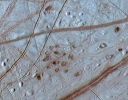
Europa-PIA03878_modest.jpgLenticulae on Europa68 visiteCaption NASA originale:"Reddish spots and shallow pits pepper the enigmatic ridged surface of Europa in this view combining information from images taken by the Galileo spacecraft during 2 orbits. The spots and pits visible in this region of Europa's northern hemisphere are each about 10 Km across. The dark spots are called "lenticulae," the Latin term for freckles. Their similar sizes and spacing suggest that Europa's icy shell may be churning away like a lava lamp, with warmer ice moving upward from the bottom of the ice shell while colder ice near the surface sinks downward. Other evidence has shown that Europa likely has a deep melted ocean under its icy shell. Ruddy ice erupting onto the surface to form the lenticulae may hold clues to the composition of the ocean and to whether it could support life".
Nota Lunexit: Si, la NASA parla di un "profondo oceano liquido" al di sotto della crosta ghiacciata di Europa.
Un oceano "vivo", forse?
Ci chiediamo: ma perchè abbiamo abbandonato questa strada (sempre complessa, ma più vicina e più solida) per andare a cercare "qualcosa" di completamente indefinibile - e per giunta muovendoci alla cieca - su Titano?
Insomma, l'idea del Landing su Titano (attuata) è stata un Grande Passo, ma fermarsi su Europa e guardare meglio era proprio un'idea sbagliata?!?... Misteri della NASA.
(5 voti)
|
|

Europa-Lineae-Agenor_Linea.jpgEuropa: the "Agenor Linea"57 visiteCaption NASA originale:"This bright white swath cutting across the surface of icy Jovian moon Europa is known as "Agenor Linea". In all about 1000 Km long and 5 Km wide, only a section is pictured here as part of a combined color and black and white Galileo's images. Most linear features on Europa are dark in color but Agenor Linea is uniquely bright for unknown reasons. Also unknown is the origin of the reddish material along the sides. While these and other details of Europa's surface formations remain mysterious, the general results of Galileo's exploration of Europa have supported the idea that an ocean of liquid water lies beneath the cracked and frozen crust. An extraterrestrial liquid ocean holds out the tantalizing possibility of life". Curioso: alla NASA sono davvero incapaci di fare commenti equilibrati alle immagini che loro stessi propongono. Parlano di "Tantalizing possibility of life" sotto il ghiaccio di Europa, ma sono incapaci di dire che su Marte, forse, esiste qualche forma di vita...
(5 voti)
|
|

Callisto-Asgard emisph.-Gal-PIA01100_modest.jpgThe "Asgard" hemisphere of Callisto56 visiteCaption NASA originale:"False color view of a portion of the leading hemisphere of Jupiter's moon Callisto as seen through the infrared filters of the Solid State Imaging (CCD) system aboard NASA's Galileo spacecraft. North is to the top of the picture and the sun illuminates the surface from the east. More recent impacts have excavated bright, relatively clean ice from beneath Callisto's battered surface. Callisto's dark mottled appearance may be due to contamination by non-ice components contributed by impactors or concentrated in a residue as ice is removed".
(5 voti)
|
|
| 324 immagini su 27 pagina(e) |
 |
|
|
|
|
14 | |
|
|
|
|





