| |

| Piú votate - Jupiter: the "King" and His Moons |
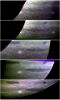
Jupiter-PIA10076.jpgAmmonia Ice-Clouds on Jupiter56 visiteCaption NASA:"The top cloud layer on Jupiter is thought to consist of ammonia ice, but most of that ammonia "hides" from spectrometers. It does not absorb light in the same way ammonia does. To many scientists, this implies that ammonia churned up from lower layers of the atmosphere "ages" in some way after it condenses, possibly by being covered with a photochemically generated hydrocarbon mixture.
The New Horizons Linear Etalon Imaging Spectral Array (LEISA), the half of the Ralph instrument that is able to see in infrared wavelengths that are absorbed by ammonia ice, spotted these clouds and watched them evolve over 5 Jupiter days (about 40 Earth hours). In these images, spectroscopically identified fresh ammonia clouds are shown in bright blue. The largest cloud appeared as a localized source on day 1, intensified and broadened on day 2, became more diffuse on days 3 and 4, and disappeared on day 5.
The diffusion seemed to follow the movement of a dark spot along the boundary of the oval region. Because the source of this ammonia lies deeper than the cloud, images like these can tell scientists much about the dynamics and heat conduction in Jupiter's lower atmosphere".MareKromium
(5 voti)
|
|

Europa.jpg"Faces & Phases" of Europa57 visitenessun commentoMareKromium
(5 voti)
|
|

Jupiter-Clouds_NewHorizons_big.jpgJupiter's Clouds (from New Horizon) - HR56 visiteCaption NASA:"The New Horizons Spacecraft took some stunning images of Jupiter earlier this year while on the way out to Pluto. Famous for its Great Red Spot, Jupiter is also known for its regular, equatorial cloud bands, visible through even modest sized telescopes. The above image was taken near Jupiter's Terminator, and shows that the Jovian giant possibly has the widest diversity of cloud patterns in our Solar System. On the far left are clouds closest to Jupiter's South Pole.
Here turbulent whirlpools and swirls are seen in a dark region, dubbed a belt, that rings the Planet.
Even light colored regions, called zones, show tremendous structure, complete with complex wave patterns. The energy that drives these waves likely comes from below. New Horizons is the fastest space probe ever launched, and is zipping through the Solar System on track to reach Pluto in 2015".MareKromium
(5 voti)
|
|

Himalia-lor_0035585519_0x630_sci_1-01.jpgHimalia, from New Horizons58 visiteData & Statistics for Himalia:
Discovered by: C. Perrine
Date of discovery: AD 1904
Mass (in Kg): approx. 9,56e+18
Mass (if Earth = 1): 1,5997e-06
Equatorial radius (in Km): approx. 93
Equatorial radius (if Earth = 1): 1,4581e-02
Mean density (in grm/cm^3): approx. 2,8
Mean distance from Jupiter (in Km): 11.480.000
Rotational period (in days): 0,4
Orbital period (in days): 250,5662
Mean orbital velocity (in Km/sec): 3,34
Orbital eccentricity: 0,1580
Orbital inclination: 27,63°
Escape velocity (in Km/sec): 0,117
Visual geometric albedo: 0,03
Magnitude (Vo): 14,84MareKromium
(5 voti)
|
|

Ganymede-lor_0035286119_0x630_sci_1.jpgThe "obscure outline" of Ganymede (1)58 visiteDescription: Ganymede crossing crescent Jupiter
Time: 2007-03-04 03:50:01 UTC
Exposure: 2 msec
Target: GANYMEDE
Range: 5,9 MKMMareKromium
(5 voti)
|
|

JupiterSystem-050107_09.jpgThe "Galilean Family" of Jupiter87 visiteThis montage shows the best views of Jupiter's four large and diverse "Galilean" satellites as seen by the Long Range Reconnaissance Imager (LORRI) on the New Horizons spacecraft during its flyby of Jupiter in late February 2007. The four moons are, from left to right: Io, Europa, Ganymede and Callisto. The images have been scaled to represent the true relative sizes of the four moons and are arranged in their order from Jupiter.
Io, 3,640 kilometers (2,260 miles) in diameter, was imaged at 03:50 Universal Time on February 28 from a range of 2.7 million kilometers (1.7 million miles). The original image scale was 13 kilometers per pixel, and the image is centered at Io coordinates 6 degrees south, 22 degrees west. Io is notable for its active volcanism, which New Horizons has studied extensively.
Europa, 3,120 kilometers (1,938 miles) in diameter, was imaged at 01:28 Universal Time on February 28 from a range of 3 million kilometers (1.8 million miles). The original image scale was 15 kilometers per pixel, and the image is centered at Europa coordinates 6 degrees south, 347 degrees west. Europa's smooth, icy surface likely conceals an ocean of liquid water. New Horizons obtained data on Europa’s surface composition and imaged subtle surface features, and analysis of these data may provide new information about the ocean and the icy shell that covers it.
New Horizons spied Ganymede, 5,262 kilometers (3,268 miles) in diameter, at 10:01 Universal Time on February 27 from 3.5 million kilometers (2.2 million miles) away. The original scale was 17 kilometers per pixel, and the image is centered at Ganymede coordinates 6 degrees south, 38 degrees west. Ganymede, the largest moon in the solar system, has a dirty ice surface cut by fractures and peppered by impact craters. New Horizons’ infrared observations may provide insight into the composition of the moon’s surface and interior.
Callisto, 4,820 kilometers (2,995 miles) in diameter, was imaged at 03:50 Universal Time on February 28 from a range of 4.2 million kilometers (2.6 million miles). The original image scale was 21 kilometers per pixel, and the image is centered at Callisto coordinates 4 degrees south, 356 degrees west. Scientists are using the infrared spectra New Horizons gathered of Callisto’s ancient, cratered surface to calibrate spectral analysis techniques that will help them to understand the surfaces of Pluto and its moon Charon when New Horizons passes them in 2015.
MareKromium
(5 voti)
|
|

Io-032807.jpgBurning Io!54 visiteNew Horizons captured this unique view of Jupiter's moon Io with its color camera - the Multispectral Visible Imaging Camera (MVIC) - at 00:25 UT on March 1, 2007, from a range of 2,3 MKM (about 1,4 MMs). The image is centered at Io coordinates 4°South lat. and 162° West Long., and was taken shortly before the complementary Long Range Reconnaissance Imager (LORRI) photo of Io released on March 13, which had higher resolution but was not in color.
Like that LORRI picture, this processed image shows the nighttime glow of the Tvashtar volcano and its plume rising 330 kilometers (200 miles) into sunlight above Io's north pole. However, the MVIC picture reveals the intense red of the glowing lava at the plume source and the contrasting blue of the fine dust particles in the plume (similar to the bluish color of smoke), as well as more subtle colors on Io's sunlit crescent. The lower parts of the plume in Io's shadow, lit only by the much fainter light from Jupiter, are almost invisible in this rendition. Contrast has been reduced to show the large range of brightness between the plume and Io's disk.
A component of the Ralph imaging instrument, MVIC has three broadband color filters: blue (480 nanometers), red (620 nm) and infrared (850 nm); as well as a narrow methane filter (890 nm). Because the camera was designed for the dim illumination at Pluto, not the much brighter sunlight at Jupiter, the red and infrared filters are overexposed on Io's dayside. This image is therefore composed from the blue and methane filters only, and the colors shown are only approximations to those that the eye would see. Nevertheless, the human eye would easily see the red color of the volcano and the blue color of the plume.
(5 voti)
|
|

Io-030107-01.jpgThe greatest Volcanic Plume in the Solar System!57 visiteThis dramatic image of Io was taken by the Long Range Reconnaissance Imager (LORRI) on New Horizons at 11:04 Universal Time on February 28, 2007, just about 5 hours after the spacecraft's closest approach to Jupiter. The distance to Io was 2.5 million kilometers (1.5 million miles) and the image is centered at 85 degrees west longitude. At this distance, one LORRI pixel subtends 12 kilometers (7.4 miles) on Io.
This processed image provides the best view yet of the enormous 290-kilometer (180-mile) high plume from the volcano Tvashtar, in the 11 o'clock direction near Io's north pole. The plume was first seen by the Hubble Space Telescope two weeks ago and then by New Horizons on February 26; this image is clearer than the February 26 image because Io was closer to the spacecraft, the plume was more backlit by the Sun, and a longer exposure time (75 milliseconds versus 20 milliseconds) was used. Io's dayside was deliberately overexposed in this picture to image the faint plumes, and the long exposure also provided an excellent view of Io's night side, illuminated by Jupiter. The remarkable filamentary structure in the Tvashtar plume is similar to details glimpsed faintly in 1979 Voyager images of a similar plume produced by Io's volcano Pele. However, no previous image by any spacecraft has shown these mysterious structures so clearly.
The image also shows the much smaller symmetrical fountain of the plume, about 60 kilometers (or 40 miles) high, from the Prometheus volcano in the 9 o'clock direction. The top of a third volcanic plume, from the volcano Masubi, erupts high enough to catch the setting Sun on the night side near the bottom of the image, appearing as an irregular bright patch against Io's Jupiter-lit surface. Several Everest-sized mountains are highlighted by the setting Sun along the terminator, the line between day and night.
This is the last of a handful of LORRI images that New Horizons is sending "home" during its busy close encounter with Jupiter - hundreds of images and other data are being taken and stored onboard. The rest of the images will be returned to Earth over the coming weeks and months as the spacecraft speeds along to Pluto.
(5 voti)
|
|

Jupiter_s_Aurorae.jpgJovian Aurorae54 visiteNASA's HST has recently taken images of Jupiter in support of the New Horizons Mission. The images were taken with Hubble's Wide Field Planetary Camera 2 and the Advanced Camera for Surveys. Hubble will continue to photograph Jupiter, as well as its volcanically active moon, Io, over the next month as the New Horizons spacecraft flies past Jupiter. New Horizons is en route to Pluto, and made its closest approach to Jupiter on February 28, 2007. Through combined remote imaging by Hubble and in situ measurements by New Horizons, the two missions will enhance each other scientifically, allowing scientists to learn more about the Jovian atmosphere, the Aurorae, and the charged-particle environment of Jupiter and its interaction with the Solar Wind.
For this photo, the combined ultraviolet- and visible-light images of Jupiter were taken with Hubble from February 17-21. The image segments in the boxes, obtained using the Advanced Camera for Surveys's ultraviolet camera, show auroral emissions that are always present in Jupiter's polar regions. The equatorial regions of Jupiter were imaged in blue light by the Wide Field Planetary Camera 2. Cloud features in Jupiter's main atmosphere are revealed. In the ultraviolet views, the atmosphere looks more hazy because sunlight is reflected from higher in the atmosphere.MareKromium
(5 voti)
|
|

PSP_002162_9030_RED_browse.jpgJupiter from Mars56 visiteCaption NASA:"The HiRISE camera is the most powerful telescope to have left Earth orbit. As such, it is capable of some interesting astronomical observations.
This image of Jupiter and its major satellites was acquired to calibrate the pointing and color response of the camera. An oversight in planning this unusual observation put the focus mechanism in the wrong location, blurring the image. This does not detract from the calibration objectives, but makes the raw image less esthetic.
To compensate, the image has been "sharpened" on the ground by Dennis Gallagher, the HiRISE chief optical designer. With this sharpening, and because Mars is closer to Jupiter than Earth is, this image has comparable resolution as the HST's pictures of Jupiter.
The colors are not what is seen by the human eye because HiRISE is able to detect light with a slightly longer wavelength than we can (that is, the infrared)".MareKromium
(5 voti)
|
|
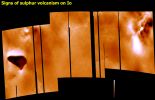
Io-Sulphur_Volcanism-Original_NASA_Galileo.jpgRecent Sulphur Volcanism on Io (natural colors)55 visitenessun commento
(5 voti)
|
|

Jupiter-01.jpgWhat's inside Jupiter?57 visitenessun commento
(5 voti)
|
|
| 324 immagini su 27 pagina(e) |
|
|
|
|
|
13 | |
|
|
|
|
|
|





