| Piú votate - Jupiter: the "King" and His Moons |

Europa-PIA03002_modest.jpgGeologic evidence of a "liquid" Ocean under Europa's icy surface54 visiteCaption NASA originale:"The image on the left shows a region of Europa's crust made up of blocks which are thought to have broken apart and rafted into new positions. These features are the best geologic evidence to date that Europa may have had a subsurface ocean at some time in its past. Combined with the geologic data, the presence of a magnetic field leads scientists to believe an ocean is most likely present at Europa today. In this false color image, reddish-brown areas represent non-ice material resulting from geologic activity. White areas are rays of material ejected during the formation of the 25-Km diameter impact crater Pwyll (see global view). Icy plains are shown in blue tones to distinguish possibly coarse-grained ice (dark blue) from fine-grained ice (light blue). Long, dark lines are ridges and fractures in the crust, some of which are more than 3.000 Km long. These images were obtained by NASA's Galileo spacecraft during September and December 1996 and February 1997".
(6 voti)
|
|

Callisto-V1-PIA02277_modest.jpgCallisto's basin from Voyager 156 visiteCaption NASA originale:"This picture of a multi=ring basin on Callisto was taken the morning of March 6, 1979, from a distance of about 200.000 Km. The complicated circular structure seen at left center is similar to the large circular impact basins that dominate the surface of the Earth's moon and also the planet Mercury. The inner parts of these basins are generally surrounded by radially lineated ejecta and several concentric mountainous ring structures that are thought to form during the impact event. This multi-ring basin on Callisto consists of light floored central basin some 300 k m in diameter surrounded by at least eight to ten discontinuous rhythmically spaced ridges. No radially lineated ejecta can be seen. The ring structures on Moon and Mercury have been likened to ripples produced on a pond by a rock striking the water. The great number of rings observed around this basin on Callisto is consistent with its low planetary density and probable low internal strength".
(6 voti)
|
|

Europa-Lineae-Agenor_Linea-PIA00877.jpgThe "Agenor Linea" on Europa69 visitenessun commento
(6 voti)
|
|

Europa-PIA00874.jpgEuropa's Leading Hemisphere55 visiteThis image of Europa's Leading Hmisphere was obtained by the Solid State Imaging (CCD) System on board NASA's Galileo spacecraft during its seventh orbit of Jupiter. In the upper left part of the image is Tyre, a multi-ringed structure that may have formed as a result of an ancient impact. Also visible are numerous lineaments that extend for over 1000 Km. The limb, or edge, of Europa in this image can be used by scientists to constrain the radius and shape of the satellite. North is to the top of the picture and the Sun illuminates the surface from the right. The image, centered at -40° Latitude and 180° Longitude, covers an area approx. 2000 by 1300 Km. The finest details that can be discerned in this picture are about 6,6 Km across. The images were taken on April 3, 1997 at 17 h, 42', 19" Universal Time when the spacecraft was at a range of about 318.000 Km from Europa.
(6 voti)
|
|

JUPITER from 81,3 MKM.jpgJupiter from 81,3 MKM57 visitenessun commento
(6 voti)
|
|
Jupiter-Juno-Rings.jpgFrom inside the Rings102 visitenessun commentoMareKromium
(5 voti)
|
|

Ganymede_-_Juno.jpgGanymede from Juno102 visitenessun commentoMareKromium
(5 voti)
|
|

Jupiter-Juno-Lightning_Green.jpgGreen Light on Jupiter83 visiteIf that "Green Thing" is a true Lightning, then it is a VERY funny-looking one. But we are on Jupiter and so, everything is possible! At least, so the Scientists said, swearing on the Third Newton's Law.MareKromium
(5 voti)
|
|

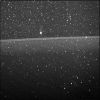
JUPITER_S_RINGS-01-PIA25038_width-640.jpg95 visiteCaption NASA Originale:"This high-resolution image of Jupiter's main dust ring was collected by the Stellar Reference Unit (SRU) navigation camera aboard NASA's Juno spacecraft. The image was taken from inside the ring looking out as Juno flew between Jupiter and the radiation belts during the spacecraft's 36th close flyby on Sept. 2, 2021. The brightest thin dust bands are associated with the orbits of Jupiter's small moons, Metis and Adrastea. The image is at a resolution of nearly 20 miles (32 kilometers) per pixel".MareKromium
(5 voti)
|
|

Jupiter-Upper_Atmosphere-PIA16837-PCF-LXTT-IPF.jpgInside Jupiter's Atmosphere (Absolute Natural Colors; credits for the additional process. and color.: Dr Paolo C. Fienga/Lunar Explorer Italia/Italian Planetary Foundation)75 visiteThe Jupiter's "Dark Hot Spot" visible in this image - taken on December, 13 of the AD 2000 by the NASA - Cassini Spacecraft Imaging Science Subsystem (while Cassini was on its way to the Saturnian System) - is, in a manner of speaking, a "window" that opens deep inside into Jupiter's Upper Atmosphere. In fact, all around the Dark Hot Spot, there are Layers of higher Clouds, with shapes and colors that can help us to identify which Layer of the Jovian Amosphere they actually belong to.
For instance, the three small gray-bluish Clouds visible to to the right of the frame, are located in the Jovian Upper Troposphere, or perhaps even higher, into the Jovian Stratosphere. On the other hand, the large Gray Band located under the Dark Hot Spot (inside which can be - really - barely seen a few bizarre-looking dense Cloud Formations), is positioned in the Lower Troposphere of Jupiter. In addition, a high, gauzy orangish Haze seems to cover a large portion of the frame.
This picture (which is an Original NASA - Cassini Spacecraft b/w false-color frame published on the NASA - Planetary Photojournal with the ID n. PIA 16837) has been additionally processed and then re-colorized in Absolute Natural Colors (such as the colors that an average human eye would actually perceive if someone were onboard the NASA - CASSINI Spececraft and then looked outside, towards the Jupiter), by using an original technique created - and, in time, dramatically improved - by the Lunar Explorer Italia Team.
Note: we apologize to our Readers, but some of the details (i.e.: a so-called "Gyre" and a "Plume") which characterize part of the dense Cloud-Formations located in the Lower Troposphere of Jupiter can ONLY be seen by watching the false-color version of this frame, as edited by NASA, and found in the Planetary Photojournal. If seen through "human eyes", the aformentioned details disappear almost completely (only the Plume, in fact, can be barely spotted, left of center of the gray Clouds-Band).MareKromium
(5 voti)
|
|

Callisto-PIA02277-PCF-LXTT-IPF.jpgValhalla! (Absokute Natural Colors; credits for the additional process. and color.: Dr Paolo C. Fienga/Lunar Explorer Italia/Italian Planetary Foundation)73 visiteThis picture of the gigantic Multi-Ring Impact Basin named "Valhalla" and located on the Jovian moon Callisto, was taken by the NASA - Voyager 1 Spacecraft in the morning of March 6, of the AD 1979, at a distance of about 200.000 Km (such as approx. 124.000 miles) from the Surface of the farthermost of the 4 (four) so-called "Galilean" Natural Satellites (or moons) of the Gas-Giant Planet Jupiter. The complicated Circular Structure which characterizes Valhalla is, in a way (and according to NASA), relatively similar to other large Circular Impact Basins that can be seen on the Surface of the Earth's Moon as well as on the Planet Mercury but, as we already wrote and underlined in the past, we, as IPF, do believe that a true and strong resemblance between Valhalla and another Multi-Ring Impact Basin can only be found with the huge Tyre Crater; a Multi-Ring Impact Crater that is located, as you know, on the Jovian moon Europa.
Usually, the inner portions of these Multi-Ring Impact Basins are generally surrounded by Radially Lineated Ejecta and several Concentric Mountainous Ring Structures, which are thought to have formed during the Impact Event itself. However, the Callistoan Valhalla Multi-Ring Impact Basin consists of a Light-Floored Central Basin, that is approx. 300 Km (such as a little more than 186 miles) in diameter, surrounded by at least 8 (eight) to 10 (ten) discontinuous and rhythmically spaced Ridges, but no Radially Lineated Ejecta can be seen. In any case, the great number of Rings observed around Valhalla is a fact which is consistent with the hypothesis that Callisto possesses a very low Planetary Density and, also, a low internal strength. Furthermore, if you look carefully on the upper right side of the frame, at about 2 o'clock, a beautiful and extremely long and regular Catena (---> Chain of Craters, probably originated by a Cometary Strike or a Meteor that was heavily fragmented at the time of the Impact) can be seen.
This frame (which is an Original NASA - Voyager 1 Spacecraft b/w image published on the NASA - Planetary Photojournal with the ID n. PIA 02277) has been additionally processed and then colorized, according to an educated guess, by Dr Paolo C. Fienga (LXTT-IPF), in Absolute Natural Colors (such as the colors that a human eye would actually perceive if someone were onboard the NASA - Voyager 1 Spacecraft and then looked outside, towards the Jovian moon Callisto), by using an original technique created - and, in time, dramatically improved - by the Lunar Explorer Italia Team. Different colors, as well as different shades of the same color, mean, among others, the existence of different Elements present on the Surface of Callisto, each having a different Albedo (---> Reflectivity) and Chemical Composition.MareKromium
(5 voti)
|
|

Io-Eruption-VG1_p21286.jpgActive and Powerful Volcanic Eruption seen from Atop (Extremely Enhanced Natural Colors; credits for the additional process. and color.: Dr Paolo C. Fienga - Lunar Explorer Italia)233 visitenessun commentoMareKromium
(5 voti)
|
|
| 324 immagini su 27 pagina(e) |
 |
|
|
|
|
11 | |
|
|
|
|





