| |

| Piú votate - Jupiter: the "King" and His Moons |

Io-050107_04.jpgPlanetary Flares57 visiteThis montage demonstrates New Horizons' ability to observe the same target in complementary ways using its diverse suite of instruments. Previously released views taken at visible and slightly longer infrared wavelengths with the Long Range Reconnaissance Imager (LORRI), New Horizons’ high-resolution black-and-white camera, and the Multispectral Visible Imaging Camera (MVIC), its color camera, are here compared with a nearly simultaneous view from the Linear Etalon Imaging Spectral Array (LEISA), which observes its targets in more than 200 separate wavelengths of infrared light. This color LEISA view of Io (bottom right) combines three wavelength ranges, centered at 1.80, 2.04, and 2.31 micrometers.
The LORRI image (left) shows fine details on Io's sunlit crescent and in the partially sunlit plume from the Tvashtar volcano, and reveals the bright nighttime glow of the hot lavas at the source of the Tvashtar plume. The MVIC image (top right) shows the contrasting colors of the red lava and blue plume at Tvashtar, and the sulfur and sulfur dioxide deposits on Io's sunlit surface. The LEISA image shows that the glow of the Tvashtar volcano is even more intense at infrared wavelengths and reveals the infrared glow of at least 10 fainter volcanic hot spots on the moon’s nightside. The brightest of these, Amirani/Maui, which is visible to the lower right of Tvashtar, is less than 4% as bright as Tvashtar. All of these are long-lived hot spots that have been observed previously by the Galileo orbiter. Further analysis of the LEISA data will provide information on the volcanoes’ temperatures, and data on the sunlit crescent of Io will reveal details of Io's surface composition.
The LORRI, MVIC and LEISA images were taken March 1, 2007, at 00:35, 00:25 and 00:31 Universal Time, respectively, from a range of 2,3 MKM (about 1,4 MMs).
The images are centered at Io coordinates 4° South and 164° West.MareKromium
(6 voti)
|
|

Io-050107_07.jpgAs Time goes by...On Io!54 visiteThis montage compares similar sides of Io photographed by the Galileo spacecraft in October 1999 and the New Horizons spacecraft on February 27, 2007.
The New Horizons image was taken with its Long Range Reconnaissance Imager (LORRI) from a range of 2,7 MKM (about 1,7 MMs).
Most features on Io have changed little in the 7-plus years between these images, despite continued intense volcanic activity. The largest visible feature is the dark oval composed of deposits from the Pele Volcano, nearly 1200 Km (about 750 miles) across its longest dimension. At high Northern Latitudes, the volcano Dazhbog is prominent as a dark spot in the New Horizons image, near the edge of the disk at the 11 o'clock position. This volcano is much less conspicuous in the Galileo image. This darkening happened after this 1999 Galileo image but before Galileo took its last images of Io in 2001.
A more recent change, discovered by New Horizons, can be seen in the Southern Hemisphere (circled).
A new volcanic eruption - near 55° South and 290° West - has created a roughly circular deposit nearly 500 Km (about 300 miles) in diameter that was not seen by Galileo. Other New Horizons images show that the plume that created this deposit is still active.
The New Horizons image is centered at Io coordinates 8° South and 269° West.
MareKromium
(6 voti)
|
|

IO_-_TRUE_COLOR_FROM_GALILEO.jpgIo: the World of Sulphur62 visitenessun commentoMareKromium
(6 voti)
|
|

Io-Tohill-Scarp-00.jpgThe mysterious Tohill Mons and Patera (1) - natural colors54 visitenessun commento
(6 voti)
|
|

Jupiter-PIA02401.jpgLook at Me!60 visiteWhen 17th-century astronomers first turned their telescopes to Jupiter, they noted a conspicuous reddish spot on the Giant Planet. This Great Red Spot is still present in Jupiter's atmosphere, more than 300 years later. It is now known that it is a vast storm, spinning like a cyclone. Unlike a low-pressure hurricane in the Caribbean Sea, however, the Red Spot rotates in a counterclockwise direction in the Southern Hemisphere, showing that it is a high-pressure system. Winds inside this Jovian storm reach speeds of about 270 mph.
The Red Spot is the largest known storm in the Solar System. With a diameter of about 15.400 miles, it is almost twice the size of the entire Earth and 1/6th the diameter of Jupiter itself.
The long lifetime of the Red Spot may be due to the fact that Jupiter is mainly a gaseous planet. It possibly has liquid layers, but lacks a solid surface, which would dissipate the storm's energy, much as happens when a hurricane makes landfall on the Earth. However, the Red Spot does change its shape, size, and color, sometimes dramatically. Such changes are demonstrated in high-resolution Wide Field and Planetary Cameras 1 & 2 images of Jupiter obtained by NASA's Hubble Space Telescope between 1992 and 1999(PIA01594 thru PIA01599 and PIA02400 thru PIA02402). This image was obtained in April 1997.
(6 voti)
|
|

Jupiter-PIA02873.jpgJupiter, from Cassini56 visiteOriginal caption:"This true-color simulated view of Jupiter is composed of 4 images taken by NASA's Cassini spacecraft on December 7, 2000. To illustrate what Jupiter would have looked like if the cameras had a field-of-view large enough to capture the entire Planet, the cylindrical map was projected onto a globe. The resolution is about 144 Km (about 89 miles) per pixel. Jupiter's moon Europa is casting the shadow on the Giant Gas Planet".
(6 voti)
|
|
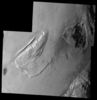
Io-PIA02555.jpgShamshu Mons and Patera from 34.500 Km54 visiteThis mosaic of images taken by NASA's Galileo spacecraft on February 22, 2000 shows 3 mountains and two lava-filled depressions in the Shamshu Region of Io. The dark oval feature on the left side is a depression that has been resurfaced by lava flows. The rough terrain North-East of the depression is Shamshu Mons. A 10-Km (6-mile) wide canyon oriented in North-East to South-West direction cuts this mountain. The northwestern edge of the mountain has been scalloped by erosion and it appears that the material has flowed along the canyon floor. Portions of 2 more mountains can be seen on the right side. The depression between these mountains is Shamshu Patera, a volcanic hotspot. The dark patches within it are recent and active lava flows. The northernmost edge of Shamshu Patera appears to be cutting into the mountain to its northeast. North is to the top of the picture and the Sun illuminates the surface from the West. This mosaic has a resolution of about 345 mt/pixel and covers an area of about 390x380 Km.
(6 voti)
|
|

Europa-PIA00578.jpgIce "floes" on Europa56 visiteJupiter's moon Europa, as seen in this image taken June 27, 1996 by NASA's Galileo spacecraft, displays features in some areas resembling ice floes (--->banchise) seen in Earth's Polar Seas. Europa has an icy crust that has been severely fractured, as indicated by the dark linear, curved, and wedged-shaped bands seen here. These fractures have broken the crust into plates as large as 30 Km (approx. 18,5 miles) across. Areas between the plates are filled with material that was probably icy slush contaminated with rocky debris. Some individual plates were separated and rotated into new positions. Europa's density indicates that it has a shell of water ice thicker than 100 Km, parts of which could be liquid. Currently, water ice could extend from the surface down to the rocky interior, but the features seen in this image suggest that motion of the disrupted icy plates was lubricated by soft ice or liquid water below the surface at the time of disruption. This image covers part of the Equatorial Region of Europa.
(6 voti)
|
|

Europa-PIA00366.jpgEuropa: computer mosaic from Voyager 254 visiteEuropa looks like a cracked egg in this computer mosaic of the best Voyager 2 images. In this presentation, the variation of surface brightness due to the angle of the sun has been removed by computer processing, so that surface features can be seen equally well at all places. The many broad dark streaks show up well, but this presentation does not bring out the much fainter and more enigmatic light streaks. These pictures were taken from a distance of about 250.000 Km and show features as small as 5 Km across.
(6 voti)
|
|

Ganymede-PIA00496.jpgFrost on crater-tops of Ganymede55 visiteScientists believe that water-ice frosts are the likely cause for the brightening seen around the circular rims of these craters located at a high northern latitude (57°) on Jupiter's moon Ganymede in this image taken by NASA's Galileo spacecraft on September 6, 1996. The image shows the same kind of bright, high-latitude surface areas as those first seen by the Voyager 1 spacecraft in 1979, but at higher resolution (this image spans about 18 Km - or 11 miles on a side). Even though the Sun is shining from the south, the north-facing walls of the ridges and craters are brighter than the walls facing the Sun. This is interpreted to mean that the very bright north-facing slopes are covered with surface water-ice frosts, and that these frosts preferentially accumulate in such high-latitude locations.
Galileo scientists say that at the HR seen in Galileo images, the high-latitude brightness seen by Voyager 1 might be partly attributable to frosts forming on cooler, north-facing slopes. The right-hand side of the image is dominated by a north-south line of impact craters; the smallest ones at the top are about 2 kilometers (1.2 miles) in diameter and the large one at the bottom is about 5 kilometers (about 3 miles) in diameter. Ganymede is the largest moon in the solar system, larger than the planet Mercury and nearly the size of Mars.
(6 voti)
|
|
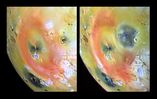
Io-PillanPatera-PIA00744.jpgPillan Patera56 visiteThese images of Jupiter's volcanic moon, Io, show the results of a dramatic event that occurred on the fiery satellite during a five-month period. The changes, captured by the solid state imaging (CCD) system on NASA's Galileo spacecraft, occurred between the time Galileo acquired the left frame, during its seventh orbit of Jupiter, and the right frame, during its tenth orbit. A new dark spot, 400 kilometers (249 miles) in diameter, which is roughly the size of Arizona, surrounds a volcanic center named Pillan Patera. Galileo imaged a 120 kilometer (75 mile) high plume erupting from this location during its ninth orbit. Pele, which produced the larger plume deposit southwest of Pillan, also appears different than it did during the seventh orbit, perhaps due to interaction between the two large plumes. Pillan's plume deposits appear dark at all wavelengths. This color differs from the very red color associated with Pele, but is similar to the deposits of Babbar Patera, the dark feature southwest of Pele. Some apparent differences between the images are not caused by changes on Io's surface, but rather are due to differences in illumination, emission and phase angles. This is particularly apparent at Babbar Patera.
North is to the top of the images. The left frame was acquired on April 4th, 1997, while the right frame was taken on Sept. 19th, 1997. The images were obtained at ranges of 563,000 kilometers (350,000 miles) for the left image, and 505,600 kilometers (314,165 miles) for the right.
(6 voti)
|
|
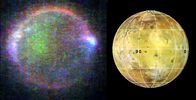
Io-PIA01637.jpgIo's "aurorae"60 visiteThis eerie view of Jupiter's moon Io in eclipse (left) was acquired by NASA's Galileo spacecraft while the moon was in Jupiter's shadow. Gases above the satellite's surface produced a ghostly glow that could be seen at visible wavelengths (red, green and violet). The vivid colors, caused by collisions between Io's atmospheric gases and energetic charged particles trapped in Jupiter's magnetic field, had not previously been observed. The green and red emissions are probably produced by mechanisms similar to those in Earth's polar regions that produce the aurora, or northern and southern lights. Bright blue glows mark the sites of dense plumes of volcanic vapor, and may be places where Io is electrically connected to Jupiter. The viewing geometry is shown in the image on the right. North is to the top of the picture and Jupiter is on the right. The resolution is 13,5 Km (about 8 miles) per picture element. The images were taken on May 31, 1998 at a range of 1,3 MKM (such as about 800.000 miles) by Galileo's onboard solid state imaging camera system during the spacecraft's 15th orbit of Jupiter.
(6 voti)
|
|
| 324 immagini su 27 pagina(e) |
|
|
|
|
|
10 | |
|
|
|
|
|
|





