| Piú votate - Jupiter: the "King" and His Moons |

Jupiter_s Rings-PIA01529_modest.jpgColorful Jupiter's Rings833 visiteCaption NASA originale:"Jupiter's faint ring system is shown in this color composite as two light orange lines protruding from the left toward Jupiter's limb. This picture was taken in Jupiter's shadow through orange and violet filters. The colorful images of Jupiter's bright limb are evidence of the spacecraft motion during these long exposures. The Voyager 2 spacecraft was at a range of 1.450.000 kilometers about two degrees below the plane of the ring. The lower ring image was cut short by Jupiter's shadow on the ring itself".
(70 voti)
|
|

Io-Flares from V2-PIA01362_modest.jpgBlue flares and eruptions on the limb of crescent Io76 visiteAncora flares (di colore blu, questa volta), riprese da una distanza approssimativa di 1,2 milioni di kilometri da Io.
La ripresa, in questo caso (e si tratta comunque di un'immagine di splendida qualità e fattura), è stata effettuata dalla Sonda Voyager 2 il 9 Luglio 1979. Ci pensate? Più di 25 anni fa...
Voyager 2 took this picture of Io on the evening of July 9, 1979, from a range of 1.2 million kilometers. On the limb of Io are two blue volcanic eruption plumes about 100 kilometers high. These two plumes were first seen by Voyager 1 in March, 1979, and are designated Plume 5 (upper) and Plume 6 (lower). They have apparently been erupting for a period of at least 4 months and probably longer. A total of six plumes have been seen by Voyager 2, all of which were first seen by Voyager 1. The largest plume viewed by Voyager 1 (Plume 1) is no longer erupting. Plume 4 was not viewed on the edge of the moon's disc by Voyager 2 and therefore it is not known whether or not it is still erupting. This picture is one of a series taken to monitor the eruptions over a 6 hour period.
(17 voti)
|
|

Io-Fire Fountain from Earth-PIA02522.jpgA "Fire Fountain" on Io...from Earth!86 visiteIl 25 Novembre 1999, dall'Osservatorio di Mauna-Kea (Hawaii), viene osservata e ripresa questa straordinaria immagine relativa ad una gigantesca "flare" (o "Fontana di Luce") occorsa su Io. Noi riteniamo che immagini come questa siano destinate ad entrare nella Storia della Scienza, ed è un peccato che a questi fenomeni i mezzi di comunicazione di massa non dedichino - praticamente - alcun rilievo. Peccato, davvero peccato...
(16 voti)
|
|
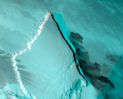
Io-Zal Patera-PIA02553.jpgThe "Zal" Patera80 visiteThis stereo image of Jupiter's moon Io shows the topography of a region on Io that includes the Zal Patera feature and a mountain or plateau that borders it to the west. It was created by combining two different views taken by NASA's Galileo spacecraft on November 25, 1999 (shown in red) and February 22, 2000 (shown in blue).
A mountain 120 kilometers (75 miles) wide rises to the west of the patera, a dark volcanic depression. By measuring the shadow, scientists were able to determine that the eastern margin of this mountain is about 1.5 kilometers (5000 feet) high. To the west and northwest, the mountain's margins are scalloped, which may indicate that a process called sapping is eroding them. Sapping occurs when fluid escapes from the base of a cliff, causing the material above it to collapse. Along the northwestern margin, the rough material at the base of the cliff maybe debris left over from the sapping process. Dark lava flows can be seen coming from a fissure to the east of the mountain.
Galileo scientists are in the process of generating topographic maps from these images. Such maps will reveal the heights and slopes of different landforms in this region, which will help scientists determine the strength and other properties of Io's surface materials. They will also be useful in understanding the processes of uplift and erosion on Io.
The picture is centered at 42.3 degrees north latitude and 76.9 degrees west longitude. North is to the top of the picture. The observations used to make the stereo image were made at ranges of 26,000 and 33,500 kilometers (16,200 and 20,900 miles) from Io. The resolution of the stereo image is about 335 meters (370 yards) per picture element.
(14 voti)
|
|

IO 6.jpgIo (On top of the erupting volcano)118 visiteForse l'immagine più famosa di un vulcano attivo su "Io". Essa è stata usata non solo in tanti documentari, ma anche - come fondale - per l'effettuazione del film "2010 - Odissea 2", in una sequenza in cui due Astronauti (un Russo ed un Americano) si spostano dall'Astronave Leonov alla Discovery, sospesa in quello che tecnicamente si chiama "Punto Lagrangiano" - o di equilibrio gravitazionale - fra Giove ed Io.
This color picture of Io, Jupiter's innermost Galilean satellite, was taken by Voyager 1 on the morning of March 5, 1979 at a range of 128,500 kilometers (77,100 miles). It is centered at 8 south latitude and 317 longitude. The width of the picture is about 1000 kilometers (600 miles). The diffuse reddish and orangish colorations are probably surface deposits of sulfur compounds, salts and possibly other volcanic sublimates. The dark spot with the irregular radiating pattern near the bottom of the picture may be a volcanic crater with radiating lava flows.
(14 voti)
|
|

Europa-V1-PIA00016-1-PCF-LXTT-1.jpgBizarre Image-Artifact... (Absolute Natural Colors; credits for the additional process. and color.: Dr Paolo C. Fienga - Lunexit Team)818 visitenessun commentoMareKromium
(13 voti)
|
|

Jupiter-HR.jpgJupiter's North Pole (HR)59 visiteDa "NASA - Picture of the Day" dell'11-09-2005:"Gas giant Jupiter is the Solar System's largest world with about 320 times the mass of Earth. Famous for its Great Red Spot, Jupiter is also known for its regular, equatorial cloud bands, also visible in very modest sized telescopes.
The dark belts and light-colored zones of Jupiter's cloud bands are organized by the Planet's girdling winds which reach speeds of up to 500 Km/hour. On toward the Jovian poles though, the cloud structures become more mottled and convoluted until, as in this Cassini spacecraft mosaic of Jupiter, the Planet's Polar Region begins to look something like a brain. This striking equator-to-pole change in cloud patterns is not presently understood, but may be due in part to the effect of Jupiter's rapid rotation or to convection vortices generated at high latitudes by the massive Planet's internal heat loss.
Cassini took this dramatically detailed view of Jupiter in December 2000, during its flyby enroute to Saturn".
(13 voti)
|
|

Io-Sodium cloud-PIA01110.jpgA sodium cloud from Io (3)58 visiteEd infatti la nuvola di Sodio emessa dalla Sonda Lunik-2, in particolare, venne realmente vista, identificata e fotografata dall'Osservatorio Francese di Haute-Provence, in quanto essa si "staccava", debolmente, del fondo del cielo. Per il Lunik-1, invece, il momento del rilascio della nube non fu altrettanto propizio, in quanto la Luna NON era visibile dall'Europa. Tuttavia - a quanto oggi ne sappiamo - anche questa prima nube venne vista, identificata e ripresa da alcuni Osservatori situati nell'URSS meridionale.
(13 voti)
|
|
Io-Sodium cloud-PIA01111.jpgA sodium cloud from Io (4)57 visiteForse tutto questo processo potrà sembrare, ad alcuni giovani Ricercatori, come un tantino "naif" (se non addirittura ridicolo), ma occorre ricordare che le tecniche - oggi diventate di uso familiare - di "controllo a distanza" erano, in quegli anni, pura fantascienza e quindi, nel programmare gli eventi, ci si doveva anche affidare, oltre che alla cara, vecchia matematica (e a dei calcoli che, sebbene fatti solo "a mano" o con l'aiuto di un buon "regolo calcolatore", erano tendenzialmente perfetti), anche ad una eccellente dose di "intraprendenza, fantasia e buona sorte".
Non si finisce davvero mai di conoscere ed imparare, vero?!?
(13 voti)
|
|

Jupiter-1994-33-a-full_jpg.jpgJupiter in natural colors, after being struck by Shoemaker-Levy 959 visiteThis image of the giant planet Jupiter, by NASA's HST, reveals the impact sites of fragments "D" and "G" from Comet Shoemaker-Levy 9.
The large feature was created by the impact of fragment "G" on July 18, 1994 at 3:28 a.m. EDT. It entered Jupiter's atmosphere from the south at a 45° angle and the resulting ejecta appears to have been thrown back along that direction. The smaller feature to the left of the fragment "G" impact site was created on July 17, 1994, at 7:45 a.m. EDT by the impact of fragment "D".
This image was taken 1h and 45' after fragment "G" impacted the Planet. The "G" impact has concentric rings around it, with a central dark spot that is about 2.500 Km in diameter. Such a dark spot is surrounded by a thin, dark, ring whose diameter is roughly 7.500 Km.
Last (but not least...), the dark, thick, outermost ring's inner edge has a diameter of approx. 12.000 Km (the size of Earth...).
The impact sites are located in Jupiter Southern Hemisphere at a latitude of about 44°.
(12 voti)
|
|

Jupiter-1994-35-a-web_print.jpgJupiter in ultraviolet light, after being struck by Shoemaker-Levy 958 visiteUltraviolet image of Jupiter taken by the Wide Field Camera of the HST. The image shows Jupiter's atmosphere at a wavelength of 2550 Angstroms after many impacts by fragments of comet Shoemaker-Levy 9. The most recent impactor is fragment R which is below the center of Jupiter (third dark spot from the right). This photo was taken 3:55 EDT on July 21, 1994, about 2,5 hours after R's impact. A large dark patch from the impact of fragment H is visible rising on the morning (left) side. Proceeding to the right, other dark spots were caused by impacts of fragments Ql, R, D and G (now one large spot) and L, with L covering the largest area of any seen thus far.
The spots are all very dark in ultraviolet light because - we think - a large amount of dust, right after the impacts, was being deposited on the upper layers of Jupiter stratosphere - and dust absorbs Sunlight.
The dark, round spot just above the center of Jupiter is the moon "Io".
(12 voti)
|
|

Io-Sulphur volcanism-PIA03887_modest.jpgPotential Source of Sulphur Flow on Io69 visiteA field of bright lava flows next to a shield volcano could be a source of recent sulfur volcanism on Io, as detected by instruments aboard NASA's Galileo spacecraft.
The mosaic at left combines higher-resolution images (330 meters or about 1080 feet per picture element) taken in October 2001 with lower-resolution color images (1.4 kilometers or 0.9 mile per picture element) taken in July 1999 by Galileo's solid-state imaging camera.
By comparing these images with a map of hot spots taken in February by Galileo's near-infrared mapping spectrometer (lower right), Galileo scientists noted that a new hot spot west of the active volcano Prometheus became bright in February 2000 and dimmed later. This hot spot appears to correspond with the bright flow field just west of a recently discovered shield volcano (see PIA03532), which is the only fresh volcanic material in the area.
The relatively low intensity of the February 2000 hot spot in the infrared data suggests a low-temperature eruption, consistent with sulfur lava rather than silicate lava as found elsewhere on Io and also on Earth. Sulfur lavas are thought to cool to a gray-yellow color on Io, as seen in the new flow field visible in the camera image. This bright flow field could be the best example of active sulfur lava flows deposited on Io during the Galileo mission. At upper right is a global view of Io showing the location of the more-detailed images.
The low temperature of this hot spot differs from many of Io's other active volcanoes, such as Pele, Tvashtar and Prometheus. Intense tidal flexing of Io helps keep the moon's interior molten, at some places producing silicate lavas hotter than any seen on Earth in billions of years. Io has the greatest known diversity of volcanic activity in the solar system.
North is to the top of all these images.
(12 voti)
|
|
| 324 immagini su 27 pagina(e) |
1 |
 |
|
|
|
|
|
|
|
|
|





