| Piú votate - Venus |

Craters-Fossey_Crater-PCF-LXTT-01.jpgFossey Crater (Natural Colors; credits: Lunar Explorer Italia)54 visitenessun commentoMareKromium
(2 voti)
|
|
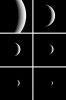
Venus-PIA10125.jpgFarewell to Venus54 visiteCaptio NASA:"After acquiring hundreds of HR images during close approach to Venus, the MESSENGER Spacecraft turned its wide-angle camera back to the Planet and acquired a departure sequence. These images provide a spectacular good-bye to the cloud-shrouded Planet while also providing valuable data to the camera calibration team. The MESSENGER Spacecraft was 60.688 Km (about 37.710 miles) from the Planet at the start of the sequence and 89.310 Km (approx. 55.495 miles) at the end. Initially, images were acquired at a rate of one of every 20', and then as Venus shrank the timing interval was increased to 60'.
The first image was taken on June 6, 2007, at 12:58 UTC (8:58 p.m. EDT on June 5), and the final image on June 7 at 02:18 UTC (10:18 p.m. EDT on June 6). During this 25 h, 20' period the Spacecraft traveled 833.234 Km (about 517.748 miles-more than twice the distance from the Earth to the Moon) with respect to Venus at an average speed of 9,13 Km-per-second (such as 5,67 miles-per-second).
These images represent the last view of Venus by the MESSENGER Spacecraft, but they also point toward the spacecraft's first encounter with Mercury in January 2008".MareKromium
(2 voti)
|
|

Thermal_Map-ORB410_01_surf_comp_H1.jpgThermal Map of Venusian Surface (comparison ESA/NASA)54 visiteCaption ESA:"An unprocessed thermal map of the Venusian Surface obtained by VIRTIS on 5 June 2007 (left) is compared here with a radar image of the same area obtained by NASA’s Magellan Spacecraft in the 1990s (right).
VIRTIS, the imaging spectrometer on board Venus Express, obtained this image at 1 micrometre, a wavelength that allows detection of radiation originating from the surface. The imaged region is that which NASA’s MESSENGER flew over as it made its closest approach to the Planet.
Magellan’s radar imaging and altimetry maps made it possible to measure the elevation and the radio-optical properties of the surface. Venus Express’ VIRTIS is providing the first complete set of thermal maps of the surface of Venus.
Correlations between topographic and thermal data similar to the ones shown in this image-composite will allow the scientists to understand if the measured temperature of the surface depends only on the altitude – where higher altitudes simply corresponds to colder, temperatures such as on Earth – or if it depends on the presence of previously undetected sources of heat such as active volcanoes".MareKromium
(2 voti)
|
|

Venus-Volcano-NasaRubin_1600.jpgVenusian "Active" Volcano150 visiteCaption NASA Originale:"What would an erupting volcano on Venus look like? Evidence of currently active volcanoes on Venus was announced earlier this year with the unexplained warmth of regions thought to contain only ancient volcanoes.
Although large scale images of Venus have been taken with radar, thick sulfuric acid clouds would inhibit the taking of optical light vistas. Nevertheless, an artist's reconstruction of a Venusian volcano erupting is featured.
Volcanoes could play an important role in a life cycle on Venus as they could push chemical foods into the cooler upper atmosphere where hungry microbes might float. Pictured, the plume from an erupting volcano billows upwards, while a vast lava field covers part of the hot and cracked surface of Earth's overheated twin. The possibility of airborne microbial Venusians is certainly exciting, but currently controversial".MareKromium
(1 voti)
|
|
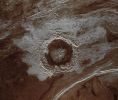
Craters-Dickinson_Crater-PIA00479.jpgDickinson Crater (possible Natural Colors; credits: Dr Paolo C. Fienga - Lunexit Team)63 visiteThis Magellan image is centered at 74,6° North Latitude and 177,3° East Longitude, in the North/Eastern Atalanta Region of Venus.
The image is approximately 185 Km (about 115 miles) wide at the base, and shows Dickinson, an Impact Crater of about 69 Km (approx. 43 miles) in diameter. The Crater is complex, characterized by a partial Central Ring and a Floor flooded by radar-dark and radar-bright materials.
Hummocky, rough-textured ejecta extend all around the Crater, except to the West. The lack of ejecta to the West may indicate that the Impactor that produced the Crater reached the Surface on an oblique angle, and from the West.
Extensive radar-bright flows that emanate from the Crater's Eastern Walls may represent large volumes of impact melt, or they may be the result of volcanic material released from the Subsurface during the cratering event.MareKromium
(1 voti)
|
|

Hestia_Rupes-PIA00469.jpgComplex Network of Narrow Fractures near Hestia Rupes Region (possible Natural Colors; credits: Dr Paolo C. Fienga - Lunexit Team)55 visiteThis is a Magellan radar image covering an about 105- Km (approx. 63-mile) by 45-Km (approx. 27-mile) Region near Hestia Rupes on the North-Western corner of Aphrodite Terra.
The complex network of narrow (such as <1 Km) Fractures in the center of the image extends for approx. 50 Km (about 31 miles). This network exhibits tributary-like branches similar to those observed in river systems on Earth. However, the angular intersections of the tributaries suggest tectonic control.
These features appear to be due to drainage of lava along preexisting fractures and subsequent collapse of the Surface. The underlying tectonic fabric can be observed in the North-East trending Ridges which predate the Plains.MareKromium
(1 voti)
|
|

Craters-Mona_Lisa_Crater-PCF-LXTT-01.jpgMona Lisa Crater (Natural Colors; credits: Lunar Explorer Italia)56 visitenessun commentoMareKromium
(1 voti)
|
|

Venusian_Surface-Venera_10-00.jpgVenus from Venera 10 - October, 25, 1975 - The Original Frame197 visiteNostante la fittissima schermatura costituita dalle nuvole (35/40 Km di spessore), però, la luminosità del paesaggio su Venere sarebbe in ogni caso molto elevata. Per quanto attiene le rocce piatte riprese dal Lander Sovietico (in parte ricoperte da polveri), diremmo che si potrebbe trattare di rocce basaltiche, non troppo diverse da quelle che potremmo trovare sia su Marte, sia sulla Terra stessa, in prossimità di aree vulcaniche attive.
(17 voti)
|
|
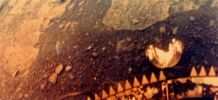
Venusian_Surface-Venera_13-04.jpgVenus from Venera 13 - March, 1, 1982 - color detail426 visiteAncora un'area vulcanica, dunque, dal colore giallastro.
Un probabile segnale della presenza di zolfo? Può darsi, ma può anche darsi che si tratti di un effetto di illuminazione causato dalla presenza, nei pressi della Sonda, di un'intensa sorgente luminosa di color giallo e rosso.
Come un camino vulcanico attivo, ad esempio, o un lago di lava. Entrambe le ipotesi, in difetto di elementi decisivi, sono valide ed accettabili.
(27 voti)
|
|

2-Rising_Venus.jpgThe Phases of Venus (1)104 visiteThe images above, by the talented amateur astronomer Damian Peach, show the appearance of Venus through a high-quality telescope, at various points in its orbit. When Venus is close, its diameter is almost visible to the naked eye (one minute of arc), but it is then lit from behind.
(16 voti)
|
|

Venusian_Surface-Venera_13-01.jpgVenus from Venera 13 (camera 1)127 visitenessun commento
(16 voti)
|
|

Volcanic_Features-_Volcanic_Domes_in_Tinantin_Planitia.jpgMagellan Probe: radio image of Volcanic Domes in Tinatin Planitia138 visiteTra le altre cause della perdita del contatto radio possiamo anche includere l'impatto della Navicella con un "corpo vagante" o magari il verificarsi di un repentino mutamento nell'orbita di Magellano causato da un fenomeno di influenza gravitazionale (p.e.: un altro corpo celeste che transita in prossimità della Navicella e la "spinge" fuori dalla propria orbita).
Forse la Sonda si è "rotta" o forse essa ha, semplicemente, esaurito la propria "energia vitale" e si è spenta per sempre: ognuno può pensare quello che vuole e, anche se la verità non la sapremo mai, i risultati del lavoro di Magellano, qualunque sia stata la causa della sua fine, renderanno questa Sonda, comunque, degna di una memoria immortale.
(18 voti)
|
|
| 126 immagini su 11 pagina(e) |
 |
|
|
|
|
|
|
9 | |
|





