| Piú votate - Venus |

Craters-Geopert_Crater-PIA00269.jpgMagellan Probe: radio image of Geopert-Meyer Impact Crater73 visiteCaption NASA originale:"During the third global cycle of Magellan's radar mapping mission, images were obtained at viewing angles that were slightly different than those used in the first two cycles. This strategy was designed to produce stereo image pairs, which take advantage of distortions induced by the different views to provide details of the surface topography. This is a stereo image pair of Crater Geopert-Meyer, named for the 20th Century Polish physicist and Nobel laureate (60° north latitude; 26,5° east longitude). The Crater, 35 Km (22 miles) in diameter, lies above an escarpment at the edge of a ridge belt in southern Ishtar Terra. West of the crater the scarp has more than 1 Km of relief. Perception of relief may be obtained with stereo glasses or a stereoscope".
(4 voti)
|
|

Venus-Mariner_10.jpgVenus, from Mariner 10 (Natural Colors; credits: NASA/JPL)103 visitenessun commentoMareKromium
(3 voti)
|
|

Craters-Unnamed_Complex_Crater-PIA00462-PCF-LXTT-IPF.jpgUnnamed Complex Crater (Possible Absolute Natural Colors; credits for the additional process. and color.: Dr Paolo C. Fienga/Lunar Explorer Italia/Italian Planetary Foundation)82 visiteThe NASA - Magellan Spacecraft imaged this multiple-Floored, highly Irregular Impact Crater at Latitude 16,4° North and Longitude 352,1° East, during its 481st and 482nd orbits around the Planet Venus (on Earth, it was September, 27, 1990). This Impact Crater, about 9,2 Km (such as approx. 5,7 miles) in maximum diameter, was formed on what appears to be a slightly fractured, radar-dark (---> smooth) Venusian Plain. The abundant, low viscosity Flows associated with this Impact Event have, however, filled local Fault-controlled Troughs (---> Graben). These shallow Grabens are well portrayed on this Magellan image but they would have been unrecognizable if they had not (coincidentally) been infillled by the radar-bright Crater Flows.
This fortuitous enhancement by the Crater Flows - of Fault Structures - that were below the resolution capacity of the Magellan Synthetic Aperture Radar provided the Magellan Science Team with valuable Geologic information. For instance, the Flow Deposits from this Impact Crater are now thought to consist - primarily - of "Shock Melted Rock" (---> such as a remarkable quantity of almost liquid rocky material that got pushed away and outwards by the powerful shock-wave/s that followed the original Impact Event/s) and Fragmented Debris resulting from the nearly simultaneous impacts of 2 (two) projectile fragments into the hot (---> approx. 426° Celsius - or about 800 degrees Farheneit) Surface Rocks of Venus. On the other hand, the presence of various Floors in this highly Irregular Impact Crater is interpreted to be the result of Crushing, Fragmentation, and eventual Aerodynamic Dispersion of a single entry projectile (---> meteor) during its passage through the dense Venusian Atmosphere.
This frame (which is an Original NASA - Magellan Spacecraft Radio-Image published on the NASA - Planetary Photojournal with the n. PIA 00462), since it is just a Radio-Image of the Venusian Surface and NOT a real view of it, has been colorized, according to an educated guess carried out by Dr Paolo C. Fienga (LXTT-IPF), in what they could reasonably be its possible Absolute Natural Colors (such as the colors that a human eye would perceive if someone were onboard the NASA - Magellan Spacecraft and, once the thick layer of Venusian Clouds and Fogs is completely overcome, looked down, towards the Surface of Venus itself), by using an original technique created - and, in time, dramatically improved - by the Lunar Explorer Italia Team.MareKromium
(3 voti)
|
|

Venus-PIA10124-PCF-LXTT-IPF.jpgApproaching Venus (Absolute Natural Colors; credits for the additional process. and color.: Dr Paolo C. Fienga/Lunar Explorer Italia/Italian Planetary Foundation)79 visiteCaption NASA:"The Planet Venus is enshrouded by a Global Layer of Clouds that obscures its surface to the MESSENGER Dual Imaging System (MDIS) cameras. This single frame is part of a color sequence taken to help the MESSENGER team calibrate the camera in preparation for the spacecraft's first flyby of Mercury on January 14, 2008. Over the next several months the camera team will pore over the 614 images taken during this Venus encounter to ascertain color sensitivity and other optical properties of the instrument. These tasks address two key goals for the camera at Mercury: understanding surface color variations and their relation to compositional variations in the Crust, and ensuring accurate cartographic placement of features on Mercury's Surface.
Preliminary analysis of the Venus Fly-By images indicates that the cameras are healthy and will be ready for next January's close encounter with Mercury".
Nota Lunexit: questo NASA - MESSENGER color-frame è stato prima riportato sulla Scala dei Grigi, poi ingrandito, riprocessato e poi ricolorizzato in Colori Naturali Assoluti. Il risultato è un pò bizzarro, probabilmente poco realistico, ma sen'altro suggestivo. Giudicate Voi!MareKromium
(3 voti)
|
|
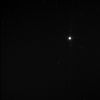
Venus-PIA12443.jpgVenus, overexposed and from VERY FAR AWAY...54 visiteImages from the latest Vulcanoid search are currently being transmitted to Earth, and one of those 256 images is shown here.
Vulcanoids are small rocky bodies that have been postulated to exist in orbits between Mercury and the Sun, though no such object has yet been detected.
MESSENGER has the unique opportunity to search for smaller and fainter Vulcanoids than has ever before been possible.
The best opportunities for MESSENGER to search for Vulcanoids are during perihelion passages, when the Spacecraft's orbit brings it closest to the Sun. MESSENGER has searched for Vulcanoids during three perihelion passages to date, in June 2008, in February 2009, and most recently in January 2010.
There will be another three perihelion passages in 2010, which will provide additional opportunities to continue the search.
MESSENGER images acquired to date have not revealed any Vulcanoids.
The bright object in the image here is Venus. For examining Venus, the image is over-exposed, but in the quest for very small, very faint objects, this type of image is just what is needed.MareKromium
(3 voti)
|
|

Craters-Isabella_Crater-PIA00480.jpgIsabella Crater (possible Natural Colors; credits: Dr Paolo C. Fienga - Lunexit Team)55 visiteCrater Isabella, with a diameter of approx. 175 Km (such as about 108 miles), seen in this MRI (Magellan Radar Image), is the second largest Impact Crater on Venus.
The feature is named in honor of the 15th Century Queen of Spain, Isabella of Castile. Located at 30° South Latitude and 204° East Longitude, the Crater has two extensive flow-like structures extending to the South and to the S/E.
The end of the Southern Flow partially surrounds a pre-existing 40 Km (approx. 25 mile) circular Volcanic Shield.
The South-Eastern Flow shows a complex pattern of Channels and Flow Lobes, and is overlain at its South-Eastern tip by deposits from a later approx. 20 Km (about 12 mile) diameter Impact Crater, Cohn (for Carola Cohn, Australian artist, 1892-1964).
The extensive Flows, unique to Venusian Impact Craters, are a continuing subject of study for a number of Planetary Scientists. It is thought that the Flows may consist of "Impact Melt", suc as rock melted by the intense heat released in the impact explosion. An alternate hypothesis invokes "Debris Flows", which may consist of clouds of hot gases and both melted and solid rock fragments that race across the landscape during the impact event.
That type of Emplacement Process is similar to that which occurs in violent eruptions on Earth, such as the 1991 Mount Pinatubo eruption in the Philippines.MareKromium
(3 voti)
|
|

Ovda_Regio-PIA00218.jpgOvda Regio (possible Natural Colors; credits: Dr Paolo C. Fienga - Lunexit Team)56 visiteThis Magellan image shows part of the interior of Ovda Regio, one of the large Highlands ringing the Equator of Venus.
Several tectonic events formed this complex block fractured terrain. An underlying fabric of Ridges and Valleys strikes N/E - S/W. These Ridges are spaced approx. 10 to 20 Km (such as about 6 to 12 miles) apart and may have been caused by shortening of the crust at right angles to this trend.
These structures are cut by thoroughgoing extension fractures trending N/W - S/E, suggesting a later episode of N/E - S/W extension. Lastly, the largest Valleys, particularly the about 20 Km (approx. 12 mile) wide one extending across the image, were filled with dark material, probably Lava.
The complex internal fabric of Ovda Regio attests to a long history of tectonic deformation.
This image, centered approx. at 1° South Lat. and 81° East Long., measures approx. 225 Km (about 140 miles) by approx. 150 (about 90 miles) and was acquired by Magellan in November 1990.MareKromium
(3 voti)
|
|

Volcanoes-Ammavaru-PCF-LXTT.jpgAmmavaru (Natural Colors; credits: Lunar Explorer Italia)61 visitenessun commentoMareKromium
(3 voti)
|
|

Craters-Balch_Crater-1.jpgBalch Crater (Natural Colors; credits: Lunar Explorer Italia)54 visitenessun commentoMareKromium
(3 voti)
|
|

Venus-South_Pole-00.jpgThe South Pole of Venus (False Colors; credits: ESA)55 visiteCaption ESA:"This is a false-colour image taken with the Venus Monitoring Camera (VMC) on board ESA’s Venus Express.
It shows the full view of the Southern Hemisphere from Equator (Dx) to the Pole.
The South Pole is surrounded by a dark oval feature. Moving to the right, away from the Pole and towards the Equator, we see streaky clouds, a bright mid-latitude band and mottled clouds in the convective Sub-Solar Region.
This image was taken in the ultraviolet at 365 nanometres on 23 July 2007 as Venus Express was about 35.000 Km from the Surface of the Planet".MareKromium
(3 voti)
|
|

Venusian_Clouds-29_VM_Pericentre_mosaic_H.jpgChaotic "Cloud Patterns" at Venus54 visiteCaption ESA:"This mosaic of Venus’ cloud tops was put together with several images obtained by the Venus Monitoring Camera (VMC) on board ESA’s Venus Express. The images where taken in the ultraviolet (365-nanometre wavelength) on 15 August 2006 at distances from 5000 to 1000 Km from the Planet.
The picture clearly shows streaks, wave trains and convection cells. The elongated orbit of Venus Express allows one to zoom into the cloud features as the Spacecraft approaches the Planet. This mosaic shows that mottled and chaotic cloud patterns at low latitudes give way to oriented streaks at about 15° South.
This behaviour indicates transition between two different cloud motion regimes – a ‘dynamic’ regime dominated by local convection where the Sun light hits the Planet perpendicularly (so-called "Sub-Solar Point") - and a more regular, quasi-laminar-flow regime".
MareKromium
(3 voti)
|
|

Venusian_Atmosphere_and_the_Solar_Wind-Interaction.jpgInteraction between Venus and the Solar Wind55 visiteCaption ESA:"Mars, Earth and Venus are immersed in a flow of plasma, a ionised and highly variable gas originating from the Sun, called the Solar Wind. While Earth has a Planetary Magnetic Field, which can deviate its flow, Venus (and Mars) don’t.
Gases in the upper atmospheres of these Planets are ionised, and can thus interact with the Solar Wind. Venus is as large as Earth and it is difficult for its Atmosphere to escape due to the Planet’s Gravity. The Solar Wind is the best source of energy to accelerate the upper atmosphere’s charged particles, giving them enough energy to escape. This is why Venus loses its atmosphere due to interaction with the Solar Wind.
To understand this phenomenon, the key questions that the instruments studying plasma on Venus Express must answer are: what and how much of the Atmosphere is lost, and where is it lost? Right now, solar activity is at its minimum in the 11-year cycle, making the Solar Wind weaker than average.
The critical question now is how solar wind interacts with Venus when solar activity is low".MareKromium
(3 voti)
|
|
| 126 immagini su 11 pagina(e) |
 |
|
|
|
|
7 | |
|
|
|





