| |

| Piú votate - Venus |

Venusian_Atmosphere-ORB157_00_17_WB_H.jpgVenusian Turbulence: South Polar Region54 visiteThis image of the Venusian South Polar Region was acquired on 24 September 2006 by the Ultraviolet, Visible and Near-Infrared Mapping Spectrometer (VIRTIS) on board ESA’s Venus Express, from a distance of about 60.000 Km from the Planet’s surface.
The image, taken on the night-side of Venus at a wavelength of 1,7 micron, shows waves structure (faint light vertical streaks at the lower left part of the dark band in the centre-left side of the image) and a highly turbulent region (bottom left).
The Alpha Regio area is at the bottom left of the image. This area is characterised by a series of troughs, ridges, and faults that are oriented in many directions, with surface features that can be up to 4 kilometres high. It is not yet clear if atmospheric turbulences may be induced by the rough topography below the clouds.
The grey-scale of the image is such that black means more transparency, therefore less clouds, while white means more opacity, therefore more cloud concentration. MareKromium
(4 voti)
|
|
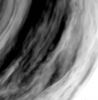
Venusian_Atmosphere-ORB157_01_17_WB_H.jpgVenusian Turbulence: the Alpha Regio Area61 visiteThis image of the Venusian South Polar Region was acquired on 24 September 2006 by the Ultraviolet, Visible and Near-Infrared Mapping Spectrometer (VIRTIS) on board ESA’s Venus Express, from a distance of about 65.000 Km from the Planet’s surface.
The image, showing a complex cloud system, was taken on the night-side of Venus (04:00 Local Time - V.L.T.), at a wavelength of 1,7 micron that allows viewing the deep atmospheric layers. The field of view covers an area located at approximately 20° West Longitude (diagonal top left to bottom right), spanning from the Equator (at the horizon on the right) to 60° Southern Latitude (top left corner of the image).
The grey-scale of the image is such that black means more transparency, therefore less clouds, while white means more opacity, therefore more cloud concentration.
The Alpha Regio area is at the bottom left of the image. This area is characterised by a series of troughs, ridges, and faults that are oriented in many directions, with surface features that can be up to 4 kilometres high. It is not yet clear if atmospheric turbulences may be induced by the rough topography below the clouds.MareKromium
(4 voti)
|
|

Venusian_Atmosphere-ORB157_02_17_WB_H.jpgVenusian Turbulence: the Alpha Regio Area54 visiteThis image of the Venusian South Polar Region was acquired on 24 September 2006 by the Ultraviolet, Visible and Near-Infrared Mapping Spectrometer (VIRTIS) on board ESA’s Venus Express, from a distance of about 53.000 Km from the Planet’s surface.
The image, taken on the night-side of Venus at a wavelength of 1,7 micron, shows waves structure (faint light vertical streaks at the lower left part of the dark band in the centre-left side of the image) and a highly turbulent region (bottom left).
The Alpha Regio area is at the bottom left of the image. This area is characterised by a series of troughs, ridges, and faults that are oriented in many directions, with surface features that can be up to 4 Km high. It is not yet clear if atmospheric turbulences may be induced by the rough topography below the clouds.
The grey-scale of the image is such that black means more transparency, therefore less clouds, while white means more opacity, therefore more cloud concentration.MareKromium
(4 voti)
|
|

Venusian_Atmosphere-ORB157_03_17_WB_H.jpgVenusian Turbulence: the Near-Equatorial Region55 visiteThis image of the Near-Equatorial Region of Venus was acquired on 24 September 2006 by the Ultraviolet, Visible and Near-Infrared Mapping Spectrometer (VIRTIS) on board ESA’s Venus Express, from a distance of about 37.000 Km from the Planet’s surface.
The image, taken on the night-side of Venus at a wavelength of 1,7 micron, provides a close-up view of a highly turbulent region, with irregular and warped clouds, which is common at these low latitudes. This is different from what happens at higher latitudes (pole-ward) where clouds are generally streaky and more regularly shaped.
The gray ‘bubble’ slightly below the centre of the image is located at about 27° Southern Latitude and 7° Western Longitude, and has a diameter of about 300 Km.
The Alpha Regio area is at the bottom left of the image. This area is characterised by a series of troughs, ridges, and faults that are oriented in many directions, with surface features that can be up to 4 Km high. It is not yet clear if atmospheric turbulences may be induced by the rough topography below the clouds.
The grey-scale of the image is such that black means more transparency, therefore less clouds, while white means more opacity, therefore more cloud concentration.MareKromium
(4 voti)
|
|

South_Polar_Vortex-00.jpgVenusian South Polar Vortex (1)55 visiteOriginal ESA caption:"On 20 April 2006, after its first 9-day, elongated orbit around Venus, ESA’s Venus Express started to get closer to the Planet, until it reached its final 24-hour long orbit on 7 May. During this time, and up to today, the spacecraft has been working relentlessly: the new data coming in are already providing first glimpses on planetary features never seen before.
If taking the first ever clear images of the double-eye vortex at Venus’ South Pole - imaged by Venus Express during its very first orbit - was already a first in the history of planetary exploration and a very pleasant surprise for the scientists, nobody could expect that the vortex had a structure even more complicated than possibly foreseen".
(4 voti)
|
|

South_Polar_Region-InfraRed-2.jpgVortexes at the South Pole of Venus (infrared) - frame 255 visiteThese 6 (4 in the previous frame plus 2 in this frame) different infrared images (in false colour) were taken by the VIRTIS on board ESA’s Venus Express spacecraft between 12 and 19 April 2006, during the first orbit, or ‘capture orbit’, around the Planet.
The images (taken at 5 microns) were obtained at six different time slots and different distances from Venus (top left - frame 1: 12 April, from 210.000 Km; top centre - frame 1: 13 April, from 280.000 Km; top right - frame 2: 14 April, from 315.000 Km; bottom left - frame 1:16 April, from 315.000 Km; bottom centre - frame 1: 17 April, from 270.000 Km; bottom right - frame 2: 19 April, from 190.000 Km), while the spacecraft moved along a long ellipse around the Planet.
(4 voti)
|
|

South_Polar_Region-InfraRed-1.jpgVortexes at the South Pole of Venus (infrared) - frame 155 visiteHigh velocity winds are known to spin westwards around the planet, and to take only four days to complete a rotation. This 'super-rotation', combined with the natural recycling of hot air in the atmosphere, would induce the formation of a vortex structure over each pole. But why two vortexes?
"We still know very little about the mechanisms by which the super-rotation and the polar vortexes are linked," said Håkan Svedhem, ESA’s Venus Express Project Scientist. "Also, we are still not able to explain why the global atmospheric circulation of the planet results in a double and not single vortex formation at the poles. However the mission is just at the beginning and it's doing fine; we expect this and many other long-standing mysteries to be addressed and possibly solved by Venus Express" he added. Atmospheric vortexes are very complex structures that are very difficult to model, even on Earth.
Thanks to these first pictures, it has also been possible to observe the presence of a collar of cold air around the vortex structure, possibly due to the recycling of cold air downwards.
(4 voti)
|
|

Venus-South Pole-PioneerVenus_South%20PoleVortex_H.jpgThe South Pole of Venus (again)63 visiteThese two images of Venus’s South Pole were taken by NASA’s Mariner 10 (during a Venus fly-by on its way to Mercury) and Pioneer Venus Missions during the early 1970s and 1980s, respectively.
The images provided the first glimpses about a stormy atmospheric behaviour at the south pole of the planet.
(4 voti)
|
|

Venus-South Pole-Infrared-COB_combi_38b.jpgVortex over the South Pole of Venus (infrared vision)60 visiteDuring this first orbit – called the 'capture orbit' – some of the Venus Express instruments were used to perform the first observations at different distances from Venus, for a few hours per time on six different slots between 12 and 19 April 2006.
Amazing infrared, visible and ultraviolet images of the Venusian globe already reveal several atmospheric features of great interest.
The most striking of these is a huge, double-eye atmospheric vortex over the South Pole, not dissimilar from the equivalent structure present at the North Pole – the only one previously studied in some detail.
Only glimpses of the stormy atmospheric behaviour at the south pole were obtained by previous missions (Pioneer Venus and Mariner 10), but such a double-eye structure was never clearly seen before now.
This composite image shows six infrared views of Venus as seen by the Ultraviolet/Visible/Near-Infrared spectrometer (VIRTIS) on board ESA’s Venus Express spacecraft between 12 and 19 April 2006, during the first orbit, or ‘capture orbit’, around the planet.
The images (taken at 5 microns) were obtained at six different time slots and at different distances from Venus (top left: 12 April, from 210 000 kilometres; centre left: 13 April, from 280 000 kilometres; bottom left: 14 April, from 315 000 kilometres; top right: 16 April, from 315 000 kilometres; centre right: 17 April, from 270 000 kilometres; bottom right: 19 April, from 190 000 kilometres), while the spacecraft moved along a long ellipse around the planet.
The infrared radiation coming from Venus was converted in this reddish colour scheme. Thermal radiation comes from the lower atmosphere, (just above the cloud top, located at about 60 kilometres altitude). Solar radiation reflected by the upper atmospheric layers (roughly between 60 and 80 kilometres altitude) and thermal radiation from the layers below contribute to the brightest part of the image.
The south polar vortex structure is visible from different view points close to the centre of the images, mostly in the dark side.
(4 voti)
|
|
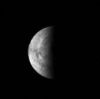
Venus-South_Pole-04.jpgVenus' South Pole (UV)60 visiteIn the 1st capture orbit, Venus Express will have 5 more opportunities for gathering data until reaching pericentre. These observations represent a great opportunity because, at apocentre, the full disc of Venus is fully visible for the spacecraft’s imagers. Such opportunities will not occur again during the nominal mission, starting on June, 4, 2006, when the range of distances from the Planet will be much smaller. In addition to VMC and VIRTIS, the spacecraft’s MAG (Venus Express Magnetometer) has been switched on for initial verification and is operating nominally. Together with the ASPERA (Analyser of Space Plasma and Energetic Atoms), the 2 instruments are expected to gather information about the unperturbed solar wind and the atmospheric escape processes on Venus, a Planet with no magnetic protection.
A series of further engine and thruster burns are planned to gradually reduce the apocentre during the following 16 orbital loops around the planet and the spacecraft is due to attain its final 24-hour polar orbit on 7 May, ranging from 66 000 to 250 kilometres above Venus.
(4 voti)
|
|

Venus-South_Pole-05.jpgVenus' South Pole (UV)63 visiteFalse-colour view imaged in ultraviolet of Venus' South pole captured by VMC - onboard Venus Express - on April, 12, 2006.
(4 voti)
|
|

Volcanoes-Maat_Mons-PIA00106.jpg3D view of Maat Mons77 visiteCaption NASA originale:"Maat Mons is displayed in this computer generated 3D view of the surface of Venus. The viewpoint is located 634 Km North of Maat Mons at an elevation of 3 Km above the terrain.
Lava flows extend for hundreds of kilometers across the fractured plains shown in the foreground, to the base of Maat Mons. The view is to the south with the volcano Maat Mons appearing at the center of the image on the horizon and rising to almost 5 Km above the surrounding terrain. Maat Mons is located at approx. 0,9° North latitude; 194,5° East longitude with a peak that ascends to 8 Km above the mean surface. Maat Mons is named for an Egyptian Goddess of Truth and Justice. Magellan synthetic aperture radar data is combined with radar altimetry to develop a three-dimensional map of the surface. The vertical scale in this perspective has been exaggerated 10 times".
(4 voti)
|
|
| 126 immagini su 11 pagina(e) |
|
|
|
|
6 | |
|
|
|
|
|
|





