| |

| Piú votate - Venus |

Venusian_Atmosphere-Airglow_VIRTIS_Anticlockwise-00.jpgThe "Airglow" of Venus54 visiteNew infrared data is now available about Venus’ oxygen airglow – a phenomenon detectable on the night-side that makes the planet glow like a ‘space lantern’.
“The oxygen airglow was first discovered thanks to ground observations, and also observed by other missions to Venus such as the Russian Venera spacecraft and the US Pioneer Venus orbiter,” said Pierre Drossart, co-Principal Investigator on Venus Express’ VIRTIS instrument. “However, the global and detailed view we are getting thanks to Venus Express is truly unprecedented.”
The fluorescence of the airglow is produced when oxygen atoms present in the atmosphere ‘recombine’ into molecular oxygen (or ‘O2’) emitting light. Where does the oxygen come from?
“The oxygen in the atmosphere of Venus is a very rare element,” continued Drossart. At high altitudes in the atmosphere, on the day-side of Venus, the strong flux of ultraviolet radiation coming from the Sun ‘breaks’ the molecules of carbon dioxide (‘CO2’) present in large quantity in the atmosphere, liberating oxygen atoms. “These atoms are then transported by the so-called ‘sub-solar’ and ‘anti-solar’ atmospheric circulation towards the night side of the planet. Here the atoms migrate from the high atmosphere to a lower layer, called ‘mesosphere’, where they recombine into O2. By doing this, they emit light at specific wavelengths that can be observed through remote sensing from Earth and with Venus Express,” added Drossart.
The detection of the airglow, and the capability to follow its evolution in time, is extremely important for several reasons.
“First, we can use the distribution and motion of these fluorescent O2 ‘clouds’ to understand how the atmospheric layers below move and behave,” said Giuseppe Piccioni, the other co-Principal Investigator on VIRTIS. “In this sense, the O2 airglow is a real ‘tracer’ of the atmospheric dynamics on Venus.”
“Second, the analysis of this phenomenon will provide new clues on how its global atmospheric chemistry works – a very challenging task indeed, and still an open field of research,” continued Piccioni. “By calculating the speed at which this chemical ‘recombination’ takes place, we might be able – in the future – to understand if there are mechanisms that favour, or catalyze, this recombination, and learn more about the production and recombination of the other chemical species in the Venusian atmosphere.”
“Third, the observation of the oxygen airglow also allows to a better understanding of the global ‘energetic’ exchange between Venus’s mesosphere – at upper boundary of which the airglow is situated, with Venus’ thermosphere, an even higher layer directly influenced by the Sun.”
MareKromium
(5 voti)
|
|

9-Venus.gifApproaching Venus (GIF anim.)56 visiteOn 20 April 2006, after its first 9-day, elongated orbit around Venus, ESA’s Venus Express started to get closer to the Planet, until it reached its final 24-hour long orbit on 7 May. During this time, and up to today, the spacecraft has been working relentlessly: the new data coming in are already providing first glimpses on planetary features never seen before.
If taking the first ever clear images of the double-eye vortex at Venus’ south pole - imaged by Venus Express during its very first orbit - was already a first in the history of planetary exploration and a very pleasant surprise for the scientists, nobody could expect that the vortex had a structure even more complicated than possibly foreseen.
Infrared images taken by the Ultraviolet/Visible/Near-Infrared spectrometer (VIRTIS) on board the spacecraft not only provided the first clear view of the vortex, but also gave a much closer insight into it when Venus Express flew over the South Pole at the end of May this year (2006). MareKromium
(5 voti)
|
|

Venusian_Clouds_and_winds_in_the_infrared_H.jpgVenusian cloud structures - Night view (2)57 visiteOriginal ESA caption:""We are also collecting the first information on the minor chemical components of the atmosphere, such as CO - Carbon Monoxide" added Pierre Drossart.
"With VIRTIS we can see in the atmosphere of the southern hemisphere deeper than any other previous mission, and we started gathering data on the yet unknown chemistry of the lower atmospheric layers, to build a global picture. Studying the variation of minor chemical compounds over different latitudes and depths is also a very useful tracer for the atmospheric global motion".
(5 voti)
|
|

Venusian_Clouds-Venus_Express-VOI_composit.jpgVenusian cloud structures: day-side and night-side55 visiteThe early infrared image making use of the windows, show complex cloud structures, all revealed by the thermal radiation coming up from different atmospheric depths. In this colour scheme, the brighter the colour (that is, the more radiation comes up from the lower layers), the less cloudy is the observed area.
During capture orbit, preliminary data about the chemical composition of the Venusian atmosphere were also retrieved. Venus’ atmosphere is mainly composed of Carbon Dioxide (CO2). The incoming solar radiation dissociates this molecule into Carbon Monoxide (CO) and Oxygen (O2) in the upper atmospheric layers. In fact, Venus Express has already spotted the presence of an Oxygen airglow high in the atmosphere. However, Venus Express has revealed the presence of Carbon Monoxide as low as the cloud-layer top.
Scientists will continue the data analysis and retrieval to understand the phenomenon, which is very important to clarify the complex chemical processes and cycles at work in the atmosphere of Venus under the influence of solar radiation.
(5 voti)
|
|

Craters-Unnamed_Craters_in_Lavinia_Planitia-PIA00103.jpg3D view of impact craters in Lavinia Planitia (simulated colors)87 visiteCaption NASA originale:"Three impact craters are displayed in this 3D perspective view of the surface of Venus. The center of the image is located at approx. 27° South latitude, 339° East longitude in the NWestern portion of Lavinia Planitia. The viewpoint is located SW of Howe Crater, which appears centered in the lower portion of the image. Howe is a crater with a diameter of 37,3 Km. Danilova, a crater with a diameter of 47,6 Km, appears above and to the left of Howe in the image. Aglaonice, a crater with a diameter of 62,7 Km, is shown to the right of Danilova.Magellan synthetic aperture radar data is combined with radar altimetry to develop a three-dimensional map of the surface. Rays cast in a computer intersect the surface to create a three-dimensional perspective view. Simulated color and a digital elevation map developed by the U.S. Geological Survey are used to enhance small-scale structure. The simulated hues are based on color images recorded by the Soviet Venera 13 and 14 spacecraft".
(5 voti)
|
|

Volcanoes-Maat_Mons-PIA00487.jpgVolcanic Domes on the Flank of Maat Mons - East Ovda Region (possible Natural Colors; credits: Dr Paolo C. Fienga - Lunexit Team)56 visiteThis Magellan image is centered at about 3,2° North Latitude and 194,9° East Longitude, in the Eastern Ovda Region of Venus.
The image, which is approx. 90 Km (about 56 miles) in width and approx. 80 Km (such as about 50 miles) in length, shows some small Volcanic Domes on the Flank of the volcano Maat Mons. The bright flows to the East are most likely rough Lava Flows while the darker flows to the West are probably smoother flows. The dark flows do show some roughness, however, as can be seen by the structure in the flows to the South/West.
These dark flows also have some debris that has been deposited on top of them. The debris may be fine material from the surrounding Plains on top of the flow by wind or it may be ash from the volcano.
Small Volcanic Domes are very common features on the Surface of Venus, indicating that there has been (and maybe there still is) much volcanic activity going on almost everywhere.
Assuming that the central Volcanic Cone is symmetrical in shape and knowing the length of the cone's side and the incidence angle, radar foreshortening yields a height and slope of 688 meters and 8,2°, respectively, for the Cone.
These values are similar to heights and slopes of some Volcanic Cones on the Earth. MareKromium
(4 voti)
|
|

Channels-Unnamed_Outflow_Channel-PIA00483.jpgOutflow Channel in South Nawka Vallis (possible Natural Colors; credits: Dr Paolo C. Fienga - Lunexit Team)57 visiteThis SAR image from the Southern portion of Navka (24,4-25,3° South Latitude and 338,5-340,5° East Longitude) is a mosaic of twelve Magellan orbits that covers approx. 180 Km (about 108 miles) in width and approx. 78 Km (about 47 miles) in length.
In the center of this image are two bright Deposits running North to South.
These Deposits outline an Outflow Channel that flowed from an about 60-Km diameter Crater that is to the South of the Channel itself. Inside the Outflow Channel and outlined by some so-called 'Bathtub Ring' Deposits are small Cones, most likely of volcanic origin.
At the end of the Outflow Channel, where one would expect the smallest particles to be deposited, are specular features which may represent Sand Dunes.
Seasat and space shuttle radar images of sand dunes on Earth also show specular reflections from smooth dune faces that are near-normal to the radar beam.
Other evidence for aeolian activity are the dark and bright Windstreaks running East to West and that formed behind the Cones. Notice how the wind changes direction from a South/East-North/West flow at the right of the image to an East-West flow at the eastern edge of the Outflow Channel.MareKromium
(4 voti)
|
|
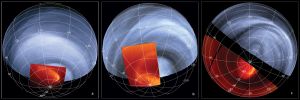
South_Polar_Regions-2008-04-03438_Composite_H.jpgThe Southern Hemisphere of Venus55 visiteCaption ESA:In this mosaic, InfraRed images taken at a wavelength of 5 micrometres (in red) are overlaid on UltraViolet images, taken at 0.365 micrometres.
The bright areas in the IR Images represent the temperatures at the cloud tops (dark regions denote lower temperatures). The oval feature that stands out in these images is the giant eye of a hurricane, or the Polar Vortex, at the Planet’s South Pole. Its centre is displaced from the South Pole and the structure measures about 2000 Km across, rotating around the Pole in about 2.5 days.
The Atmosphere rotates counterclockwise in this figure".MareKromium
(4 voti)
|
|

Craters-Adivar_Crater-1.jpgAdivar Crater (Natural Colors; credits: Lunar Explorer Italia)81 visitenessun commentoMareKromium
(4 voti)
|
|

Venus-South_Pole-01.jpgThe South Pole of Venus (false colors; credits: ESA)54 visiteDa "NASA - Picture of the Day", del 26 Febbraio 2006:"Why did an acidic haze spread across Venus? The unusual clouds were discovered last July by ESA's robotic Venus Express Spacecraft currently orbiting Venus. The bright and smooth haze was found by Venus Express to be rich in Sulfuric Acid (H2SO4), created when an unknown process lifted Water Vapor and Sulphur Dioxide (SO2) from lower levels into Venus' upper Atmosphere.
There, sunlight broke these molecules apart and some of them recombined into the volatile Sulfuric Acid. Over the course of just a few days last July, the smooth acidic clouds spread from the South Pole of Venus across half the Planet.
The above false-color picture of Venus was taken last July 23rd (2007) in UV (Ultraviolet Light), and shows the unusual haze as relatively smooth regions across the image bottom. The cause of the dark streaks in the clouds is also not yet understood and is being researched".MareKromium
(4 voti)
|
|

Venusian_Clouds_and_Haze-27_VMC_polar_views_H.jpgVenusian "Variable Clouds" and "Hazes"54 visiteCaption ESA:"This is a composite of several ultraviolet (365-nnmts) images taken with the Venus Monitoring Camera (VMC) on board ESA’s Venus Express.
These images show variability of the clouds and hazes in Venus’ South Polar Region.
The South Pole is at the Terminator in the bottom-left of the images.
Super-Rotation, a phenomenon where cloud layers on Venus rotate much faster than the surface below, is in the anticlockwise direction. The period of Super-Rotation varies between 3 and 5 days, depending on the latitude.
The images a, b and c in the top row were taken between 27 and 30 June 2006, at a distance of about 65.000 Km from the Planet.
It is obvious from the pictures that the near-polar features vary from one day to another.
An extreme case of such variability is shown in Figure d (obtained on 13 January 2007, from about 35.000 Km). The bright haze located above the absorbing cloud layer has expanded to 35º South and has also become denser, masking all features except the oval. This dense haze disappeared within a day, probably due to very quick coagulation of aerosols making up the haze.
The figure in panel e (obtained on 27 December 2006, from about 38.000 Km) shows the full view of the Southern Hemisphere from the Equator (right) to the Pole".MareKromium
(4 voti)
|
|

Venusian_Atmosphere-VI410_01_23_with_spot_H1.jpgThe Venusian Atmosphere under the Messenger56 visiteCaption ESA:"This grey-scale image, obtained by the VIRTIS instrument on board ESA’s Venus Express, shows the Atmospheric Region of Venus over which NASA’s MESSENGER Spacecraft passed on 5 June 2007. The Region of MESSENGER’s closest approach is in the night side (marked by a circle).
VIRTIS obtained this image at 2,3 micrometres from about 35.000 Km from the Planet, on the night side.
This wavelength makes it possible to probe the atmosphere down to about 30 Km from the surface. Much of the contrast in this image is due to the structure of the lower clouds.
The bright areas correspond to radiation from the lower atmospheric layers, indicating that the clouds are thinner in those areas. At the 2,3-micrometre wavelength it is possible to study not only the morphology of the cloud layers, but also its chemical composition (such as Carbon Monoxide - CO -, Water - H2O -, Sulphur Dioxide - SO2 -, etc)".MareKromium
(4 voti)
|
|
| 126 immagini su 11 pagina(e) |
|
|
|
5 | |
|
|
|
|
|
|
|





