| Piú votate - Venus |

Venusian_Surface-Venera_13-05.jpgVenus, from Venera 13 (an Image-Mosaic by Dr Marco Faccin - Lunexit Team)64 visiteQuesta immagine esce un pò dai canoni tipici e propri delle solite (ed orrende) immagini che si trovano in giro sulla Rete; sono stati usati, per la fotocomposizione, i frames originali - che sono stati ri-processati per ottenere qualcosa di decente su cui lavorare.
Parte dell'illuminazione di fondo ("glare") dell'Atmosfera di Venere è stata rimossa e/od abbattuta (ed infatti il pezzo che si vede in mezzo al frame ha una parte bianca, ed essa è bianca rispetto a tutte le altre famose foto reperibili sul WWW; la bandierina dei colori è meno confusa - si nota il rosso ed anche un altro colore, più blando, che però si stacca e non si fonde con il resto del panorama.
A qualcuno questa immagine potrà sembrare brutta, ma i colori originali sono quelli e NON SONO STATI ALTERATI!
Intendiamoci, questa elaborazione è nettamente più scura delle altre che si trovano sulla Rete, ma è proprio questo il nostro punto: creare un'alternativa RAZIONALE e CREDIBILE!
ATTENZIONE: l'Atmosfera di Venere non consente la diffusione della Luce Blu e, probabilmente, dei toni più chiari della Luce Verde.
Un altro grandissimo Lavoro del nostro eccezionale Dr Faccin (alias Titanio44).MareKromium
(5 voti)
|
|

Craters-Stephania_Crater-PIA00475.jpgStephania Crater (possible Natural Colors; credits: Dr Paolo C. Fienga - Lunexit Team)56 visiteCrater Stephania is located at 51,3° Norh Latitude and 333,3° East Longitude in Northern Sedna Planitia.
With a diameter of about 11 Km (6,8 miles), Stephania is one of the smaller Craters on Venus.
Because many small meteoroids disintegrate during their passage through the dense Venusian atmosphere, there is an absence of craters smaller than 3 Km (approx. 1,9 miles) in diameter, and even craters smaller than 25 Km (15,5 miles) are relatively scarce.
The apron of ejected material suggests that the impacting body made contact with the Surface from an oblique angle. Upon closer observation it is possible to delineate secondary craters, impact scars from blocks ejected from the primary crater.
A feature associated with this and many other Venusian Craters is a radar-dark halo.
Since dark radar return signifies a smooth surface, it has been hypothesized that an intense shock wave removed or pulverized previously rough surface material or that a blanket of fine material was deposited during or after the impact.MareKromium
(5 voti)
|
|

Volcanoes-PIA00261.jpgVolcanoes in Guinevere Planitia (possible Natural Colors; credits: Dr Paolo C. Fienga - Lunexit Team)55 visiteThis image, with radar illumination from West to East, shows three unusual Volcanoes located in the Guinevere Planitia Lowland. At the center of the image is a large feature (approx. 50 Km or about31 miles in diameter) with an unusual shape; very round when viewed from above with steep slides and a flat top.
These Volcanoes are believed to be the result of relatively thick and sticky (viscous) Lava Flows that originated from a point source. Although a faint remnant of its original circular shape is preserved, the Northern Rim of this center Volcano has a steep Scarp.
The Scarp is probably the result of material that has slid away from the Volcano and subsequently has been covered by Lava Flows. This Volcano overlaps another feature to the South-West that is about 45 Km (approx. 28 miles) in diameter and disrupted by many fractures.
The South-Eastern Volcano (about 25 Km or approx. 15,5 miles in diameter) appears to be the highest of the three as its illuminated Western Edge has the brightest radar return. The scalloped Edges give this feature a bottlecap-like appearance. The highly scalloped Edges are probably the result of multiple material slides along the Volcano Margin.MareKromium
(5 voti)
|
|

Venus_in_UV-2008-04-03438_Figure_1_H.jpgVenus in UV54 visiteCaption ESA:"Venus Monitoring Camera image taken in the UltraViolet (0.365 micrometres), from a distance of about 30.000 Km. This picture shows numerous high-contrast features, caused by an unknown chemical in the clouds that absorbs UltraViolet light, creating the bright and dark zones.
With data from Venus Express, scientists have learnt that the Equatorial Areas on Venus that appear dark in UV Light are Regions of relatively high temperature, where intense convection brings up dark material from below. In contrast, the bright regions at Mid-Latitudes are areas where the temperature in the Atmosphere decreases with depth. The temperature reaches a minimum at the cloud tops suppressing vertical mixing.
This annulus of cold air, nicknamed the ‘cold collar’, appears as a bright band in the UV images".MareKromium
(5 voti)
|
|

South_Polar_Regions-VI0310_00_5_H-PCF-LXTT.jpgVenus' South Polar Vortex (Absolute Natural Colors; credits for the additional process. and color.: Dr P>aolo C. Fienga - Lunexit Team)55 visiteCaption ESA:"This image, of the ‘Eye of the Hurricane’ on Venus was taken by the Visible and Infrared Thermal Imaging Spectrometer (VIRTIS) on board Venus Express.
This picture shows a Region in the Venusian Atmosphere about 60 Km from the Surface, at a wavelength of about 5 micrometres. In this figure, the dipole assumes an eye-like shape and from here until the last image, it is possible to see how its shape evolves rapidly in a span of only 24 hours.
The yellow dot in the image indicates the location of the South Pole".MareKromium
(5 voti)
|
|

Venusian_Surface-Venera_13-08.jpgVenus, from Venera 13 (Natural Colors; credits: Ted Stryk)66 visiteTed Stryk comments:"...Here is the other Venera 13 pan. The color data is OK on the sides, but in the center, all color data is nearly blank, making any color variations dubious in that part of the image...".
MareKromium
(5 voti)
|
|

Venus-South_Pole-02.jpgThe South Pole of Venus (Natural Colors; credits for the additional process. and color.: Dr Paolo C. Fienga - Lunexit Team)54 visitenessun commentoMareKromium
(5 voti)
|
|
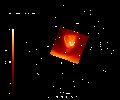
Venus-South_Polar_Vortex-13_VIRTIS_vortex_movie_H.gifThe restless South Pole of Venus (GIF-Movie - credits: ESA)54 visiteCaption ESA:"This video is composed of a set of images acquired by the Visible and Infrared Thermal Imaging Spectrometer (VIRTIS) on board ESA’s Venus Express, during two observations slots in August 2007. The spacecraft was flying at a distance of about 65.000 Km from the Planet.
The video was obtained at 3.8-micrometre wavelength, allowing the instrument to see the cloud top thermal emission at an altitude of about 60-65 Km.
The South Polar "Dipole", a complex atmospheric vortex-like feature situated over the South Pole of the Planet, can be clearly seen".MareKromium
(5 voti)
|
|

Venus-South_Polar_Vortex-12_VIRTIS_vortex_movie_H.gifThe restless South Pole of Venus (GIF-Movie - credits: ESA)79 visiteCaption ESA:"This video is composed of a set of images acquired by the Visible and Infrared Thermal Imaging Spectrometer (VIRTIS) on board ESA’s Venus Express, during two observations slots in August 2007. The spacecraft was flying at a distance of about 65.000 Km from the Planet.
The video was obtained at 3.8-micrometre wavelength, allowing the instrument to see the cloud top thermal emission at an altitude of about 60-65 km.
The South Polar "Dipole", a complex atmospheric vortex-like feature situated over the South Pole of the Planet, can be clearly seen.
The change of the Polar Vortex shape in a time scale of a few hours is remarkably noticeable here"MareKromium
(5 voti)
|
|
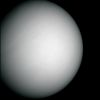
Venus-PIA10124.jpgVenus (natural colors; credits: NASA)54 visiteCaption NASA:"The Planet Venus is enshrouded by a global layer of clouds that obscures its surface to the MESSENGER Dual Imaging System (MDIS) cameras.
This single frame is part of a color sequence taken to help the MESSENGER team calibrate the camera in preparation for the spacecraft's first flyby of Mercury on January 14, 2008. Over the next several months the camera team will pore over the 614 images taken during this Venus encounter to ascertain color sensitivity and other optical properties of the instrument. These tasks address two key goals for the camera at Mercury: understanding surface color variations and their relation to compositional variations in the crust, and ensuring accurate cartographic placement of features on Mercury's surface.
Preliminary analysis of the Venus flyby images indicates that the cameras are healthy and will be ready for next January's close encounter with Mercury".MareKromium
(5 voti)
|
|
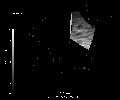
Venusian_Clouds-VI410_411_23_tot.gifVenusian Cloud Structure (GIF-movie)54 visiteCaption ESA:"This movie consists of a sequence of six images obtained by the VIRTIS imaging spectrometer on board ESA’s Venus Express on 5 and 6 June 2007, before and after NASA MESSENGER’s closest approach to the Planet. The image sequence, obtained by VIRTIS, provides a night-side view of the same region that Messenger flew over and imaged.
They were obtained at 1,7 micrometres, revealing atmospheric details down to an altitude of 50 Km from the surface".MareKromium
(5 voti)
|
|
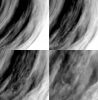
Venusian_Atmosphere-ORB157_multiple_H.jpgVenusian Turbulence: Image Mosaic of the (visible) Venusian Cloud System54 visiteThis image is a composite of four different views of the Venusian Cloud System.
The images were acquired on 24 September 2006 by the Ultraviolet, Visible and Near-Infrared Mapping Spectrometer (VIRTIS) on board ESA’s Venus Express, from distances of about 65.000 Km (top left), 60.000 Km (top right), 53.000 Km (bottom left), 37.000 Km (bottom right) from the Planet’s surface.
The images, showing a complex cloud system, were taken on the night-side of Venus (04:00 V.L.T.), at a wavelength of 1,7 micron that allows viewing the deep atmospheric layers.
The grey-scale of the images is such that black means more transparency, therefore less clouds, while white means more opacity, therefore more cloud concentration.MareKromium
(5 voti)
|
|
| 126 immagini su 11 pagina(e) |
 |
|
4 | |
|
|
|
|
|
|





