| Piú votate - Venus |

Venusian_Atmosphere-ORB410_411_tot_H1.jpgThe Venusian Atmosphere under the Messenger54 visiteCaption ESA:"The images in this panel were obtained by the VIRTIS imaging spectrometer on board Venus Express on 5 and 6 June 2007, before and after MESSENGER’s closest approach to the Planet. These panels from VIRTIS provide a night-side view of the same Region that Messenger flew over and imaged.
The images where obtained at 1,7 micrometres, revealing atmospheric details down to an altitude of 50 Km from the surface".MareKromium
(6 voti)
|
|

Venusian_Atmosphere-Airglow_VIRTIS_Anticlockwise-02.jpgThe "Glowing Oxygen" of Venus (false colors - elab. ESA)54 visite“During one year of observations, we have already collected huge amount of data, which is exactly what we need to decode the secrets of an atmosphere as complex as that of Venus,” said Håkan Svedhem, Venus Express Project Scientist at ESA. “Analysing it is an extreme effort for all science teams, but it is definitively paying back in terms of results.”
The first ever, terrific global views of the double-eyed vortex at Venus’ south pole, the first sets of 3D data about the structure and the dynamics of the sulphuric-acid clouds surrounding the planet in a thick curtain, temperature maps of the surface and the atmosphere at different altitudes, are only a few of the results obtained so far.
“Continuing at today’s rate, and on the basis of what we were able to see so far, there is no doubt that Venus Express will eventually allow a better global understanding of this planet,” continued Svedhem. “Not only will planetary science in general benefit from this, but also understanding Venus – its climate and atmospheric dynamics –will provide a better comprehension of the mechanisms that drive long-term climate evolution on our own Earth.”
MareKromium
(6 voti)
|
|

7-Venus_orbit31V3_fc_H.jpgThe Bright&Blue Northern Hemisphere of Venus60 visitenessun commento
(6 voti)
|
|

Venusian_Clouds_tracking_infrared_2_b_H.jpgVenusian cloud structures - Night view (1)54 visiteOriginal ESA caption:"Tracking cloud motion and starting to characterise the wind speed is an exercise that the Venus Express scientists have already started. A spectacular night view of the mid to low atmospheric layers over low latitudes (between 20º and 90 º South) by VIRTIS, show clouds being clearly pushed by winds.
"We can now make a first qualitative assessment of the wind fields and circulation, which is comfortably matching with previous measurement from the Galileo mission over the North Pole", said Giuseppe Piccioni.
"We are now collecting more data from different atmospheric depths, to be able to provide the first precise numbers, possibly in the near future".
(6 voti)
|
|

South_Polar_Vortex-02.jpgVenusian South Polar Vortex (3)54 visiteOriginal ESA caption:"The reason why the morphology of the vortex varies so extensively along a 'vertical' line is still unexplained.
"This is why we are organizing a campaign to observe the South Polar Vortex, fully dedicated to solve this unexpected puzzle", said Giuseppe Piccioni, VIRTIS co-Principal Investigator.
"First we want to understand how the structure is organized - actually, with VIRTIS we are building a true 3D view of the vortex. Then we hope to be able to better understand what are the driving forces that shape it".
(6 voti)
|
|

8-Venus_from_Venus_Express-VIRTIS_COB05_vis_397_b.jpgVenus, from Venus Express (natural colors)79 visiteCaption ESA originale:"Views of the Southern Hemisphere of Venus in visible and ultraviolet light show interesting atmospheric stripe-like structures.
Spotted for the first time by Mariner 10 in the 1970s, they may be due to the presence of dust and aerosols in the atmosphere, but their true nature is still unexplained. "Venus Express has the tools to investigate these structures in detail. Studies have already begun to dig into the properties of the complex wind fields on Venus, to understand the atmospheric dynamics on local and global scales".
Venus Express also made use for the first time ever from orbit of the so-called 'infrared windows' present in the atmosphere of Venus – if observed at certain wavelengths, it is possible to detect thermal radiation leaking from the deepest atmospheric layers, revealing what lies beneath the dense cloud curtain situated at about 60 Km altitude".
(6 voti)
|
|

Venusian_Surface-Venera_09-000.jpgVenera 9: the Spacecraft65 visiteGiven the intense temperatures and pressures of Venus, it is indeed impressive that Russian engineers were able to successfully land vehicles there 10 times during the 1970s and 1980s. These were Venera 7 to 14, and Vega 1 and 2 which deployed landers and balloon-born instrument packages. Although not designed to land, one of the free-falling Pioneer atmosphere probes gets honorable mention by surviving impact and continuing to transmit for a few minutes. The atmosphere of Venus is so thick that terminal velocity was only about 30 mph.
Seen above, the six-foot-tall Venera 9 lander was the first to take pictures of the surface, on October 20, 1975. The Venera orbiter and lander was a 10,000-pound spacecraft, one of the largest unmanned vehicles ever sent into space. Besides the camera system, the Venera landers measured the sky spectrum, atmospheric gases, cloud particles, and performed chemical analysis of surface rocks.
Looking out through 1 cm quartz pressure windows, Venera 9 to 14 captured spherical panoramas of 40º by 180º. The cameras used a pivoting mirror and photomultiplier tube, giving remarkably low-noise images which were digitized to 9 bits per pixel. Venera 13 and 14 had two cameras and were able to capture images though clear, red, green and blue filters. So some portions of their panoramas contain color information. Venera 11 and 12 were unable to return pictures because of an equipment failure, but the rest of their experiments were successful.
These images have often been displayed as very poor quality pictures taken off film or even photographed off printed pages of Soviet journals. The images I show here are derived from the digital telemetry by the Russian image processing team. In the case of Venera 9 and 10, I undid a pixel replication and replaced it with a higher quality interpolation filter. For Venera 13 and 14, I combined the chroma signal from the dark somewhat noisy color images with the luminance signal of the clear-filter images.
Venera 13 and 14 survived longer than expected and returned dozens of images, repeating their program of clear and color scans. I hope to process that data into a super resolution image and to recalculate the perceptual color values.
(6 voti)
|
|

South_Polar_Regions-2.jpgHot vortex over Venus' South Pole60 visiteESA's Venus Express has returned the first-ever images of the hothouse Planet’s South Pole from a distance of 206.452 Km, showing surprisingly clear structures and unexpected detail. The images were taken on April 12, 2006, during the spacecraft’s initial capture orbit after successful arrival on the 11th.
Engineers have lost no time in switching on several of the instruments and yesterday the VMC (Venus Monitoring Camera) and VIRTIS (Visible and Infrared Thermal Imaging Spectrometer) imaged, for the first time in space history, the Southern Hemisphere of Venus as the spacecraft passed below the Planet in an elliptical arc.
Scientists are especially intrigued by the dark vortex shown almost directly over the South Pole, a previously suspected but until now unconfirmed structure that corresponds to a similar cloud structure over the North Pole. “Just one day after arrival, we are already experiencing the hot, dynamic environment of Venus” said Dr Hakan Svedhem, Venus Express project scientist“.
“We will see much more detail at an unprecedented level as we get over 100 times better resolution as we get closer to Venus, and we expect to see these spiral structures evolve very quickly.”
(6 voti)
|
|
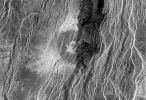
Craters-Somerville_Crater-PIA00100.jpgMagellan Probe: radio image of fractured Somerville Crater73 visiteCaption NASA originale:"This Magellan radar image is of a 'half crater' located in the rift between Rhea and Theia Montes in Beta Regio on Venus. The unnamed crater is 37 Km in diameter and is located at 29,9° North latitude and 282,9° East longitude. It has been cut by many fractures or faults since it was formed by the impact of a large asteroid. The eastern half of the crater was destroyed during the formation of a fault valley that is up to 20 Km wide and apparently quite deep. A north-south profile through the very center of this crater is visible as a result of the down dropping and removal of the eastern half of the crater".
(6 voti)
|
|

Landslides-Navka_Region-PIA00262.jpgMagellan Probe: radio image of Landslides in Navka Region80 visiteCaption NASA originale:"The Magellan spacecraft has observed remnant landslide deposits apparently resulting from the collapse of volcanic structures. This Magellan radar image is centered about 25,4° south latitude and 308° east longitude in the southwestern Navka Region of Venus. The image shows a 17,4 Km (approx. 10,8 mile) diameter volcanic dome on the plains. The dome is approximately 1,86 Km (approx. 1,2 mile) in height and it has a slope of about 23°. The northwest and northeast flanks of the dome have collapsed to form landslides that have deposited debris on the plains. The image shows an area 110 Km (approx. 68 miles) across and 100 Km (approx. 62 miles) in length".
(6 voti)
|
|

Venusian_Surface-Venera_13-07-DPM.jpgTerra Incognita (Additional Credits: Don P. Mitchell - perspective visualization)190 visiteFrame Sx ---> Venera 13; Frame Dx ---> Venera 14MareKromium
(5 voti)
|
|

Volcanoes-Idunn_Mons-PIA13001-2.jpgIdunn Mons (Perspective View and False Colors; credits: NASA/JPL-Caltech/ESA)55 visiteCaption NASA:"This figure shows the Volcanic Peak Idunn Mons (at about 46° South Lat. and 214,5° East Long.) in the Imdr Regio area of Venus. The topographic backbone derives from data obtained by NASA's Magellan spacecraft, with a vertical exaggeration of 30 times.
Radar data (in brown) from Magellan has been draped on top of the topographic data. Bright areas are rough or have steep slopes. Dark areas are smooth.
The warmest area of Idunn is centered on the Summit, which stands about 2,5 Km (approx. 1,6 miles) above the Datum, and the bright Lava Flows that originate there. Idunn Mons has a diameter of about 200 Km (approx. 120 miles).
The spectrometer data was collected from May 2006 to the end of 2007. A movie featuring 360-degree views of the volcano is based on the same data and can be viewed at JPL's Multimedia".MareKromium
(5 voti)
|
|
| 126 immagini su 11 pagina(e) |
 |
3 | |
|
|
|
|
|
|
|





