| |

| Piú votate - Venus |

Venusian_Clouds-IR-PIA00124.jpgLow altitude Venusian clouds (false colors)93 visiteThis false-color image is a near-infrared map of lower-level clouds on the night side of Venus, obtained by the Near Infrared Mapping Spectrometer aboard the Galileo spacecraft as it approached the planet's night side on February 10, 1990. Bright slivers of sunlit high clouds are visible above and below the dark, glowing hemisphere. The spacecraft is about 100.000 Km above the planet. An infrared wavelength of 2,3 microns (about 3 times the longest wavelength visible to the human eye) was used. The map shows the turbulent, cloudy middle atmosphere some 50-55 Km above the surface, 10-16 Km below the visible cloudtops. The red color represents the radiant heat from the lower atmosphere (about 400° Fahrenheit) shining through the sulfuric acid clouds, which appear as much as 10 times darker than the bright gaps between clouds. This cloud layer is at about -30° Fahrenheit, at a pressure about 1/2 Earth's surface atmospheric pressure. Near the equator, the clouds appear fluffy and blocky; farther north, they are stretched out into East-West filaments by winds estimated at more than 150 mph, while the poles are capped by thick clouds at this altitude.
(11 voti)
|
|

Volcanoes-Ammavaru.jpgMagellan Probe: radio image of Ammavaru Volcano & surroundings126 visiteGli scopi di Magellano consistevano, sommariamente, nella tracciatura di un modello relativo all'interno di Venere, nonchè nell'effettuazione di una serie di osservazioni di supporto allo studio della tettonica di Venere, nonchè delle sue vere e proprie forme esteriori, ivi inclusi i processi di superficie susseguenti ad impatti, erosioni, depositi ed altre reazioni chimiche.
(11 voti)
|
|

Venusian_Surface-Venera_09-002.jpgVenus from Venera 9 - October, 22, 1975 - The Original Frame179 visiteEd ora qualche dato ottenuto dalle Sonde: temperatura minima al suolo: 465°C, max 485°C; pressione superficiale minima: tra le 90 e le 94 volte la press. terr. al livello del mare.
Alcuni elementi atmosferici: HCl, HF, I e Br; vento: intorno ai 3,5 Km/ora; non si sono rilevate polveri in sospensione; altezza delle nuvole dal suolo: circa 30 Km.
Un mondo decisamente diverso dal nostro e dall'ormai familiare Marte, non credete?!?
(11 voti)
|
|

Venusian_Atmosphere-Airglow_VIRTIS_Anticlockwise-01.jpgThe "Airglow" of Venus54 visiteOne year has passed since 11 April 2006, when Venus Express, Europe’s first mission to Venus and the only spacecraft now in orbit around the planet, reached its destination. Since then, this advanced probe, born to explore one of the most mysterious planetary bodies in the Solar System, has been revealing planetary details never caught before.
Intensively visited by several Russian and American probes from the 60s to the early 90s, Venus has always represented a puzzling target for scientists worldwide to observe. Venus Express, designed and built in record time by ESA, was conceived with the purpose of studying Venus - unvisited since 1994 - in the most comprehensive and systematic way ever, to provide a long-due tribute to a planet so interesting, yet cryptic.
Using state-of-the-art instrumentation, Venus Express is approaching the study of Venus on a global scale. The space probe is collecting information about Venus’ noxious and restless atmosphere (including its clouds and high-speed winds, as seen from this video obtained with the VMC camera on board) and its interaction with the solar wind and the interplanetary environment. Last but not least, it is looking for signs of surface activity, such as active volcanism. MareKromium
(9 voti)
|
|

Volcanic_Features-Lava_Flows-PIA00471.jpgLava Flows (possible Natural Colors; credits: Dr Paolo C. Fienga - Lunexit Team)56 visiteThis is a full resolution mosaic centered at 25° North Latitude and 351° East Longitude.
The Region is approximately 160 Km (100 miles) across. It shows a series of complex Lava Flows which emerge from the Northern Flank of Sif Mons, a large Southern Venusian Volcano.
Several of the Flows occupy narrow troughs formed by long fractures. A sequence of events that can be inferred from this image is the formation of the dark background Plains by eruptions of extremely fluid volcanic material, and the formation of the small Shield Volcanoes on the Plains' Surface that can be seen in the upper left part of the image.
Next, the Region was domed upward probably by heat from the interior of Venus that ultimately caused magmas to break out from the Surface near the Summit Regions forming the Sif volcanic structure and its associated flank eruptions which can be seen in this image.MareKromium
(8 voti)
|
|

Venusian_Surface-Venera_14-03.jpgVenus, from Venera 14 (Natural Colors; credits: Ted Stryk)55 visiteTed Stryk comments:"...Venera 14, which landed in a much rockier area, took a pretty good partial color pan (again, complete in black and white), but while the other pan was complete in both black and white and through color filters (althoug again the blue was almost useless), the color data in this set was horribly underexposed.
Here is the Venera 14 partial pan, my favorite of the set because of the cool rock right near the lander. It seems to be sitting on the rocky plain...it makes one wonder how it got there. I don't see anything else like it in the Venera pans, although given their limited coverage, it doesnt mean there aren't perhaps a few more rocks like it around. But still , it is lucky it was so close to the lander and in a color zone...".
Nota Lunexit: notate anche Voi una - secondo noi STRAORDINARIA - similitudine fra questa superficie e la superficie di Titano?...MareKromium
(8 voti)
|
|
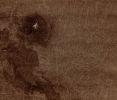
Craters-Unnamed_Craters-Lakshmi_Region-PIA00477.jpgPossible Remnants of a Meteoroid in Lakshmi Region (possible Natural Colors; credits: Dr Paolo C. Fienga - Lunexit Team)55 visiteThis full resolution mosaiced image covers an area of approx. 100 by 120 Km (such as about 62 by 74 miles) and is located in the Lakshmi Region of Venus, at 47° North Latitude and 334° East Longitude.
Due to the dense Venusian Atmosphere, Primary Impact Craters of less than a 3 Km (a little less than 2 miles) diameter are nonexistent.
The dark circular region and associated central bright feature in this image are thought to be the remnants of a Meteoroid smaller than the size necessary to create an Impact Crater, and entering the Atmosphere at low velocity (approx. 350 meters/second.)
The central bright feature appears to be a cluster of small secondary impacts, ejecta and debris from the original meteor that broke up in the Atmosphere.
Even though most of the meteorite did not hit the Surface, the Atmospheric Shock wave could be great enough to modify the surrounding region. One explanation for this radar dark circular formation, called "Dark Margins", could be that the shock wave was energetic enough to pulverize the Surface (smooth surfaces generally appear radar dark).
Another explanation is that the Surface could be blanketed by a fine material that was formed by the original meteor's breakup through the Atmosphere.
More than half of the Impact Craters on Venus have associated Dark Margins, and most of these are prominently located left of center of the rater. This is another effect which could be caused by the extremely dense Atmosphere of Venus. MareKromium
(7 voti)
|
|
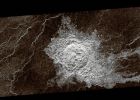
Craters-Unnamed_Crater-PIA00468.jpgUnnamed (and heavily degraded) Crater (possible Natural Colors; credits: Dr Paolo C. Fienga - Lunexit Team)55 visiteDuring orbits 423 through 424 on 22 September 1990, Magellan imaged this Impact Crater that is located at Latitude 10,7° North and Longitude 340,7° East.
This Crater is shown as a representative of Venusian Craters that are of the proper diameter (about 15 Km) to be 'transitional' in their morphology between 'complex' and irregular'.
Complex Craters account for about 96% of all craters on Venus with diameters larger than about 15 Km; they are thought to have been formed by the impact of a large, more or less intact, mass of asteroidal material that has not been excessively effected during its passage through the dense Venusian Atmosphere.
Complex Craters are characterized by circular Rims, terraced Inner Wall Slopes, well developed Ejecta Deposits, and flat Floors with a Central Peak or Peak Ring.
Irregular Craters make up about 60% of the Craters with diameters less than about 15 Km. Irregular Craters are thought to form as the result of the impact of asteroidal projectiles that have been aerodynamically crushed and fragmented during their passage through the Atmosphere.
Irregular craters are characterized by irregular and/or discontinuous Rims and hummocky or multiple Floors.
The 'Transitional' Crater shown here has a somewhat circular Rim like larger Complex Craters, but has the hummocky Floor and asymmetric Ejecta characteristic of smaller Irregular Craters. MareKromium
(7 voti)
|
|

Venusian_Surface-Venera_13-09a.jpgVenus, from Venera 13 (Natural Colors; credits: Ted Stryk)54 visiteTed Stryk comments:"...Here is a composite of Venera 13 images, looking towards a ridge on the horizon...I have watched with great excitement how the Mars Exploration Rovers have explored the Red Planet.
However, Venus, while it has had more successful landers on its Surface, was the subject of much less capable Spacecraft. There are four color image sets of the Surface, all with blank or nearly blank blue channels. Venera 13 sent back one full pan in color, which is the best set we have, and another partial one (complete in black and white) that hs much poorer color data..."
Nota Lunexit: non lo diciamo (rectius: scriviamo) certo per polemizzare con Mr Ted Stryk, nè per "esaltare" le imprese dell'Agenzia Spaziale Sovietica, ma il paragone fra le capacità dei Lander della Classe "VENERA" che raggiunsero con successo la Superficie di Venere ed i MER Spirit ed Opportunity (nonchè i Lander Viking 1, 2, Pathfinder e Phoenix) che hanno felicemente raggiunto la Superficie del Pianeta Rosso e che Ted stesso opera per giungere alla conclusione che i Venera Lander erano "...much less capable spacecraft..." non sta nè in Cielo, nè...su Marte o Venere!
Tralasciamo in questa sede il gap di evoluzione tecnica che separa le Sonde VENERA (fine Anni '70, primi Anni '80) da quelle NASA e focalizziamoci sulle condizioni della Superficie di Venere rispetto a quelle della Superficie Marziana: avete un'idea - anche vaga - della diversità di ambienti?
Temperatura media al suolo su Venere: tra i 465 ed i 485° Celsius; pressione: 92/94 Bar (e cioè oltre 9 volte la pressione terrestre al livello del mare); il tutto condito da vulcanismo attivo e frequenti piogge a base di Acido Solforico.
Come si fa, viste le summenzionate premesse, a dire che le Sonde Sovietiche erano "più scadenti"??? Insomma: di paragoni se ne possono sempre fare, certo, ma devono essere "sensati" e fondati su oggetti e situazioni congruibili, altrimenti...sono solo chiacchiere in libertà.MareKromium
(7 voti)
|
|

North_Polar_Regions-Ishtar_Terra.jpgIshtar Terra73 visiteIshtar Terra: this is a topographic map made by Don P. Mitchell, from Venera and Magellan altimetry data.
It shows the continent-sized highlands of Ishtar Terra, near the North Pole of Venus.
(7 voti)
|
|

Venusian_Surface-Venera_13-06-DPM-PCF-LXTT-IPF-1.jpgTerra Incognita (Additional Credits: Don P. Mitchell - perspective visualization - and Dr Paolo C. Fienga - Colorization)162 visiteFollowing yesterday's APOD, we have decided to take you once again on the Surface of the Planet Venus (as imaged by the Soviet Lander Venera 13) and we are proud to show you the result of a combined effort: the perspective imaging of the Venusian Surface as seen from the the Lander (a work carried out by the American Researcher Dr Don P. Mitchell) with the Absolute Natural Colorization of the landscape and Sky (this job carried out by the Italian Researcher Dr Paolo C. Fienga). The result, as you can see, is a deeply suggestive (and, maybe, even a little scary...) vision of what has been called by many Scientists and Researchers, "The Venusian Inferno": such as a World that, from every point of view, seems to be completely hostile to the human concept of Life itself.
And here is a brief story of what happened that day, such as March 1st, 1982, when the Descent Module of the Venera 13 Spacecraft landed on Venus, as told us by Dr Don P. Mitchell himself:"...Two optical-mechanical cameras repeatedly scanned 180° or 60° through Clear and Colored Filters and at higher resolution than the Venera 9/10 System. The camera system was developed by Dr A.S. Selivanov's Team at the Institute of Space Device Engineering. The main Spacecraft, flying on a Fly-By Trajectory, remained in radio contact with the Lander for 127 minutes. It relayed the video to Earth as a phase-modulated digital signal, at 9 bits per pixel. The Venera 13 (and Venera 14 too) Lander/s transmitted digital images with a depth of 9 bits and an approximately logarithmic encoding of photometric brightness. Multiple panoramas were scanned by the camera, including some with red, green or blue glass filters in place. The entire transmission was relayed to Earth in real time, and also replayed from digtal tape recordings onboard the Venera 13 Spacecraft. This peculiar tecnique permitted the reconstruction of an almost noiseless version from the multiple transmissions. An accurate conversion of that encoding to linear brightness has also been derived, using calibration information included with the images (to be noted is the improved rendering of shape and details in very dark and very light portions of the image). The original Soviet versions of this frame included a full panorama from Clear-Filter images, and color panoramas from the red, green and blue-filter images. The signal to noise was poorer for the color images, because they were much darker. I (meaning Dr Don P. Mitchell) combined the two types of panoramas by adding the Chroma Signal (in CIE Lab Color Space) from the color images with the luminance from the clear images, thus obtaining simply spectacular results. Furthermore, the Venera 13 panoramas were just spherical projections and therefore they had to be remapped to perspective projections and overlayed (using Adobe Photoshop CS2) to produce views that were good enough to give us a better subjective impression of the Venusian Surface. In the overhead view, notice the subtle shadowing existing around the Lander. The Surface illumination is from the uniformly bright hemisphere of the Sky, but the Lander (as you can better see in the spherical projections) blocks part of the Sky from nearby Ground. In addition to the above, please notice that in this frame the thick yellow-orange color of the Sky is due to Rayleigh Scattering of the Sunlight by the thick Venusian Atmosphere and, possibly, by an additional (still) unknown blue-absorbing Gas Component. Brightness has been normalized. Please remember that the variations in the color of the Surface and Sky that you may certainly notice once you will have compared different color images taken by the different Soviet Venera Class Landers that made it to the Venusian Surface, are due to differing Atmospheric Depths and Opacities, as well as to the differing Sun Angles existing at the different Landing Sites...".
MareKromium
(6 voti)
|
|

Volcanoes-Sacajawea_Patera-PIA00485.jpgSacajawea Patera (possible Natural Colors; credits: Dr Paolo C. Fienga - Lunexit Team)56 visiteThis Magellan image reveals Sacajawea Patera, a large, elongate caldera located in Western Ishtar Terra on the smooth plateau of Lakshmi Planum.
The image is centered at 64,5° North Latitude and 337° East Longitude. It is approximately 420 Km (about 252 miles) wide at the base.
Sacajawea is a depression approximately 1-2 Km (0,6-1,2 miles) deep and abo 120 by 215 Km (approx. 74 by 133 miles) in diameter; it is elongate in a S/W-N/E direction.
The depression is bounded by a zone of circumferential curvilinear structures interpreted to be Graben and Fault Scarps. These structures are spaced 0,5-4 Km (0,3-2,5 miles) apart, are 0,6-4 Km (0,4-2,5 miles) in width and up to 100 Km (approx. 62 miles) in length.
Extending up to approximately 140 Km (about 87 miles) in length from the South/East of the Patera, is a system of linear structures thought to represent a flanking rift zone along which the lateral injection and eruption of magma may have occurred.
A shield edifice of approx. 12 Km (about 7 miles) in diameter with a prominent Central Pit, lies along the trend of one of these features.
The Impact crater Zlata, approx. 6 Km (a little less than 4 miles) in diameter is located within the zone of Graben to the N/W of the Patera.
Few flow features are observed in association with Sacajawea, possibly due to age and state of degradation of the flows.
Mottled bright deposits of about 4 to 20 Km (such as 2,5 up to approx. 12 miles) in width are located near the periphery and in the center of the Patera Floor, within local topographic lows. Diffuse patches of dark material approx. 40 Km (such as about 25 miles) in width are observed S/W of the Patera, superposed on portions of the surrounding Graben.
The formation of Sacajawea is thought to be related to the drainage and collapse of a large Magma Chamber. Gravitational relaxation may have caused the resultant Caldera to sag, producing the numerous Faults and Graben that circumscribe the Patera.
Regions of complex, highly deformed tessera-like terrain are located North and East of the Patera and are seen in the upper portion of the image.MareKromium
(6 voti)
|
|
| 126 immagini su 11 pagina(e) |
2 | |
|
|
|
|
|
|
|
|
|
|





