| Piú votate - Saturn: the "Ringed Beauty" and His Moons |
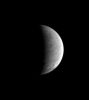
Enceladus-PIA08276.jpgEnceladus57 visiteCaption NASA originale:"Cassini spies the wrinkled, fractured and remarkably crater-poor terrain of Enceladus. Scientists are working to understand what causes the moon's surprising geologic activity (see also PIA07759).
North on Enceladus is up and rotated 20° to the left.
The image was taken in visible light with the Cassini spacecraft narrow-angle camera on Sept. 8, 2006 at a distance of approx. 560.000 Km (about 348.000 miles) from Enceladus and at a Sun-Enceladus-spacecraft, or phase, angle of 103°. Image scale is roughly 3 Km (a little less than 2 miles) per pixel".
(4 voti)
|
|
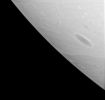
Saturn-PIA08274.jpgSaturnian turbulences...56 visiteCaption NASA originale:"With no solid land to obstruct their progress, dark vortices often roll through Saturn's Atmosphere for months or years, before merging with other vortices. On Earth, the continents usually halt the progress of large storms, like hurricanes. Vortices like these are part of the general circulation pattern of East-West flowing cloud bands, called jets, on Saturn.
The image was taken using a spectral filter sensitive to wavelengths of infrared light centered at 939 nanometers. The image was obtained with the Cassini spacecraft wide-angle camera on Aug. 16, 2006 at a distance of approximately 259.000 Km (about 161.000 miles) from Saturn. Image scale is roughly 12 Km (about 7 miles) per pixel".
Nota: quando la NASA parla di "distanza da Saturno" (come da Giove, Urano e Nettuno) essa fa convenzionalmente riferimento alla distanza che intercorre fra Sonda e "clouds' top", ovvero lo strato più alto (e l'ultimo) di nuvole, superato il quale inizia lo spazio esterno. In caso di corpi rocciosi, invece, la distanza è riferita allo spazio esistente fra Sonda e "datum" (o altitudine zero) del corpo celeste considerato.
(4 voti)
|
|

Japetus-PIA08273.jpgDuotone Moon58 visiteCaption NASA originale:"The many impact scars borne by Japetus are made far more conspicuous in the Region of Transition from its dark Hemisphere to its bright one.
In this terrain, the dark material that coats Cassini Regio accentuates slopes and crater floors, creating a land of stark contrasts.
The image was taken in visible light with the Cassini spacecraft narrow-angle camera on Sept. 6, 2006 at a distance of approx. 2,2 MKM (about 1,4 MMs) from Japetus and at a Sun-Japetus-spacecraft, or phase, angle of 26°. Image scale is roughly 13 Km (about 8 miles) per pixel".
(4 voti)
|
|

Saturn-W00018110.jpgDust and other particles in the E-Ring Space (2)58 visitenessun commento
(4 voti)
|
|

Saturn-W00018107.jpgDust and other particles in the E-Ring Space (1)67 visitenessun commento
(4 voti)
|
|

Saturn-W00018094.jpgOverexposed F-Ring, a few Stars and some Image-Artifacts58 visitenessun commento
(4 voti)
|
|

Enceladus-N00065810.jpgEnceladus (HR)65 visiteUna bellissima immagine ad elevata risoluzione di Encelado, la "Luna di Neve", come la NASA stessa l'ha battezzata.
Siamo ad 'appena' 221.000 Km (circa) di distanza, e le "fontane" che dovrebbero rendere questo piccolo mondo un mondo unico nel suo genere, non si vedono. Come mai?
Ebbene, anche al tempo del transito (pure ravvicinato) della Sonda Voyager 1, Encelado non mostrò le sue "fontane" a noi Terrestri e quindi la domanda di cui sopra appare più che legittima.
Ebbene, c'è chi pensa - come Lunar Explorer - che le "Fontane di Encelado" sìano un fenomeno oltremodo recente e legato - inter alia - ad un "riscaldamento" della superficie di questo piccolo mondo il quale potrebbe essere stato causato, p.e., da un aumento di radiazioni provenienti dal Sole (!) o da Saturno stesso (!!).
C'è invece chi pensa che i geysers sud-polari di Encelado sìano un fenomeno meramente "stagionale" e quindi legato a determinati "momenti" orbitali di Encelado (e cioè: quando Encelado è più vicino a Saturno - ergo ai suoi influssi mareali - esso diventa "attivo" - con ciò deducendosi che sono gli influssi gravitazionali ad "accendere", letteralmente, i geysers sud-polari della piccola luna; d'altro canto, quando Encelado si allontana dal Gigante Anellato, gli influssi mareali di Saturno "perdono vigore" ed il fenomeno dei geysers si spegne).
Esiste, infine, anche una terza possibilità: la visibilità delle "Fontane di Encelado" è definita dall'angolo di fase (l'angolo descritto da Sole-Corpo Celeste Osservato e Cassini) il che significa, molto semplicemente, che queste Fontane si vedono solo quando Encelado è fotografato in particolari condizioni, dal punto di vista di chi fotografa e che il fenomeno delle "Fontane" in sè potrebbe anche essere costante e continuativo.
(4 voti)
|
|

Dione & Rhea-PIA08261.jpgNight-lights, in the Saturnshine...58 visiteCaption NASA originale:"Soft light from Saturn lifts the veil of night from the moons Dione (lower left) and Rhea (upper right).
A scant crescent on each satellite marks the limit of the Sun's direct reach. The remaining light is reflected onto the moons by the Ringed Planet (Saturn-shine).
This view was acquired using an image compression scheme that results in minor artifacts being present - on Rhea in particular.
Rhea (approx. 1.528 Km, or 949 miles across - pictured above) is somewhat bland in appearance at this image scale, although Dione's spectacular fractures stand out marvelously. Dione is approx. 1.126 Km (about 700 miles) across.
North, on both moons, is rotated 45° to the right.
The image was taken in visible light with the Cassini spacecraft narrow-angle camera on Aug. 11, 2006 at a distance of approx. 2,6 MKM (about 1,6 MMs) from Dione and 2.8 MKM (1,7 MMs) from Rhea. Image scale is about 15 Km (approx. 10 miles) per pixel on Dione and about 17 Km (approx. 11 miles) on Rhea".
(4 voti)
|
|

The Rings-PIA08257.jpgThe Music of Pan...The Waves in the Rings...56 visiteCaption NASA:"The Encke Gap displays gentle waves in its inner and outer edges that are caused by gravitational tugs from the small moon Pan. These scalloped edges were captured in a dramatic image taken by Cassini during its insertion into Saturn orbit in 2004.
The Encke Gap is a 325-Km (about 200-mile) wide division in Saturn's outer A-Ring.
Pan (26 Km, or approx. 16 miles across) orbits squarely in the center of this gap.
The original image was stretched in the horizontal direction by a factor of four to exaggerate the amplitude of the waves, then reduced to half size and cropped to focus on the gap.
The image was taken in visible light with the Cassini spacecraft narrow-angle camera on July 23, 2006 at a distance of approx. 290.000 Km(such as about 180.000 miles) from Saturn.
Scale in the original image was roughly 1 Km (about 0,6 mile) per pixel".
(4 voti)
|
|

Dione-PIA08256-C.jpgThe "White (and Bright) Cliffs" of Dione (detail mgnf n. 3)59 visitenessun commento
(4 voti)
|
|
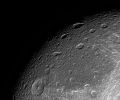
Dione-PIA08256-A.jpgThe "White (and Bright) Cliffs" of Dione (detail mgnf n. 1)58 visitenessun commento
(4 voti)
|
|
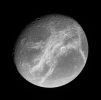
Dione-PIA08256.jpgThe "White (and Bright) Cliffs" of Dione (context image)66 visiteCaption NASA:"This splendid view showcases Dione's tortured complex of bright cliffs. At lower right is the feature called Cassandra, exhibiting linear rays extending in multiple directions.
This is the Trailing Hemisphere of Dione; North is up.
The image was taken in polarized green light with the Cassini spacecraft narrow-angle camera on July 24, 2006 at a distance of approx. 263.000 Km (about 163.000 miles) from Dione. Image scale is roughly 2 Km (such a little more than 1 mile) per pixel".
(4 voti)
|
|
| 2244 immagini su 187 pagina(e) |
 |
|
|
|
|
99 | |
|
|
|
|





