| Piú votate - Saturn: the "Ringed Beauty" and His Moons |

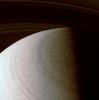
Saturn-PIA09864.jpgNever "Dark Nights"... (natural colors; credits: NASA)58 visiteCaption NASA:"Titan emerges from behind Saturn, while Tethys streaks into view, in this colorful scene. Saturn's shadow darkens the far arm of the Rings near the Planet's limb. Titan is about 5150 Km (approx. 3200 miles) wide; Tethys is 1071 Km (such as approx. 665 miles) wide.
This view looks toward the unilluminated side of the Rings from about 3° above the Ring-Plane. Images taken using red, green and blue spectral filters were combined to create this natural color view. The images were acquired with the Cassini spacecraft wide-angle camera on Jan. 30, 2008 at a distance of approx. 1,3 MKM (such as about 800.000 miles) from Saturn.
Image scale is roughly 77 Km (about 48 miles) per pixel on Saturn".MareKromium
(4 voti)
|
|
Saturn-PIA09828.jpgNorthern Latitudes (possible natural colors; credits: Lunexit)57 visiteCaption NASA:"As seasons change on Saturn, and sunlight creeps farther north, the region surrounding the North Pole is steadily coming to light. This scene reveals many features in Saturn's dynamic and beautiful Atmosphere, including a detail largely obscured from the imaging cameras until now: on the Terminator at center right is part of the Polar Hexagon, which was previously observed by Cassini's Visible and Infrared Mapping Spectrometer (VIMS) and Composite Infrared Spectrometer (CIRS).
These instruments used heat radiated from Saturn to observe the Polar Hexagon (rather than reflected sunlight, as is the case in this view). The Hexagon was first imaged by the Voyager spacecraft more than 25 years ago.
The view looks toward the unilluminated side of the Rings from about 38° above the Ring-Plane and is centered on a region 63° north of the Saturnian Equator.
The image has been brightened to show details at high Northern Latitudes, where solar illumination is presently weak.
The image was taken with the Cassini spacecraft wide-angle camera on Jan. 2, 2008 using a combination of spectral filters sensitive to wavelengths of polarized infrared light centered at 752 and 705 nanometers. The view was acquired at a distance of approx. 930.000 Km (about 578.000 miles) from Saturn.
Image scale is roughly 52 Km (approx. 32 miles) per pixel".MareKromium
(4 voti)
|
|
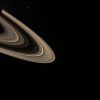
The_Rings-PIA09824.jpgThe Golden Rings of Saturn and some of His Moons... - (natural colors; credits: NASA)57 visiteCaption NASA:"A color portrait of Saturn's sunlight-scattering Rings hosts a group of several moons.
Enceladus (505 Km, or 314 miles across) is visible at top. At bottom, in increasing distance from the Rings, are Pandora (84 Km, or 52 miles across), Janus (181 Km, or 113 miles across) and Mimas (397 Km, or 247 miles across).
This view looks toward the unilluminated side of the Rings from about 10° above the Ring-Plane. Saturn's shadow can be seen on the Rings at upper left.
Images taken using red, green and blue spectral filters were combined to create this composite color view.
The images were taken with the Cassini spacecraft wide-angle camera on Dec. 22, 2007. The view was acquired at a distance of approx. 1,8 MKM (such as about 1,1 MMs) from Saturn. Image scale is about 110 Km (approx. 68 miles) per pixel". MareKromium
(4 voti)
|
|

Dione-PIA09801.jpgWhite Scars...60 visiteCaption NASA:"The Cassini spacecraft catches a glimpse of the bright fractures that adorn the Trailing Side of icy Dione.
North on Dione (1126 kilometers, or about 700 miles across) is up.
The image was taken in visible light with the Cassini spacecraft narrow-angle camera on Nov. 18, 2007. The view was obtained at a distance of approx. 1 MKM (such as about 623.000 miles) from Dione and at a Sun-Dione-spacecraft, or phase, angle of 45°.
Image scale is roughly 6 Km (about 4 miles) per pixel".MareKromium
(4 voti)
|
|
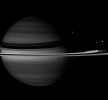
Saturn-PIA09795.jpgObscure Planet, Bright Moons... (IR)58 visiteCaption NASA:"Just before Rhea slipped behind Saturn, the Cassini Spacecraft captured the moon in its disappearing act.
Along with the partly obscured Rhea are Tethys, at right, and Enceladus, left of Tethys.
At the wavelength in which this image was taken, absorption of Sunlight by Methane gas in Saturn's Atmosphere is strong, causing the Planet to appear darker than at other wavelengths.
This view looks toward the unilluminated side of the Rings from about 4° above the Ring-Plane. The image was taken with the Cassini spacecraft wide-angle camera on Nov. 9, 2007 using a spectral filter sensitive to wavelengths of Infrared Light centered at 890 nanometers. The view was acquired at a distance of approx. 2,8 MKM (about 1,7 MMs) from Saturn and at a Sun-Saturn-spacecraft, or phase, angle of 44°.
Image scale is roughly162 Km (such as about 101 miles) per pixel".MareKromium
(4 voti)
|
|
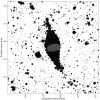
The_Rings-PIA10083.jpgFrom "Clump" to "Moonlet"63 visiteCaption NASA:"This is a computer simulation of the final stage of the growth of a "clump" in Saturn's Rings. The gravity from a hypothesized moonlet (solid gray sphere in frame center) has collected smaller ring particles (black) to form a temporary aggregation. The particles shown in the simulation are from centimeters to meters (su ch as inches to yards) across. The gray moonlet is 61 meters (200 feet) across". MareKromium
(4 voti)
|
|

Epimetheus-N00098342.jpgEpimetheus (2)56 visiteCaption NASA:"N00098342.jpg was taken on December 03, 2007 and received on Earth December 04, 2007. The camera was pointing toward EPIMETHEUS that, at the time, was approximately 40.388 Km away, and the image was taken using the RED and CL2 filters.
This image has not been validated or calibrated".MareKromium
(4 voti)
|
|
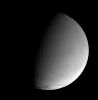
Enceladus-PIA09770.jpgThe "fresh" face of Enceladus61 visiteCaption NASA:"The Leading Hemisphere of Enceladus displays a remarkably fresh-looking surface in this recent Cassini view. At this resolution, only a few craters can be made out in this wrinkled region of the geologically active moon's surface.
A far more heavily cratered, and older, terrain region is visible to the North-West.
This view is centered on 15° North Latitude, 109° West Longitude.
North on Enceladus is up.
The image was taken in visible light with the Cassini spacecraft narrow-angle camera on Sept. 30, 2007. The view was acquired at a distance of approx. 108.000 Km (such as about 67.000 miles) from Enceladus and at a Sun-Enceladus-spacecraft, or phase, angle of 75°.
Image scale is roughly 646 meters (2.119 feet) per pixel".MareKromium
(4 voti)
|
|

Dione-PIA09764.jpgThe "spiderweb like" streaks on Dione62 visiteCaption NASA:"Bright, wispy fractures streak across Dione's trailing side. Following the Voyager flybys of the early 80s, scientists considered the possibility that the streaks were bright material extruded by cryovolcanism. A quarter-century later, Cassini's close passes and sharp vision showed these features to be a system of braided canyons with bright walls.
North on Dione is up.
The image was taken in visible light with the Cassini spacecraft wide-angle camera on Sept. 30, 2007. The view was acquired at a distance of approx. 45.000 Km (such as about 28.000 miles) from Dione and at a Sun-Dione-spacecraft, or phase, angle of 36°.
Image scale is roughly 3 Km (about 2 miles) per pixel".MareKromium
(4 voti)
|
|
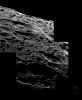
Japetus-PIA08403.jpgMiddle Northern Latitudes of Japetus57 visiteCassini soars above the many pits and basins in the rolling landscape of Saturn's moon Japetus. This mosaic view looks out onto an area close to the Northern bright/dark boundary, but still within the Dark Region, Cassini Regio.
Near upper left is a large crater with terraced walls, a mostly flat floor and a prominent group of peaks in its center. The sharp features make this likely one of the youngest craters in this area of Japetus. Cassini imaged another similarly flat-floored and relatively fresh crater during its Dec. 2004 Japetus flyby.
The mosaic consists of 3 image footprints across the surface of Japetus. The view is centered on terrain near 43,3° North Latitude, 138° West Longitude. Image scale is approx. 75 meters (246 feet) per pixel.
The clear spectral filter images in this mosaic were obtained with the Cassini spacecraft narrow-angle camera on Sept. 10, 2007, at a distance of approx. 13.500 Km (about 8.400 miles) from Japetus and at a Sun-Japetus-Spacecraft, or phase, angle of 139°.MareKromium
(4 voti)
|
|

The_Rings-PIA08389_fig1.jpgThe Rings56 visiteA scan across Saturn's incredible halo of ice rings yields a study in precision and order. This natural color mosaic was acquired by the Cassini spacecraft as it soared 39 degrees above the unilluminated side of the Rings.
Major named gaps are labeled at the top. The main rings themselves, along with the F-Ring, are labeled at the bottom, along with their inner and outer boundaries.
The view combines 45 images -- 15 separate sets of red, green and blue images -- taken over the course of about 2,5 hours, as Cassini scanned across the Rings.
The images in this view were obtained on May 9, 2007, at a distance of approx. 1,1 MKM (about 700,000 miles) from Saturn. Image scale in the radial (horizontal) direction is about 6 Km (approx. 4 miles) per pixel.MareKromium
(4 voti)
|
|
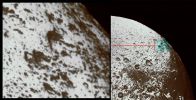
Japetus-SquaredTerrain.jpgSquares on Japetus?59 visiteUno splendido, inquietante ed...illusorio profilo individuato dal sempre bravissimo Marco Faccin. Strutture squadrate su Giapeto? Evidenze di "artificialità"?...
Ovviamente no: questo frame (e relativo detail mgnf) rappresentano solo un modo per vedere - e per far vedere! - come, volendo, si possono trovare "strutture regolari" su altri Corpi Celesti.
Illusioni determinate dalla distanza, dall'angolo di ripresa, dalla qualità del frame e dalla voglia di vedere "segni tangibili di intelligenza (passata o presente) altrove": trovare queste strutture (che appartengono alla Classe delle Strutture "Effimere") è un gioco; evidenziarle è una curiosità; spiegarle per quello che sono (senza costruirci sopra delle eso-archeo-baggianate) è, secondo noi, un dovere.
Un grazie di cuore (ed un grande BRAVO!) al Dr Faccin per aver individuato un dettaglio (comunque) intrigante e per lo spunto di riflessione che, con esso, ci ha voluto dare.MareKromium
(4 voti)
|
|
| 2244 immagini su 187 pagina(e) |
 |
|
|
|
|
92 | |
|
|
|
|





