| Piú votate - Saturn: the "Ringed Beauty" and His Moons |

Iapetus from Voyager 2.jpgJapetus from Voyager 255 visitenessun commento
(9 voti)
|
|

Saturn from Hubble Space Telescope.jpgSaturn from the Hubble Space Telescope54 visitenessun commento
(9 voti)
|
|

INORBIT3-61692main_soi5-516.jpgOrbital Insertion Complete - In orbit around Saturn (3)56 visitenessun commento
(9 voti)
|
|

Hyperion-PIA12748.jpgInteresting Optical Illusion on Hyperion (Absolute Natural Colors; credits for the additional process. and color.: Dr Paolo C. Fienga)103 visiteCaption NASA:"The Cassini Spacecraft captures a view of the Southern Latitudes of Saturn's "tumbling" moon Hyperion. Lit Terrain seen here is mostly in the Southern Hemisphere of Hyperion (approx. 270 Km or about 168 miles across). The South Pole of the moon is near the bottom of the illuminated Terrain seen here.
The image was taken in Visible Light with the Cassini Spacecraft narrow-angle camera on Nov. 28, 2010. The view was obtained at a distance of approx. 80.000 Km (about 50.000 miles) from Hyperion and at a Sun-Hyperion-Spacecraft, or Phase, Angle of 98°.
Image scale is roughly 476 meters (1562 feet) per pixel".MareKromium
(8 voti)
|
|

Unusual_Event_on_The_Rings-EB-N00164273.jpgPossible Collision inside the "F"-Ring (Credits for the additional process: Elisabetta Bonora - Lunexit Team)125 visiteN00164273.jpg was taken on October 16, 2010, and received on Earth on October 17, 2010. The camera was pointing toward MIMAS which, at the time, was approximately 195.976 Km away.
The image was taken using the CL1 and CL2 filters.
Nota Lunexit: l'Evento ripreso da Cassini non siamo in grado di spiegarlo compiutamente. Ad una prima (e molto superficiale) occhiata, avevamo pensato che si trattasse di un - consueto, si fa per dire... - Disturbo Gravitazionale derivato dal transito, attraverso l'Anello "F" del Gigante Gassoso, di una Luna Pastore (e l'Evento, in tal caso, sarebbe stato un cosiddetto "Streamer-Channel", tanto per essere chiari).
Tuttavia, la sua assai particolare configurazione esteriore (sembra un "flash") ci dice che potrebbe trattarsi anche di una collisione fra detriti di una certa dimensione oppure fra alcune "Particelle Maggiori" dell'Anello "F" ed un Corpo Estraneo. Una collisione ripresa davvero al momento in cui essa si stava verificando (alla NASA direbbero "caught in the act").
Purtroppo non siamo in grado di dire di più. Complimentissimi alla nostra Elisabetta Bonora per lo splendido Lavoro svolto (ancora una volta e come sempre).MareKromium
(8 voti)
|
|

Enceladus-N00146707_8.jpgTiger Stripes (Natural Colors; credits: Dr M. Faccin)82 visiteIn attesa che la NASA faccia di meglio (se non altro pubblicamente)...MareKromium
(8 voti)
|
|
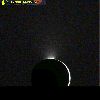
Enceladus-N00145354-N00145358.gifFountains of Light (GIF-Movie; credits: Dr G. Barca)55 visiteNota Lunexit: l'improvviso bagliore che esalta le Fontane di Encelado dovrebbe essere stato provocato, a nostro parere, da un particolare momentum di CASSINI, durante il suo passaggio attraverso un Angolo di Fase davvero ottimale (ricordiamo che è "Angolo di Fase" quell'angolo ottenuto ponendo in semplice correlazione geometrica il Sole, lOggetto Ripreso (o Target) e l'Osservatore (o Subject).MareKromium
(8 voti)
|
|

Enceladus-N00145388-N00145409.gifFountains of Light (GIF-Movie; credits: Dr G. Barca)55 visitenessun commentoMareKromium
(8 voti)
|
|

The_Rings-N00123872.jpgAnother UFO in the Space of Saturn (natural colors; credits: Lunexit)131 visiteL'Oggetto Volante Non Identificato, come vedete, conserva la sua forma e luminosità (e mantiene anche l'effetto di doppia riflessione), ma CAMBIA la sua posizione sia rispetto all'Orbiter Cassini, sia rispetto alla sezione inquadrata degli Anelli di Saturno.
Curiosamente, nei suoi pressi appare una lunga traccia luminosa che, come ovvio, NON E' un Raggio Cosmico, NON è una "feature" tipica degli Anelli di Saturno e NON è nemmeno un image-artifact.
La conclusione, interlocutoria - ma ovvia - non cambia: stiamo osservando un Oggetto Volante Non Identificato (di origine ignota).MareKromium
(8 voti)
|
|

Dione-PIA10409.jpgDione (MULTISPECTRUM-2; credits: Lunexit)54 visiteCaption NASA:"The bright fractures on Dione's Trailing Side slice across terrain that is darker than the rest of the surface. Cassini scientists are working to understand the nature of the dark material that appears to coat the surfaces of several of Saturn's moons. Only after the Cassini Spacecraft began imaging Dione did they realize that the prominent "streaks" shown here are fractures on the surface.
Lit terrain seen here is on the Saturn-Facing Side of Dione. North is up.
The image was taken in visible light with the Cassini spacecraft narrow-angle camera on May 17, 2008. The view was acquired at a distance of approx. 873.000 Km (such as about 543.000 miles) from Dione and at a Phase Angle of 47°.
Image scale is roughly 5 Km (a little less than 3 miles) per pixel".MareKromium
(8 voti)
|
|
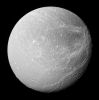
Dione-PIA09861.jpgDione54 visiteCaption NASA:"This southerly view of Dione shows enormous canyons extending from Mid-Latitudes on the Trailing Hemisphere, at right, to the moon's South Polar Region.
This view looks toward the Saturn-facing side of Dione (about 1126 Km, or 700 miles across) and is centered on 22° South Latitude, 359° West Longitude. North on Dione is up; the moon's south pole is seen at bottom.
The image was taken in visible light with the Cassini spacecraft narrow-angle camera on Feb. 8, 2008. The view was obtained at a distance of approx. 211.000 Km (such as about 131.000 miles) from Dione and at a Sun-Dione-Spacecraft, or phase, angle of 20°.
Image scale is roughly 1 Km (0,6 mile) per pixel".MareKromium
(8 voti)
|
|

Enceladus-5-CASSINI-big.jpgOver and Above... (natural colors; credits: Lunexit)54 visiteCaption NASA:"What does the surface of Saturn's ice-spewing moon Enceladus look like? To help find out, the robotic Cassini Spacecraft now orbiting Saturn was sent soaring past the cryovolcanic moon and even right through one of Enceladus' ice plumes.
Cassini closed to about 52 Km during its closest encounter to date. The above unprocessed image was taken looking down from the North, from about 30.000 Km away. Visible are at least two types of terrain.
The first type of terrain has more craters than occur near Enceladus' South Pole.
The other type of terrain has few craters but many ridges and grooves that may have been created by surface-shifting tectonic activity.
Exogeologists are currently poring over this and other Cassini images from last Wednesday's flyby to better understand the moon's patch-work surface, its unusual ice-geysers, and its potential to support life. Cassini is scheduled to fly by Enceladus at least 9 more times, including an even closer pass of just 25 Km in October 2008".MareKromium
(8 voti)
|
|
| 2244 immagini su 187 pagina(e) |
 |
|
|
|
|
9 | |
|
|
|
|





