| Piú votate - Saturn: the "Ringed Beauty" and His Moons |
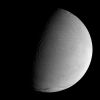
Enceladus-PIA10483.jpgThe Leading Hemisphere of Enceladus58 visiteCaption NASA:"During a distant flyby encounter with Enceladus, Cassini imaged the moon's wrinkled Leading Hemisphere.
At the scale visible here, this region of the surface is generally devoid of impact craters, suggesting that the terrain has been modified and renewed during the moon's history.
To the North lies a heavily cratered and presumably older Region. The sinuous boundary of the geologically active South Polar Region is seen at bottom. North on Enceladus is toward the top of the image.
The image was taken in visible green light with the Cassini Spacecraft narrow-angle camera on Sept. 30, 2007. The view was acquired at a distance of approx. 108.000 Km (such as about 67.000 miles) from Enceladus and at a Sun-Enceladus-Spacecraft, or phase, angle of 75°.
Image scale is 644 meters (2111 feet) per pixel".MareKromium
(4 voti)
|
|

SaturnSpaceN00115280-N00115290.gifThrough the "Eyes" of Cassini... (GIF-Movie; credits: Dr G. Barca)59 visiteSuggestivo, affascinante e, alla fine - semplicemente -, bello! (repetita iuvant)MareKromium
(4 voti)
|
|

JanusandPan-PIA10475.jpgOne is "Surrounded" and the other is "Free": Pan and Prometheus59 visiteCaption NASA:"Two of Saturn's moons coast along the outer edge of the Main Ring System. The orbits of seven small moons cluster just outside the F-Ring -- between the orbits of Pan and the co-orbital moons Janus and Epimetheus.
Pan (approx. 28 Km, or about 17 miles across at its widest point) appears as a bright dot within the Encke Gap, right of center. Janus (about 179 Km, or approx. 111 miles across at its widest point) lies outside the A and F-Rings, below center.
This view looks toward the sunlit side of the rings from about 2° below the Ring-Plane. The image was taken in visible light with the Cassini Spacecraft narrow-angle camera on Aug. 22, 2008. The view was obtained at a distance of approx. 1,3 MKM (such as about 808.000 miles) from Janus.
Image scale is roughly 8 Km (5 miles) per pixel".MareKromium
(4 voti)
|
|

Mimas-intransit-N00119952-N00119954.gifQuick Transit! (GIF-Movie; credits: Dr G. Barca)61 visite...Sembra un UFO...Ma non lo è! Si tratta, a nostro avviso, della luna Saturniana Mimas, ben riconoscibile a causa della sua forma oblunga e del suo "occhio" (!) che appare - relativamente chiaro - a ridosso del Terminatore.
Un intrigante - e MOLTO ISTRUTTIVO! - GIF-Movie, del sempre puntualissimo Dr Barca!MareKromium
(4 voti)
|
|

Streak-N00119706.jpgStreak or Star-trail?59 visitePoco al di sotto di Encelado (totalmente sovraesposto), una "Striscia di Luce" dalla forma curiosa e non regolarissima. Di che si tratta?
Sarà un fantomatico "streak", sulla cui origine si potrebbe discutere per secoli senza però arrivare a nulla, oppure si tratta di una semplicissima "star-trail"?
Voi che dite?MareKromium
(4 voti)
|
|

Dione-N00119792.jpgCross-Worlds! (8)66 visitenessun commentoMareKromium
(4 voti)
|
|

Dione-N00119794.jpgCross-Worlds! (10)79 visitenessun commentoMareKromium
(4 voti)
|
|

Mimas-PIA10467.jpgHol(e)y Mimas! (natural colors; credits: Lunexit)63 visiteCaption NASA:"The sun's low angle near the Terminator throws the craters of Mimas into stark relief.
This view looks toward high Northern Latitudes on Mimas (approx. 396 Km, or about 246 miles across) from a position 72° North of the moon's Equator. The North Pole is in darkness at center.
The image was taken in visible green light with the Cassini Spacecraft narrow-angle camera on Aug. 4, 2008. The view was obtained at a distance of approx. 153.000 Km (such as about 95.000 miles) from Mimas and at a Phase Angle of 106°.
Image scale is 918 meters (3011 feet) per pixel".MareKromium
(4 voti)
|
|

Janus-PIA10455~0.jpgNorthern Latitudes on Janus (natural colors; credits: Lunexit)59 visiteCaption NASA:"On a high-inclination orbit of Saturn, the Cassini Spacecraft gazes down at the North Polar Region of Janus. This view looks toward Janus from a perspective 72° North of the moon's Equator.
The image was taken with the Cassini Spacecraft narrow-angle camera on July 14, 2008 using a spectral filter sensitive to wavelengths of infrared light centered at 752 nanometers. The view was acquired at a distance of approx. 259.000 Km (about 161.000 miles) from Janus and at a Sun-Janus-Spacecraft, or Phase, Angle of 78°.
Image scale is roughly 2 Km (5085 feet) per pixel".MareKromium
(4 voti)
|
|

Mimas-PIA10433.jpgMimas (possible True Colors; credits: Lunexit)115 visiteCaption NASA:"Deep craters riddle the pulverized, icy surface of Saturn's moon Mimas.
This view looks toward Southern Latitudes on Mimas from a vantage point 47° below the moon's Equator. North is towards the top of the image and rotated 40° to the right.
The image was taken in visible green light with the Cassini Spacecraft narrow-angle camera on June 16, 2008. The view was obtained at a distance of about 217.000 Km (approx. 135.000 miles) from Mimas and at a Sun-Mimas-Spacecraft, or Phase, Angle of 83°.
Image scale is roughly 1 Km (about 0,6 mile) per pixel".MareKromium
(4 voti)
|
|

The_Rings-PIA10454.jpgOut of the Darkness (natural colors; credits: NASA)61 visiteCaption NASA:"Saturn's rings burst out of shadow and curve gracefully around the Planet.
Prometheus (86 Km, or 53 about miles across at its widest point) appears as a bright speck touching the inside of the narrow F-Ring. Atlas (30 Km, or approx. 19 miles across at its widest point) is also visible, faintly, upward and to the left of Prometheus, just outside the A-Ring edge. Saturn's shadow cuts across the Rings at top right.
Several dark, narrow spokes are faintly visible near the B-Ring ansa, left of center.
This view looks toward the unilluminated side of the Rings from about 13° above the Ring-Plane. Images taken using red, green and blue spectral filters were combined to create this natural color view. The images were obtained with the Cassini Spacecraft wide-angle camera on July 4, 2008 at a distance of approx. 1,2 MKM (about 775.000 miles) from Saturn.
Image scale is roughly 71 Km (about 44 miles) per pixel".MareKromium
(4 voti)
|
|
Rhea-N00118979.jpgRhea's Eclipse69 visiteCaption NASA:"N00118981.jpg was taken on August 19, 2008 and received on Earth August 21, 2008. The camera was pointing toward RHEA that, at the time, was approx. 456.744 Km away; the image was taken using the CL1 and CL2 filters. This image has not been validated or calibrated".MareKromium
(4 voti)
|
|
| 2244 immagini su 187 pagina(e) |
 |
|
|
|
|
89 | |
|
|
|
|





