| Piú votate - Saturn: the "Ringed Beauty" and His Moons |

Saturn-PIA10558.jpgPolar Blue (possible True Colors; credits: NASA/JPL/Space Science Institute)59 visiteCaption NASA:"Saturn's North Pole retains its bluish hue in this true color Cassini image, even as Northern Winter is coming to an end. The azure blue of Saturn's Winter Hemisphere during the early Cassini prime mission still remains a puzzle. Over the course of time, the blue color has faded and has been replaced with bands of other hues (see also PIA11141).
The North Pole is in shadow here, but a portion of its oscillating hexagonal pattern is visible. Storms create the look of a pockmarked surface.
Images taken using red, green and blue spectral filters were combined to create this Natural Color view. The images were acquired with the Cassini Spacecraft wide-angle camera on Nov. 29, 2008 at a distance of approx. 1,1 MKM (about 683.000 miles) from Saturn and at a Sun-Saturn-Spacecraft, or Phase, Angle of 38°.
Image scale is roughly 62 Km (about 39 miles) per pixel".MareKromium
(4 voti)
|
|

The_Rings-Shadow-N00127580.jpgEclipsing the Rings (1)60 visiteL'impressione iniziale? C'è un (gigantesco!) UFO nei pressi dell'Anello "B" di Saturno!
La realtà? Si tratta dell'ombra, affusolata, di una delle tante lune del Gigante Anellato (onestamente non abbiamo idea di quale sia, ma ci sembra logico pensare ad una Luna Pastore e, vista la forma dell'ombra, a Prometeo od Epimeteo) che, con il suo passaggio davanti al Sole, sta creando e provocando una splendida eclissi su una modestissima porzione degli Anelli di Saturno.
Insomma: "la Natura al lavoro"!MareKromium
(4 voti)
|
|

The_Rings-Shadow-N00127581.jpgEclipsing the Rings (2)57 visitenessun commentoMareKromium
(4 voti)
|
|
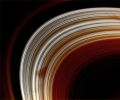
The_Rings-PIA10550.jpgA "Ghost" in the B-Ring (True - but strongly enhanced - Colors; credits: Lunar Explorer Italia)90 visiteCaption NASA:"The ghostly features in Saturn's B-Ring called "Spokes" are making an appearance again as the Cassini Spacecraft continues its tour of the Saturn System.
These dusty features on the Rings are often wedge-shaped, as this one is, with the inner portions of the Spoke being wider than the outer portions due to electromagnetic effects on the dust particles.
The image was taken in Visible Light with the Cassini Spacecraft wide-angle camera on Nov. 26, 2008 at a distance of approximately 922,000 kilometers (573,000 miles) from Saturn and at a Sun-Saturn-Spacecraft, or Phase, Angle of 39°.
Image scale is roughly 52 Km (about 32 miles) per pixel".MareKromium
(4 voti)
|
|

Mimas-PIA10548.jpgMimas over the Rings (possible True Colors credits: Lunar Explorer Italia71 visiteCaption NASA:"Gray Mimas appears to hover above the colorful Rings. The large crater seen on the right side of the moon is named for William Herschel, who discovered Mimas in 1789.
The image was taken using red, green and blue spectral filters; it was acquired with the Cassini Spacecraft narrow-angle camera on Sept. 9, 2007 at a distance of approx. 3,1 MKM (such as about 1,9 MMs) from Mimas and at a Sun-Mimas-Spacecraft, or Phase, Angle of 34°. Image scale is roughly 19 Km (about 12 miles) per pixel".MareKromium
(4 voti)
|
|

Tethys-PIA10547.jpgPenelope's still waiting... (possible True Colors; credits: Lunar Explorer Italia)58 visiteCaption NASA:"The Terminator encroaches upon Penelope, one of the largest craters on Saturn's moon Tethys. Two other large craters, Polyphemus and Phemius, are visible near the Limb in this view of the southern portions of Tethys' Trailing Hemisphere.
The far Rim of Phemius disrupts the smooth profile of the icy moon's limb. (Features on Tethys are named from characters and places mentioned in "The Odyssey")
The image was taken in Visible Light with the Cassini Spacecraft narrow-angle camera on Nov. 24, 2008 at a distance of approximately 62,000 kilometers (38,000 miles) from Tethys and at a Sun-Tethys-Spacecraft, or Phase, Angle of 94°. Image scale is 366 meters (about 1200 feet) per pixel".MareKromium
(4 voti)
|
|

Saturn-PIA11141.jpgThe Lord of the Rings (natural colors; credits: NASA)61 visiteCaption NASA:"As Saturn advances in its orbit toward Equinox and the Sun gradually moves Northward on the Planet, the motion of Saturn's Ring shadows and the changing colors of its atmosphere continue to transform the face of Saturn as seen by Cassini.
This captivating natural color view was created from images collected shortly after Cassini began its extended Equinox Mission in July 2008. It can be contrasted with earlier images from the Spacecraft's four-year Prime Mission that show the shadow of Saturn's Rings first draped high over the Planet's Northern Hemisphere, then shifting Southward as Northern Summer changed to Spring.
During this time, the colors of the Northern Hemisphere have evolved from azure/blue to a multitude of muted-colored bands.
This mosaic combines 30 images — 10 each of red, green and blue light — taken over the course of approximately two hours as Cassini panned its wide-angle camera across the entire Planet and Ring System on July 23, 2008, from a southerly elevation of 6°.
Six moons complete this constructed panorama: Titan, Janus, Mimas, Pandora, Epimetheus and Enceladus.
NASA's Cassini Spacecraft captured these images at a distance of approx. 1,1 MKM (such as about 690.000 miles) from Saturn and at a Sun-Saturn-Spacecraft, or phase, angle of 20°. Image scale is roughly 70 Km (about 43,6 miles) per pixel".MareKromium
(4 voti)
|
|

The_Rings-PIA11142.jpgSaturn's Rings: the whole System70 visitenessun commentoMareKromium
(4 voti)
|
|

The_Rings-PIA10529.jpgThe "Good Shepherds"91 visiteCaption NASA:"The moons Pan and Daphnis cruise through the Encke and Keeler gaps, respectively.
The edge waves used to discover Daphnis can be seen here as the brightening on either side of the moon. And although the edge waves Pan raises in the Encke Gap are not visible here, the wakes caused by Pan's disturbance of the Rings are clearly visible.
The image was taken in visible light with the Cassini Spacecraft narrow-angle camera on Oct. 20, 2008 at a distance of approx. 1,2 MKM (such as about 742.000 miles) from Pan and at a Sun-Pan-Spacecraft, or Phase, Angle of 29°.
Image scale is roughly 7 Km (about 4 miles) per pixel".MareKromium
(4 voti)
|
|

Mimas-PIA10517.jpgCrescent Mimas (possible natural colors; credits: Lunexit)66 visiteCaption NASA:"Mimas's lit crescent has the appearance of a golf ball thanks to its heavily cratered surface.
This image was taken with the Cassini Spacecraft narrow-angle camera on Oct. 24, 2008 using a spectral filter sensitive to wavelengths of IR light centered at 752 nanometers.
The view was obtained at a distance of approx. 189.000 Km (such as about 117.000 miles) from Mimas and at a Phase Angle of 136°.
Image scale is about 1 Km (such as 3707 feet) per pixel".MareKromium
(4 voti)
|
|

The_Rings-N00124202.jpgAnother UFO in the Space of Saturn?119 visiteCaption NASA:"N00124202.jpg was taken on November 16, 2008 and received on Earth November 17, 2008. The camera was pointing toward SATURN-RINGS that, at the time, were approx. 384.802 Km away, and the image was taken using the CL1 and CL2 filters. This image has not been validated or calibrated".MareKromium
(4 voti)
|
|
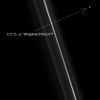
The_Rings-N00124205.jpgAnother UFO in the Space of Saturn?86 visiteCaption NASA:"N00124205.jpg was taken on November 16, 2008 and received on Earth November 17, 2008. The camera was pointing toward SATURN-RINGS which, at the time, were approximately 382.907 Km away, and the image was taken using the CL1 and CL2 filters. This image has not been validated or calibrated".MareKromium
(4 voti)
|
|
| 2244 immagini su 187 pagina(e) |
 |
|
|
|
|
87 | |
|
|
|
|





