| Piú votate - Saturn: the "Ringed Beauty" and His Moons |

Space.gifLight-vawe (GIF-Movie; credits: Dr M. Faccin)104 visitenessun commentoMareKromium
(4 voti)
|
|
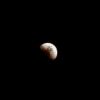
Japetus-PIA11460.jpgJapetus, from far away (Natural Colors; credits: Lunar Explorer Italia)59 visiteCaption NASA:"The Cassini Spacecraft casts its gaze across 4 MKM space for this snapshot of Japetus, Saturn's most distant Major Moon. Japetus — about 1471 Km (914 miles) across — is the 3rd largest moon, but its inclined orbit is much farther out from the other Major Moons, where Cassini spends most of its time. Nonetheless, the moon's distinctive two-tone surface is obvious.
This view looks toward the Leading Hemisphere of Japetus. North on Japetus is up and rotated 2° to the right. The image was taken in visible light with the Cassini Spacecraft narrow-angle camera on March 3, 2008.
The view was acquired at a distance of approx. 4 MKM (such as about 2,5 MMs) from Japetus and at a Sun-Japetus-Spacecraft, or Phase, Angle of 69°.
Image scale is roughly 24 Km (about 15 miles) per pixel".MareKromium
(4 voti)
|
|

PIA07966-112203.wavAudio Signals from the the Space of Saturn (by Dr M. Faccin)58 visitenessun commentoMareKromium
(4 voti)
|
|
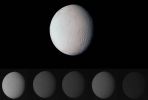
Enceladus_Approach.jpgApproaching Enceladus, from Voyager 258 visitenessun commentoMareKromium
(4 voti)
|
|

The_Rings-PIA11452.jpgSpokes in the B-Ring (Natural Colors; credits: Lunar Explorer Italia)60 visiteCaption NASA:"As Cassini sped around Saturn, the Spacecraft turned to snap this image of bright Spokes giving chase around the B-Ring.
These radial markings are appearing more often as Saturn approaches Equinox (August 2009) (see also PIA11144).
This view looks toward the sunlit side of the rings from about 31° below the Ring-Plane.
The image was taken in visible light with the Cassini Spacecraft wide-angle camera on Feb. 2, 2009. The view was acquired from a distance of approx. 578.000 Km (such as about 359.000 miles) from Saturn and at a Sun-Saturn-Spacecraft, or Phase, Angle of 144°.
Image scale is roughly 30 Km (about 20 miles) per pixel".MareKromium
(4 voti)
|
|

Janus-PIA10599.jpgJanus (Natural Colors; credits: Lunar Explorer Italia)60 visiteCaption NASA:"Janus imitates its two-faced Greek god namesake by catching light on two sides. The brighter side of Janus is lit by the Sun while light reflected off Saturn dimly illuminates the rest of the moon and reveals the non-spherical shape of this small satellite.
This image has been scaled to twice its original size.
This view looks toward the Leading Hemisphere of the Janus (about 179 Km, or approx. 111 miles across).
North on Janus is up and rotated 22° to the left.
The image was taken in visible light with the Cassini spacecraft narrow-angle camera on Feb. 12, 2009.
The view was obtained at a distance of approx. 1 MKM (such as about 621.000 miles) from Janus and at a Sun-Janus-Spacecraft, or Phase, Angle of 112°.
Image scale is roughly 6 Km (about 4 miles) per pixel".MareKromium
(4 voti)
|
|

Rhea.jpgTirawa Basin on Reha, from Voyager 1 (Natural Colors; credits: Ted Stryk)57 visiteAs Voyager 1 receded from its close flyby of Rhea, it snapped this view of Rhea's Tirawa Basin, a large impact structure seen on the Terminator in this crescent view.
It is on of the worst-imaged parts of this world, and this Voyager view is still the best. Rhea is a moon that shows some similar features to more active Dione and Tethys, but seems to have been inactive for longer, as evidenced by the fact that all of its surface is extremely worn from impacts and the evidences of internal activity are much more subtle.MareKromium
(4 voti)
|
|

Prometheus-PIA10593.jpgStreamer Channel (Natural Colors; credits: Lunar Explorer Italia)70 visiteCaption NASA:"Half an hour after Prometheus tore into this region of Saturn's F -Ring, the Cassini Spacecraft snapped this image just as the moon was creating a new Streamer in the Ring. The dark pattern shaped like an upside down check mark in the lower left of the image is Prometheus and its shadow.
The potato shaped moon can just be seen coming back out of the Ring. The moon's handiwork also is apparent in 2 previous Streamer-Channel formations on the right of the image. The darkest Streamer-Channel stretching from the top right to the center of the image shows Prometheus' previous apoapse passage about 15 hours earlier. A fainter, even earlier channel extends to the edge of the image.
Prometheus (about 86 Km, or approx. 53 miles across) dips into the inner edge of the F-Ring when it reaches apoapse, the moon's farthest orbital point from Saturn. At apoapse, the moon's gravity pulls particles of the ring outward into a streamer.
As Prometheus moves onward toward periapse — its orbit's closest point to the Planet — the Streamer gets longer. Then, as Prometheus moves back toward apoapse, the Streamer breaks apart which results in a dark channel.
This Streamer-Channel cycle repeats once every orbit with the Streamer-Channel features being streamers during Prometheus periapse and channels during Prometheus apoapse. The F-Ring is overexposed in this image which has been brightened to reveal the moon.
This view looks toward the unilluminated side of the Rings from about 18° above the Ring-Plane. The image was taken in Visible Light with the Cassini Spacecraft narrow-angle camera on Jan. 14, 2009.
The view was obtained at a distance of approx. 555.000 Km (345.000 miles) from Saturn and at a Sun-Saturn-Spacecraft, or Phase, Angle of 145°.
Image scale is roughly 3 Km (a little less than 2 miles) per pixel".MareKromium
(4 voti)
|
|
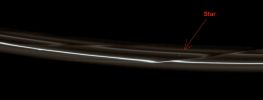
PIA10587.jpgThe "Fragile" F-Ring57 visiteCaption NASA:"Set starkly against the blackness of space are the F-Ring's delicate strands which are periodically gored by its shepherding moon, Prometheus.
Prometheus (approx. 86 Km, or about 53 miles across) and Pandora (approx. 81 Km, or about 50 miles across) both interact with the F-Ring but neither is visible here. Prometheus has the larger effect (see, for instance, PIA08397 for a movie of Prometheus creating a Streamer-Channel in the ring).
A star can be seen through the ring on the right side (Dx) of the image.
This view looks toward the unilluminated side of the Rings from about 33° above the Ring-Plane. The image was taken in visible light with the Cassini Spacecraft narrow-angle camera on Jan. 11, 2009.
The view was acquired at a distance of approx. 1 MKM (such as about 620,000 miles) from Saturn and at a Sun-Saturn-Spacecraft, or Phase, Angle of 37°.
Image scale is roughly 6 Km (about 4 miles) per pixel".MareKromium
(4 voti)
|
|

Rhea-PIA10586.jpgRhea (Natural Colors; credits: Lunar Explorer Italia)59 visiteCaption NASA:"A wide crater dominates the lower right of this image while part of Rhea's brightly lit, wispy terrain can still be seen near the limb of the moon.
Smaller craters are overprinted upon this crater, telling the story of an extremely old feature that has collected impacts over the eons. Younger craters also have been collected on another of Rhea's large basins — Tirawa (see also PIA08976).
North on Rhea (approx. 1528 Km, or about 949 miles across) is up. This view looks toward the Saturn facing-Side of Rhea. The image was taken in visible light with the Cassini Spacecraft narrow-angle camera on Aug. 27, 2008. The view was acquired at a distance of approx. 1,1 MKM (such as about 680,000 miles) from Rhea and at a Sun-Rhea-Spacecraft, or Phase, Angle of 56°.
Image scale is roughly 6 Km (about 4 miles) per pixel".MareKromium
(4 voti)
|
|

The_Rings-PIA10571.jpgThe core of the F-Ring (Natural Colors; credits: Lunar Explorer Italia)60 visiteCaption NASA:"Structure in the tenuous F-Ring can be seen in this image of the ring's bright core.
Much of the structure in the F-Ring is created by its two shepherding moons: Prometheus (about 86 Km, or approx. 53 miles across) and Pandora (about 81 Km, or approx. 50 miles across).
The image was taken in Visible Light with the Cassini Spacecraft narrow-angle camera on Dec. 8, 2008.
The view, which looks down from about 70° above the Ring-Plane toward the unilluminated side of the Rings, was acquired at a distance of approx. 613.000 Km (about 381.000 miles) from Saturn and at a Sun-Saturn-Spacecraft, or Phase, Angle of 77°.
Image scale is roughly 3 Km (a little less than 2 miles) per pixel".MareKromium
(4 voti)
|
|
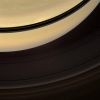
The_Rings-PIA10563.jpgThe Rings of Saturn (Natural Colors; credits: NASA/JPL/Space Science Institute)60 visiteCaption NASA:"Shadows cast onto Saturn by its Rings, visible here as dark bands, move steadily towards the Equator and grow thinner as Equinox approaches.
The Sun will cross Saturn's Ring-Plane on Aug. 10, 2009. Color variations between clouds in the Northern Hemisphere are more apparent than those in the Southern Hemisphere, which seems relatively bland, as Spring arrives in the North and Fall in the South.
Images taken using red, green and blue spectral filters were combined to create this natural color view. The images were acquired with the Cassini spacecraft wide-angle camera on Nov. 22, 2008 at a distance of approx. 859.000 Km (about 533.000 miles) from Saturn and at a Phase Angle of 56°.
Image scale is roughly 48 Km (about 30 miles) per pixel".MareKromium
(4 voti)
|
|
| 2244 immagini su 187 pagina(e) |
 |
|
|
|
|
86 | |
|
|
|
|





