| Piú votate - Saturn: the "Ringed Beauty" and His Moons |
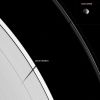
The_Rings_and_Janus_Shadow-PIA11517.jpgJanus and its Shadow on the Rings61 visiteCaption NASA: (Main Frame) "The Cassini Spacecraft catches Janus joining other Saturnian moons in the Equinox "shadow-casting" party. As Saturn approaches its August 2009 Equinox, the Planet's moons cast shadows onto the Rings. Janus (about 179 Km, or approx. 111 miles across) is not visible in this image it has been added in the inset on upper right), but its shadow stretches across Saturn's A and F-Rings. Three background stars are visible in the image.
This view looks toward the sunlit side of the Rings from about 21° below the Ring-Plane. The image was taken in vVisible Light with the Cassini Spacecraft narrow-angle camera on May 10, 2009. The view was acquired at a distance of approx. 965.000 kM (such as about 600.000 miles) from Saturn and at a Phase Angle of 46°.
Image scale is roughly 5 Km (a little more than 3 miles) per pixel".
(Inset): "The small moon Janus is illuminated by light from both the Sun and Saturn. This view looks toward the South Pole of Janus which lies on the Terminator, just below the center of the image. Brightly lit terrain seen on the right is on the Leading Hemisphere of Janus. Light reflected off Saturn dimly lights the Saturn-facing side of Janus on the top left of the image.
The image was taken in Visible Light with the Cassini Spacecraft narrow-angle camera on May 9, 2009. The view was acquired at a distance of approx. 974.000 Km (such as approx. 605.000 miles) from Janus and at a Phase Angle of 99°.
Image scale is roughly 6 Km (a little less than 4 miles) per pixel".MareKromium
(4 voti)
|
|

Daphnis_and_Rings-PIA11656-2.JPGWavy Shadows (edm)58 visiteCaption NASA:"Never-before-seen tall vertical structures created by Saturn's moon Daphnis rise above the Planet's otherwise flat, thin disk of Rings to cast long shadows in this Cassini image.
Daphnis, approx. 8 Km (about 5 miles) across, occupies an inclined orbit within the about 42-Km (approx. 26-mile) wide Keeler Gap in Saturn's outer A-Ring. Recent analyses by imaging scientists published in the Astronomical Journal illustrate how the moon's gravitational pull perturbs the orbits of the particles forming the Gap's edge and sculpts the edge into waves having both vertical and horizontal components.
Measurements of the shadows in this and other images indicate that the vertical structures range between one-half to 1,5 Km tall (about 1/3rd to one mile), making them as much as 150 times as high as the Ring is thick. The main A, B and C-Rings are only about 10 meters (about 30 feet) thick. Daphnis itself can be seen casting a shadow onto the nearby Ring".MareKromium
(4 voti)
|
|

Japetus-PIA08375~0.jpgSnow on Japetus' Mountains (Natural Colors; credits: Lunar Explorer Italia)109 visiteDopo aver effettuato la consueta colorizzazione Multispettrale ed in Colori Naturali, la nostra idea è che le chiazze bianche e dai riflessi blu che caratterizzano alcuni rilievi della misteriosa Luna Saturniana Giapeto debbano essere riferiti a ghiaccio d'acqua (la cui albedo e specifica colorazione lo rende inconfondibile).
Pronti a scusarci in caso di errore, rimettiamo la parola ai nostri Amici di Pasadena (che, sino ad oggi, sull'argomento in questione non si sono sbilanciati).MareKromium
(4 voti)
|
|
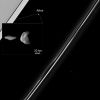
Atlas-PIA11494.jpgAtlas and a few Stars62 visiteCaption NASA:"Atlas is seen in this image with several background stars as the moon orbits within the Roche Division — the Region between Saturn's A and F-Rings.
Atlas (about 30 Km, or approx. 19 miles across) is in the top left quadrant of the image.
This view looks toward the sunlit side of the Rings from about 65° below the Ring-Plane. The image was taken in Visible Light with the Cassini Spacecraft narrow-angle camera on March 23, 2009. The view was acquired at a distance of approx. 913.000 Km (about 567.000 miles) from Saturn and at a Sun-Saturn-Spacecraft, or Phase, Angle of 105°.
Image scale is roughly 5 Km (a little more than 3 miles) per pixel".MareKromium
(4 voti)
|
|

The_Rings-PIA11483.jpgShadows on the Rings58 visite...EccoVi un altro esempio delle "gigantesche navi spaziali" che si muoverebbero attraverso gli Anelli di Saturno, secondo il Dr Bergrun...
In realtà è soltanto la lunga ombra della luna saturniana Tethys la quale, all'avvicinarsi dell'Equinozio, si stende sugli Anelli del Gigante Gassoso, dando l'impressione - ma solo ad un osservatore completamente disattento - della esistenza di un vascello scuro a forma di fuso che si muove attraverso gli Anelli "F" ed "A".
Caption NASA:"Joining other moons in heralding the coming of Saturn's August 2009 Equinox, the moon Tethys casts its shadow across Saturn's F-Ring and part of the A-Ring.
The penumbra, or outer non-opaque part of Tethys' shadow, has intersected the A-ring. Only around the time of Equinox are the shadows of the moons cast onto Saturn's Rings. For an animation of the moon Epimetheus casting a shadow on the A-Ring, see also PIA11651.
The image on the left was taken in Visible Light with the Cassini Spacecraft wide-angle camera on March 20, 2009. The image on the right was taken with the narrow-angle camera at nearly the same time. Tethys itself is not visible in these images, but the small moon Prometheus can be seen between the F and A-Rings in the top of the wide-angle camera image.
This view looks toward the unilluminated side of the Rings from about 37° above the Ring-Plane. The view was obtained from a distance of approx. 880.000 Km (about 547.000 miles) from Saturn and at a Sun-Saturn-Spacecraft, or Phase, Angle of 124°.
Image scale is roughly 49 Km (about 31 miles) per pixel in the wide-angle image. In the narrow-angle camera image, the scale is roughly 5 Km (a little more than 3 miles) per pixel".MareKromium
(4 voti)
|
|

Japetus-PIA11474.jpgCrescent Japetus (Natural Colors; credits: Lunar Explorer Italia)60 visiteCaption NASA:"Only a slice of Japetus is illuminated in this image, but still the Cassini Spacecraft spies the distinctive two-tone surface of this distant Saturnian moon.
Lit terrain seen here is on the Leading Hemisphere of Japetus (about 1471 Km, or about 914 miles across). North on Japetus is up and rotated 13° to the left.
The view was acquired at a distance of approx. 2,7 MKM (about 1,7 MMs) from Japetus and at a Sun-Iapetus-Spacecraft, or Phase, angle of 111°. The image was taken in Visible Light with the Cassini Spacecraft narrow-angle camera on March 3, 2009.
Image scale is roughly 16 Km (about 10 miles) per pixel".MareKromium
(4 voti)
|
|

Dione-PIA11471.jpgCosmic "Smile"...151 visiteCaption NASA:"Only a sliver of Dione is visible as the Cassini Spacecraft looks at the dark side of the moon. In a high-phase viewing geometry like the one in which this picture was taken, the Sun and the Spacecraft are on nearly opposite sides of the moon. Here, only a narrow crescent reflects light forward toward Cassini's camera. The outline of a crater is just visible in the Southern Hemisphere.
This view looks toward the Leading Hemisphere of Dione. North on Dione is up and rotated 2° to the right. The image was taken in Visible Light with the Cassini Spacecraft narrow-angle camera on Feb. 25, 2009.
The view was acquired at a distance of approx. 484.000 Km (such as about 301.000 miles) from Dione and at a Sun-Dione-Spacecraft, or Phase, Angle of 166°.
Image scale is roughly 3 Km (a little less than 2 miles) per pixel".MareKromium
(4 voti)
|
|

The_Rings-Shadows-1.gifLooooong (!) Shadows on the Rings (GIF-Movie)76 visitenessun commentoMareKromium
(4 voti)
|
|

The_Rings-Shadows-2.gifLooooong (!) Shadows on the Rings (GIF-Movie)63 visitenessun commentoMareKromium
(4 voti)
|
|
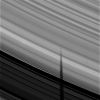
The_Rings-Shadows_cassini_big.jpgA "Wall" on the Rings60 visiteCaption NASA:"What's causing unusual jagged shadows on Saturn's Rings? No one is yet sure. As Saturn nears Equinox, its Rings increasingly show only their thin edge to the Earth and Sun. As a result, Saturn's moons now commonly cast long shadows onto the Rings. An example of this is the elongated vertical shadow of Mimas seen on the above right.
The series of shorter, jagged shadows that run diagonally, however, are more unusual. Now Saturn's Rings have been known to be made of particles for hundreds of years, but these particles have so far escaped direct imaging.
It is therefore particularly exciting that a preliminary hypothesis holds that these jagged shadows are silhouettes of transient groups of ring particles temporarily held close by their own gravity. Future work will surely continue, as the robotic Cassini Spacecraft orbiting Saturn that took the above image will continue to photograph Saturn's magnificent Rings right through Saturn's equinox this August (2009)".MareKromium
(4 voti)
|
|
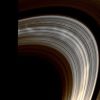
The_Rings-PIA11470.jpgMorning Spokes (Natural Colors; credits: Lunar Explorer Italia)58 visiteCaption NASA:"Bright spokes emerge from behind the shadow of the Planet and into sunlight in this view from the Cassini Spacecraft.
Saturn's long shadow covers the left side of the image. This view looks toward the sunlit side of the Rings from about 22° below the Ring-Plane.
The image was taken in visible light with the Cassini Spacecraft wide-angle camera on Feb. 26, 2009. The view was acquired at a distance of approx. 821.000 Km (about 510.000 miles) from Saturn and at a Sun-Saturn-Spacecraft, or Phase, Angle of 150°.
Image scale is roughly 46 Km (about 29 miles) per pixel".MareKromium
(4 voti)
|
|

Janus-PIA11469.jpgJanus' Polar Crater59 visiteCaption NASA:"A large crater on Saturn's tiny moon Janus is distinctly visible in this Cassini Spacecraft image. Lit terrain seen here is on the Leading Hemisphere of Janus (approx. 179 Km, or about 111 miles across). North on Janus is up and rotated 7° to the left.
The image was taken in Visible Light with the Cassini Spacecraft narrow-angle camera on March 5, 2009. The view was acquired at a distance of approx. 1,1 MKM (about 684.000 miles) from Janus and at a Sun-Janus-Spacecraft, or Phase, Angle of 53°. Resolution in the original image was roughly 6 Km (about 4 miles) per pixel.
The image has been magnified by a factor of two to aid visibility".MareKromium
(4 voti)
|
|
| 2244 immagini su 187 pagina(e) |
 |
|
|
|
|
85 | |
|
|
|
|





