| Piú votate - Saturn: the "Ringed Beauty" and His Moons |

The_Rings-PIA12512.jpgThe "E-Ring"60 visiteCaption NASA:"The Cassini Spacecraft takes a look at Saturn's diffuse E-Ring which is formed from icy material spewing out of the South Pole of the moon Enceladus (see PIA08921 to learn more about how Enceladus creates the E-Ring). The E-Ring is seen nearly edge-on from slightly above the Northern Side of Saturn's Ring-Plane.
The image was taken in Visible Light with the Cassini Spacecraft wide-angle camera on Oct. 23, 2009. The view was acquired at a distance of approx. 2,5 MKM (such as about 1,6 MMs) from Saturn.
Image scale is roughly 149 Km (approx. 92 miles) per pixel".MareKromium
(4 voti)
|
|

Saturnian_Sky.gifIn the Sky of Saturn (GIF-Movie; credits: Dr M. Faccin)59 visitenessun commentoMareKromium
(4 voti)
|
|

Tethys_and_Rhea-N00147318-N00147337.gifSilent Running: Tethys and Rhea (GIF-Movie; credits: Elisabetta Bonora)59 visitenessun commentoMareKromium
(4 voti)
|
|

Rhea-PIA11638.jpgCraterland (Natural Colors; credits: Lunexit)59 visiteCaption NASA:"Craters imprinted upon other craters record the long history of impacts endured by Saturn's moon Rhea.
This view looks toward the Mid-Southern Latitudes of the Saturn-facing side of Rhea. North on Rhea is up.
The image was taken in Visible Light with the Cassini Spacecraft narrow-angle camera on Oct. 13, 2009. The view was obtained at a distance of approx. 45.000 Km (about 28.000 miles) from Rhea and at a Sun-Rhea-Spacecraft, or Phase, Angle of 105°.
Image scale is approx. 260 meters (about 860 feet) per pixel".MareKromium
(4 voti)
|
|
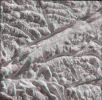
Enceladus-3D-MF.jpgTiger Stripes (High-Def-3D; credits: Dr M. Faccin)58 visiteDa guardare...MareKromium
(4 voti)
|
|
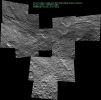
RHEA-ImageMosaic-GB2.jpgRhea (Image-Mosaic; credits: Dr G. Barca)59 visiteDedicato ai Ragazzi di Pasadena ed allo Space Science Institute (che ci offre, quest'ultimo, dei prodotti fotografici - spesso - inguardabili).MareKromium
(4 voti)
|
|
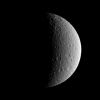
Rhea-PIA11630.jpgCrescent Rhea58 visiteCaption NASA:"The Cassini Spacecraft looks toward the battered Surface of the moon Rhea.
This view looks toward the Leading Hemisphere of Rhea. North on Rhea is up.
The image was taken in Visible Light with the Cassini Spacecraft wide-angle camera on Oct. 13, 2009. The view was acquired at a distance of approx. 44.000 Km (about 27.000 miles) from Rhea and at a Sun-Rhea-Spacecraft, or Phase, Angle of 103°.
Image scale is roughly 3 Km (a little less than 2 miles) per pixel".MareKromium
(4 voti)
|
|
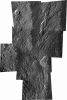
RHEA1-Panoramic-GB.jpgRhea (Image-Mosaic; credits: Dr G. Barca)58 visiteIn attesa che la NASA faccia di meglio (se non altro pubblicamente)...MareKromium
(4 voti)
|
|
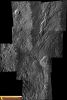
RHEA2-Panoramic-GB.jpgRhea (Image-Mosaic; credits: Dr G. Barca)59 visiteIn attesa che la NASA faccia di meglio (se non altro pubblicamente)...MareKromium
(4 voti)
|
|

Tethys-N00145736-N00145747-N00145784-N00145803.gifMoons Carousel (GIF-Movie; credits: Dr G. Barca)57 visiteLo Spettacolo dello Spazio di Saturno: meraviglioso!MareKromium
(4 voti)
|
|

Tethys-N00143729-N00143747.gifTethys and "The Runners" (GIF-Movie; credits: Dr G. Barca)58 visitenessun commentoMareKromium
(4 voti)
|
|

Tethys-N00143707_to_09.jpgTethys (Superdefinition; credits: Dr M. Faccin)57 visiteIl Cratere che ben si distingue in questa spettacolare immagine di Tethys (frame processato in Superdefinzione dal nostro eccezionale Marco Faccin) , è "Penelope": un notevole bacino da impatto che, mutatis mutandis, ci ricorda tantissimo il Cratere Odysseus (sempre su Tethys); il Cratere Herschel (noto anche come "L'Occhio di Mimas") ed il Cratere Stickney (un enorme bacino d'impatto che si trova sulla Luna Marziana "Phobos").MareKromium
(4 voti)
|
|
| 2244 immagini su 187 pagina(e) |
 |
|
|
|
|
83 | |
|
|
|
|





