| Piú votate - Saturn: the "Ringed Beauty" and His Moons |
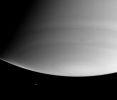
Saturn and Enceladus - PIA06483_modest.jpgSaturn and Enceladus (in ultra-violet)61 visiteCaption NASA originale:"Looking beyond Saturn's south pole, this was the Cassini spacecraft's view of the distant, icy moon, Enceladus on July 28, 2004. The planet itself shows few obvious features at these ultraviolet wavelengths, due to scattering of light by molecules of the gases high in the atmosphere. Enceladus is 499 Km wide.
The image was taken with the Cassini spacecraft narrow angle camera at a distance of 7.4 MKM from Saturn through a filter sensitive to ultraviolet wavelengths of light. The image scale is 44 Km per pixel of Saturn".
(5 voti)
|
|

Saturn_s Rings in color - PIA06114_modest.jpgSaturn's Rings in natural colors from Cassini-Huygens55 visiteCaption NASA originale:Saturn's faintly banded atmosphere is delicately colored and its threadbare rings cross their own shadows in this marvelous natural color view from Cassini.
The planet and its rings would nearly fill the space between Earth and the Moon. Yet, despite their great breadth, the rings are a few meters thick and in some places, very translucent. In this image, we can see through the C-Ring, which is closest to Saturn, and through the Cassini division, the 4.800-Km wide gap that arcs across the top of the image and separates the optically thick B-Ring from the A-Ring. The part of the atmosphere seen through the gap appears darker and more bluish due to scattering at blue wavelengths by the cloud-free upper atmosphere.
The different colors in Saturn's atmosphere are due to particles whose composition is yet to be determined.
The image was obtained with the Cassini spacecraft narrow angle camera on July 30, 2004, at a distance of 7.6 MKM from Saturn".
(5 voti)
|
|

Phoebe (3D).jpgThree-dimensional Phoebe61 visiteCaption NASA originale:"The Sun is coming from the left, illuminating craters and bumps on the surface, along with a prominent ridge-like feature in the middle. Bright material, likely to be ice, is exposed atop this ridge-like feature as well as around small craters and down the slopes of large craters. There are also bright streaks on steep slopes, perhaps where loose material slid downhill during the seismic shaking of impact events".
(5 voti)
|
|

Saturn_s Clouds-V1&V2-PIA01375_modest.jpgSaturn's Clouds from Voyager 1 and Voyager 260 visiteCaption NASA originale:"This comparison shows Saturn’s north temperate region as viewed on Nov. 5, 1980, by Voyager 1 (left) and Aug. 21, 1980, by its sister craft, Voyager 2, from a range of 5.000.000 Km; the large bright oval feature in the lower right of each frame measures about 2.500 Km. The largest bright feature in the Voyager 1 photograph extends about 7.500 Km from north to south. These giant storms lie within one of the strongest westward-flowing currents observed in the atmosphere, with wind speeds of about 20 mt p/s".
(5 voti)
|
|

Saturn from approx. 9.000.000 Km.jpgWhat is this?!? (2)56 visiteUn'immagine curiosa, misteriosa ed affascinante: gli strumenti di bordo della Sonda Cassini-Huygens dicono che questa ripresa si riferisce all'Anello "E"; in pratica diremmo che la fotocamera in questione stava riprendendo (come è già accaduto tante volte) lo Spazio di Saturno. Il chiarore rotondeggiante che vediamo in basso non sembra l'alone di luce che l'Anello "E" emana intorno a sè. E allora di che cosa si tratta?
(5 voti)
|
|

Dione from 6.200.000 Km.jpgDione from 6.200.000 Km58 visitenessun commento
(5 voti)
|
|
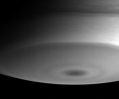
Saturn from 5.000.000 (infrared).jpgSaturn from about 5.000.000 Km (infrared)59 visitenessun commento
(5 voti)
|
|

AAB-The Sky of Saturn before the 2nd Streak.jpgSaturn's Sky just before the 2nd "Streak" - W00000827121 visiteIl giorno 6 Agosto 2004 accade nuovamente qualcosa di affascinante ed inspiegabile: una delle fotocamere di cui la Sonda Cassini/Huygens è dotata si sta riposizionando verso un nuovo obbiettivo e, nel farlo, riprende immagini "random" dello Spazio di Saturno, ossia senza puntare ad un oggetto determinato (questo in accordo a quanto riportano le fonti ufficiali). Questo è il frame che precede l'apparizione della nuova "striscia di luce": si vedono alcune stelle e tutto sembra normale.
(5 voti)
|
|

Saturn from 7.849.317 Km.jpgSaturn from 7.849.317 Km58 visitenessun commento
(5 voti)
|
|

Saturn from 7.417.701 Km.jpgSaturn from 7.417.701 Km59 visitenessun commento
(5 voti)
|
|

Saturn from 5.000.000 Km.jpgSaturn from approx. 5.000.000 Km59 visitenessun commento
(5 voti)
|
|

Japetus from 6.161.000 Km.jpgJapetus from approx. 6.161.000 Km59 visitenessun commento
(5 voti)
|
|
| 2244 immagini su 187 pagina(e) |
 |
|
|
|
|
76 | |
|
|
|
|





