| Piú votate - Saturn: the "Ringed Beauty" and His Moons |

Dione-PIA06163.jpgDione: close-up (2) - HR58 visiteCaption NASA originale:"This very detailed image taken during the Cassini spacecraft's closest approach to Saturn's moon Dione on Dec. 14, 2004 is centered on the wispy terrain of the moon. To the surprise of Cassini imaging scientists, the wispy terrain does not consist of thick ice deposits, but rather the bright ice cliffs created by tectonic fractures". Una nostra piccola annotazione: tutta la superficie di Dione è, a ben vedere, un mosaico di quelle che alla NASA chiamano "tectonic fractures"; ma guardate bene che cosa si diparte, circa al centro dell'immagine, dalla linea del terminatore: una "frattura tettonica anomala", perfettamente dritta, curiosamente molto luminosa (ci ricorda una pista di atterraggio/decollo di aeromobili oppure un'autostrada...) che attraversa altre fratture (decisamente più "naturali"...) e che costeggia il bordo di almeno 5 crateri, uno dei quali ci sembra abbastanza grande. Se non la vedete, guardate il detail mgnf che abbiamo preparato per Voi nel frame successivo.
(5 voti)
|
|

Dione-N00025942.jpgDione from approx. 167.000 Km58 visiteDa guardare: nessun commento.
(5 voti)
|
|

Japetus-N00025365.jpgThe anomalous moon "Japetus" from approx. 4,7 MKMs58 visitenessun commento
(5 voti)
|
|

Mimas, Janus, Prometheus-PIA06529_modest.jpgMimas, Janus and Prometheus, from the darkside62 visiteCaption NASA originale: "Visible in this image are: Mimas (398 Km, or 247 miles across) brightest and above center; Janus (181 Km, or 112 miles across) second brightest at upper left; and Prometheus (102 Km, or 63 miles across) just above the main rings at upper left.
The normally bright B-Ring appears very dark from this vantage point. Regions with smaller concentrations of particles, such as the Cassini division (bright near center) transmit more sunlight and thus are brighter.
The image was taken in visible light with the Cassini spacecraft wide angle camera on Oct. 27, 2004, at a distance of 757.000 Km(470.000miles) from Saturn. The image scale is about 42 Km (26 miles) per pixel".
(5 voti)
|
|

Saturn-PIA06538_modest.jpgSaturn and the shadow of his Rings59 visiteThis majestic view of Saturn captures several phenomena of interest to scientists working on the Cassini mission. The planet's nighttime atmosphere looms ahead - an excellent place to search for storms and lightning. Saturn's shadow stretches across the rings, which will over the next four years receive their most thorough examination since Galileo discovered them in 1610. And barely visible near lower right just inside the F-Ring, is the small shepherd moon Prometheus (102 Km across). Researchers will explore the many moons of Saturn, including special ones like Prometheus that help maintain some of the rings and gaps in this complex and dynamic system.
The image was taken in visible light with the Cassini spacecraft wide angle camera on Oct. 29, 2004, at a distance of about 940.000 Km from Saturn. The image scale is 52 Km per pixel."
(5 voti)
|
|
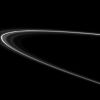
The F-Ring-PIA06144~1.jpgThe "F-Ring", alone58 visiteCaption NASA originale:"Zigzagging kinks and knots dance around Saturn in the F-Ring. From a great distance, as during Cassini's initial approach to Saturn in mid-2004, the F-Ring appears as a faint, knotted strand of material at the outer fringe of Saturn's immense ring system. From this close vantage point, just after the spacecraft rounded the planet to begin its second orbit, the F ring resolves into several ringlets with a bright central core. The core of the F ring is about 50 Km wide and is located at a distance of approximately 80.100 Km from Saturn's cloud tops".
(5 voti)
|
|
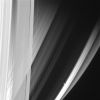
Saturn-N00023939.jpgSaturn is not alone... (2)60 visitenessun commento
(5 voti)
|
|
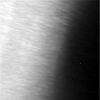
The E-Ring - W00002680.jpgThe "E-Ring" from approx. 412.000 Km57 visiteUn'immagine davvero ravvicinata (sempre in termini spaziali, come ovvio...) dell'Anello "E" di Saturno, inquadrato da una distanza inferiore al mezzo milione di Km.
Una visione decisamente spettacolare ed enigmatica, davvero.
(5 voti)
|
|
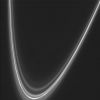
The F-Ring - N00023767.jpgThe "F-Ring" of Saturn from approx. 544.000 Km55 visiteUna spettacolare ripresa (una delle tantissime, a dire il vero) del misterioso "F-Ring" di Saturno da una distanza - relativamente - breve: poco più di mezzo milione di Km. Svariati dettagli di questo enigmatico anello sono chiaramente visibili e, in particolare, potete vedere i cosiddetti "clumps", ossìa una specie di "grumi" di roccia e detriti che rendono irregolari alcune sezioni dell'anello (in particolare ce ne sono 4 assai ben visibili in basso ed alla Vostra Dx).
Sul margine superiore interno dell'Anello, alla Dx dell'Osservatore, si vede un puntino bianco che potrebbe essere (ma di questo non ne siamo certi) un altro "Ring Master" oppure, se preferite, una "Shepherd Moon". Due modi e due nomi diversi per indicare una piccolissima Luna di Saturno che, con la sua sola presenza, contribuisce a mantenere in equilibrio il sistema degli anelli - da un lato - e, talvolta, ad "incresparlo" - dall'altro.
(5 voti)
|
|

Saturn-N00022514.jpgA big "white and round spot" on Saturn60 visiteUna configurazione transitoria delle nuvole di Saturno: si è formato, in prossimità del Polo Sud del Pianeta Anellato, un disco di nuvole bianche, molto ben definito nelle sue linee essenziali. Un uragano, probabilmente, che scarica la sua immensa energia negli strati superiori dell'atmosfera di Saturno e che si esaurirà in qualche giorno.
(5 voti)
|
|

Saturn-N00020988.jpgThe "Rings"57 visitenessun commento
(5 voti)
|
|

Saturn_s sky-N00020366.jpgThe Sky of Saturn59 visiteIl cielo di Saturno, visto da Cassini/Huygens. Queste immagini, purtroppo, non vengono molto pubblicizzate, nè dalla NASA nè da altri organi di informazione (scientifica o meramente divulgativa). Il motivo è abbastanza chiaro: frame come questo - si dice - non mostrano "nulla di particolare", se non qualche stella e qualche satellite di Saturno. Secondo noi, frame come questo possiedono una grandissima magia ed un enorme fascino: lo Spazio visto DALLO Spazio! Qualcuno ha detto che "...Se non c'è bellezza, non ci può essere curiosità; e se non c'è curiosità, non ci può essere scienza alcuna...".
Noi siamo d'accordo.
(5 voti)
|
|
| 2244 immagini su 187 pagina(e) |
 |
|
|
|
|
75 | |
|
|
|
|





