| Piú votate - Saturn: the "Ringed Beauty" and His Moons |

Rhea-PIA07554.jpgRhea's "Bright Splat"73 visiteCaption NASA originale:"This view of Saturn's moon Rhea shows the tremendous "Bright Splat" that coats much of the moon's leading hemisphere. The bright feature may be impact-related and is visible in other Cassini images of Rhea.
The image was taken in visible green light with the Cassini spacecraft narrow-angle camera on June 25, 2005, at a distance of approx. 1,1 MKM from Rhea and at a phase angle of less than 1°. Resolution in the original image was 7 Km (about 4 miles) per pixel (...)".
Nota: in qualità di Ricercatori nel campo delle Scienze Planetarie e quindi al di fuori di ogni intendimento strumentalmente polemico nei confronti della NASA e degli Scienziati che attribuiscono il 99,99% dei crateri presenti sui corpi celesti attualmente più conosciuti (dalla nostra Luna alle lune di Nettuno) all'azione di impatti, desideriamo sottolineare che un "Bright Splat" come questo, al 99,99%, NON è attribuibile ad un impatto (a meno che l'agente impattante non fosse una gigantesca palla di fango).
(5 voti)
|
|

Enceladus-PIA06250.jpgZooming-in on Enceladus59 visiteCaption NASA originale:"The tortured Southern Polar terrain of Enceladus appears strewn with great boulders of ice in these 2 fantastic views - the Highest Resolution images obtained so far by Cassini of any world.
This comparison view consists of a wide-angle camera image (left) for context, and a HR narrow-angle camera image (right). The 2 images were acquired at an altitude of approx. 208 Km, as Cassini made its closest approach yet to Enceladus. The wide-angle view shows what appears to be a geologically youthful, tectonically fractured terrain.
In the narrow-angle view, some smearing of the image due to spacecraft motion is apparent. Both of these views were acquired as Enceladus raced past Cassini's field of view near the time of closest approach. At the time, the imaging cameras were pointed close to the moon's limb (edge), rather than directly below the spacecraft. This allowed for less 'motion blur' than would have been apparent had the cameras pointed straight down. Thus, the terrain imaged here was actually at a distance of 319 kilometers (198 miles) from Cassini".
(5 voti)
|
|

Telesto~0.jpgThe Trojan Moons: Telesto, from 533.000 Km59 visiteCaption NASA originale:"This is Cassini's best look yet at the Trojan moon Telesto (24 Km, or 15 miles across), which orbits Saturn about 60° ahead of the much larger Tethys (1.071 Km, or 665 miles across). Calypso (22 Km, or 14 miles across) is the other Tethys Trojan and trails the larger moon by 60°. Trojan moons are found near gravitationally stable points ahead or behind a larger moon.
Cassini is able to partly resolve Telesto's shape in this view, but surface features are too small to be visible from this distance.
The image was taken in visible light with the Cassini spacecraft narrow-angle camera on May 20, 2005, at a distance of approx. 533.000 Km (331.000 miles) from Telesto. The image scale is 3 Km (about 2 miles) per pixel. This view of Telesto has been magnified by a factor of three and sharpened to aid visibility".
(5 voti)
|
|
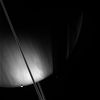
Saturn-W00009484.jpgHow many moons around Saturn? (2) - frame W0000948460 visiteUna delle due lune (diciamo) "maggiori" sembra allungarsi e sdoppiarsi, ma si tratta - a nostro parere - di un mero effetto ottico derivante dalla ripresa non buona. Se così non fosse, invece, potremmo supporre che il corpo celeste "allungato" (e minore) sia una delle "Lune Pastore": nella fattispecie, ipotizzeremmo Prometheus.
I due punti luminosi che vedete sulla Dx del frame sono inspiegabili, ma si potrebbe ragionevolmente trattare di photo-artifacts.
(5 voti)
|
|

Prometheus_and_Pandora-PIA07544.jpgPrometheus and Pandora59 visiteSaturn's moons Prometheus and Pandora are captured here in a single image taken from less than 1° above the dark side of Saturn's Rings. Pandora is on the right and Prometheus is on the left. Prometheus is 102 Km (63 miles) across, while Pandora is 84 Km (52 miles) across.
The two moons are separated by about 69.000 Km (about 43.000 miles) in this view. The F-Ring, extending farthest to the right, contains a great deal of fine, icy material that is more the size of dust than the boulders thought to comprise the dense B-Ring.
These tiny particles are particularly bright from this viewing geometry, especially at right near the ansa, or edge.
At left of center, a couple of ringlets within the Encke gap (325 Km or 200 miles wide) can also be easily seen due to their fine dust-sized material. The other dark features in the Rings are density waves and bending waves. The image was taken in visible light from a mean distance of 1,85 MKM from the moons.
(5 voti)
|
|

Enceladus-N00037000.jpgEnceladus fly-by (9) - from approx. 38.000 Km58 visitenessun commento
(5 voti)
|
|

Enceladus-N00036994.jpgEnceladus fly-by (8) - from approx. 52.000 Km59 visitenessun commento
(5 voti)
|
|

Enceladus-N00036975.jpgEnceladus fly-by (5) - from approx. 64.000 Km57 visitenessun commento
(5 voti)
|
|

Enceladus-N00036966.jpgEnceladus fly-by (3) - from approx. 69.000 Km58 visitenessun commento
(5 voti)
|
|

Enceladus-N00036954.jpgEnceladus fly-by (2) - from approx. 110.000 Km57 visitenessun commento
(5 voti)
|
|
Hyperion-N00035437.jpgHyperion, from about 330.000 Km (4)60 visitenessun commento
(5 voti)
|
|

The Rings-PIA07513.jpgWatching "through" the Rings...57 visiteGli Anelli di Saturno, come questo frame dimostra ampiamente, non sono affatto spessi, anzi...
Dietro il sottilissimo strato di detriti, ghiaccio e polveri, infatti, il profilo del Gigante Gassoso occhieggia in maniera netta e definita mentre la Sonda Cassini 'scivola' al di sotto del piano degli Anelli e scatta questa superba istantanea che, a nostro parere, rappresenta una delle più belle mai ottenute nella Storia dell'Esplorazione delle Regioni più esterne del Sistema Solare.
Caption NASA originale:"In this fabulous close-up, Cassini peers directly through regions of the A, B and C-Rings (from top to bottom) to glimpse shadows of the very same Rings cast upon the Planet's atmosphere. Near the top, shadows cast by ringlets in the Cassini division (center) look almost like a photo negative. This type of image helps scientists probe the Rings' structure in detail and provides information about the density of their constituent particles. The image was taken from a distance of 2,3 MKM from Saturn".
(5 voti)
|
|
| 2244 immagini su 187 pagina(e) |
 |
|
|
|
|
72 | |
|
|
|
|





