| Piú votate - Saturn: the "Ringed Beauty" and His Moons |
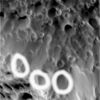
Hyperion-N00040344.jpgHyperion (16)57 visiteLa distanza si accorcia progressivamente: ora sono solo 12.700 i Km che dividono Cassini dal questo "mondo-spugna". I dettagli superficiali maggiori di Hyperion si confermano e, in aggiunta al "nero" che vediamo sul fondo di innumerevoli crateri, adesso ci paiono abbastanza visibili anche i segni di "land-slides" (o "smottamenti fangosi"), sulle pareti interne di alcuni dei crateri più grandi che si vedono in questo frame (osservare i dettagli superficiali isolati dalle tre cerchiature bianche e provare a confrontarli con le land-slides di Marte, come riprese da MGS).
Attenzione: non stiamo dicendo che su Hyperion vi sia del "fango" o qualcosa di simile: stiamo solo notando che in alcune zone, poste sugli argini dei crateri non conici o sulle loro pareti interne, sembrano essersi prodotti degli "accumuli" di materiale che ricordano le land-slides di Marte. In questo caso, usando la logica, potremmo anche supporre che si tratti di effetti di un processo noto come "gravity-wasting".
(5 voti)
|
|
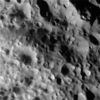
Hyperion-N00040329.jpgHyperion (13)74 visiteSiamo a circa 16.700 Km dalla superficie di Hyperion.
I dettagli che abbiamo cercato di portare alla Vostra attenzione tramire i frames precedenti si confermano.
Difficile pensare che questo tipo di superficie sia il prodotto di un semplice bombardamento meteorico...
(5 voti)
|
|
Hyperion-N00040302.jpgHyperion (10)59 visiteLa distanza di cassini dalla superficie di Hyperion è ora scesa a poco più di 24.000 Km. Nessun ulteriore dettaglio da evidenziare.
(5 voti)
|
|
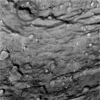
Tethys-N00040100.jpgTethys Fly-By (10)57 visiteMolto migliore, in termini di definizione e risoluzione, questo nuovo frame, ottenuto da una distanza di circa 19.800 Km dalla superficie di Tethys. I Rilievi che ci mostra (ed in particolare ci riferiamo ad una stranissima catena montuosa visibile sul suo margine superiore) sono affascinanti e piuttosto inquietanti. L'impressione che ricaviamo dal rilievo al quale si faceva cenno, infatti, è quella di una montagna la cui sommità - nella cerchiatura grigia - è non solo piuttosto "sottile", ma anche "fortemente inclinata" rispetto al piano dell'orizzonte sul quale poggia ed al quale accede (notare l'ombra che viene proiettata sul suolo).
(5 voti)
|
|
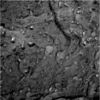
Tethys-N00040099.jpgTethys Fly-By (9)60 visiteSono "solo" 20.000, ora, i Km di distanza fra Cassini e Tethys: questo frame, purtroppo, rappresenta e contiene un autentico campionario di difetti dell'immagine i quali, forse a torto e forse a ragione, ci ricordano alcuni frames della Luna (Clementine) e di Marte i quali ci hanno fatto pensare ad attività di manipolazione.
Giudicate Voi stessi...
(5 voti)
|
|
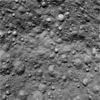
Tethys-N00040088.jpgTethys Fly-By (8)58 visiteCirca 25.000 Km separano cassini da Tethys: la qualità di questo frame è eccellente, ma non ci è possibile svolgere valutazioni ulteriori a quelle che abbiamo già operato in precedenza.
(5 voti)
|
|

Tethys-N00040073.jpgTethys Fly-By (6)58 visiteA poco meno di 30.000 Km di distanza da Tethys, le immagini diventano di gran lunga più dettagliate ma anche - inevitabilmente - più difficili da interpretare. La qualità di questo frame è cattiva (anche con un minimo di ingrandimento, l'immagine si sgrana), ma non ci sfugge la elevatissima albedo del fondo di alcuni crateri (fondo che sembra quasi bianco).
Questo tipo di effetto può dipendere dalla presenza di ghiaccio sul loro fondo, così come dalla particolare angolazione assunta dai raggi di un Sole comunque lontano rispetto alla superficie di Tethys ed all'angolo visuale di Cassini.
Last but not least: processi di vetrificazione.
(5 voti)
|
|

Phoebe-PIA06075.jpgPhoebe's SkyLine59 visiteImages like this one, showing bright wispy streaks thought to be ice revealed by subsidence of crater walls, are leading to the view that Phoebe is an ice-rich body overlain with a thin layer of dark material. Obvious down slope motion of material occurring along the walls of the major craters in this image is the cause for the bright streaks, which are over-exposed here. Significant slumping has occurred along the crater wall at top left.
The slumping of material might have occurred by a small projectile punching into the steep slope of the wall of a pre-existing larger crater. Another possibility is that the material collapsed when triggered by another impact elsewhere on Phoebe. Note that the bright, exposed areas of ice are not very uniform along the wall. Small craters are exposing bright material on the hummocky floor of the larger crater.
Elsewhere on this image, there are local areas of outcropping along the larger crater wall where denser, more resistant material is located. Whether these outcrops are large blocks being exhumed by landslides or actual 'bedrock' is not currently understood.
The crater on the left, with most of the bright streamers, is about 45 kilometers (28 miles) in diameter, front to back as viewed. The larger depression in which the crater sits is on the order of 100 kilometers (62 miles) across. The slopes from the rim down to the hummocky floor are approximately 20 kilometers (12 miles) long; many of the bright streamers on the crater wall are on the order of 10 kilometers (6 miles) long. A future project for Cassini image scientists will be to work out the chronology of slumping events in this scene.
This image was obtained at a phase, or Sun-Phoebe-spacecraft, angle of 78 degrees, and from a distance of 11,918 kilometers (7,407 miles). The image scale is approximately 70 meters (230 feet) per pixel. No enhancement was performed on this image.
(5 voti)
|
|
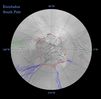
Enceladus-SP-PIA07722_modest.jpgEnceladus: Global Patterns of Fracture (Southern Polar Projection)57 visiteFractures on the surface of Enceladus record a long and complex history of tectonic activity. Many of the geologically youngest fractures define remarkably systematic patterns relative to Enceladus' axis of rotation, as well as to its tidal orientation (that is, the longitudes that point toward and away from Saturn). These fracture patterns offer clues to global changes of shape that the satellite has undergone over time, possibly in response to tidal forces exerted by Saturn or as a result of changes in the internal structure of the icy moon. Some of the most prominent global patterns of fracture are delineated in color in the Southern Hemisphere map shown here.
This map is a polar stereographic projection that was mosaicked from the best-available Cassini and Voyager clear-filter images.
The map is centered on the South Pole and coverage extends to the Equator. Gridlines show latitude and longitude in 30° increments.
(5 voti)
|
|
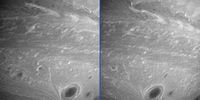
Saturn-PIA07562.jpgThe "anti-hurricanes" of Saturn60 visiteVortices mingle amidst other turbulent motions in Saturn's atmosphere in these two comparison images. The image on the right was taken about two Saturn rotations after the image on the left.
Both views show latitudes from -23° to -42°. The region below center in these images (at -35°) has seen regular storm activity since Cassini first approached Saturn in early 2004.
Cassini investigations of the atmosphere from February to October 2004 showed that most of the oval-shaped storms in the latitude region near -35° rotate in a counter-clockwise direction, with smaller storms occasionally merging into larger ones.
On Earth, hurricanes in the Southern Hemisphere rotate clockwise. Thus, the storms in these images of Saturn's southern latitudes could be called "anti-hurricanes."
This backwards spiraling (compared to Earth) is common on the giant planets.
(5 voti)
|
|

Saturn-PIA07560.jpgSaturn and Tethys58 visiteOriginal caption:"Saturn poses with Tethys in this Cassini view. The C ring casts thin, string-like shadows on the Northern Hemisphere. Above that lurks the shadow of the much denser B-Ring. Cloud bands in the atmosphere are subtly visible in the south. Tethys is 1071 Km (about 665 miles) across.
Cassini will perform a close flyby of Tethys on Sept. 24, 2005. This image was taken on June 10, 2005, in visible green light with the Cassini spacecraft wide-angle camera at a distance of approx. 1,4 MKM (such as about 900.000 miles) from Saturn. The image scale is 81 Km (about 50 miles) per pixel".
(5 voti)
|
|

Mimas-PIA06258.jpgThe "Eye of Mimas": Herschel Crater57 visiteCaption NASA originale:"During its approach to Mimas on Aug. 2, 2005, the Cassini spacecraft narrow-angle camera obtained multi-spectral views of the moon from a range of 228.000 Km (about 142.500 miles).
This image is a narrow angle clear-filter image which was processed to enhance the contrast in brightness and sharpness of visible features.
Herschel Crater, a 140-kilometer-wide impact feature with a prominent central peak, is visible in the upper right of this image.
This image was obtained when the Cassini spacecraft was above 25° South, 134° West latitude and longitude. The Sun-Mimas-spacecraft angle was 45° and North is at the top".
(5 voti)
|
|
| 2244 immagini su 187 pagina(e) |
 |
|
|
|
|
71 | |
|
|
|
|





