| Piú votate - Saturn: the "Ringed Beauty" and His Moons |
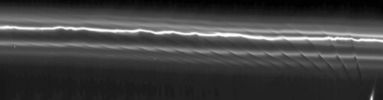
The Rings-PIA07750.jpgSurfing the waves of the F-Ring (from 1,1 MKM)57 visiteOriginal caption:"This mosaic of 15 Cassini images of Saturn's F-Ring shows how the moon Prometheus creates a gore in the Ring once every 14 h and 42', as it approaches and recedes from the F-Ring on its eccentric orbit. The individual images have been processed to make the Ring appear as if it has been straightened, making it easier to see the Ring's structure. The mosaic shows a Region 147.000 Km (about 91.000 miles) along the Ring (horizontal direction in the image); this represents about 60° of Longitude around the Ring. The Region seen here is about 1500 Km (900 miles) across (vertical direction). The first and last images in the mosaic were taken approximately 2,5 hours apart.
Each dark channel, or "gore," is clearly visible across more than 1,000 kilometers (600 miles) of the ring and is due to the gravitational effect of Prometheus (102 kilometers, or 63 miles across), even though the moon does not enter the F ring. The channels have different tilts because the ring particles closer to Prometheus (overexposed, stretched, and just visible at the bottom right of the image) move slower with respect to the moon than those farther away. This causes the channels to shear with time, their slopes becoming greater, and gives the overall visual impression of drapes of ring material. The channels at the right are the youngest and have near-vertical slopes, while those at the left are the oldest and have near-horizontal slopes. This phenomenon has not previously been detected in any other planetary ring system, but computer simulations of the system prove that the disturbance is caused by a simple gravitational interaction. The eccentric orbit of Prometheus is gradually moving so that the moon will eventually come even closer in its closest approach to the eccentric F ring. Scientists calculate that its perturbations of the F ring will reach a maximum in December 2009".
(5 voti)
|
|

Janus-PIA07615.jpgJanus and Epimetheus59 visiteOriginal caption:"Outside the soft edge of Cassini's F-Ring, Epimetheus and Janus negotiate their nearly-shared orbit. The two moons' orbits are typically about 50 Km (approx. 30 miles) apart, and the moons actually change orbits every few years: one moon becoming the innermost of the pair, the other becoming the outermost.
Epimetheus' diameter is 116 Km while Janus' diameter is 181 Km across.
The image was taken in visible light with the Cassini spacecraft narrow-angle camera on Sept. 8, 2005, at a distance of approx. 1,5 MKM (about 1 MMs) from Saturn. The image scale is about 11 Km (roughly 7 miles) per pixel on the two moons".
(5 voti)
|
|

The Rings-PIA07611.jpgDeep inside the "C-Ring"78 visiteOriginal caption:"This close-up view shows an inner region of Saturn's C-Ring. It covers a radial location on the rings located approx. 78.000 to 80.500 Km (about 48.500 to 50.000 miles) from the center of the Planet. Saturn itself has a radius of 60.330 Km (that is about 34.490 miles).
A bright feature, informally referred to as a "plateau", arcs across the image center. The plateau is not high in terms of elevation, but rather in terms of particle density (seen here as brightness). The density is fairly uniform within the bright band, and some five times higher than in the surrounding ring structure. Although the many plateaus in Saturn's Rings appear unchanged over 25 years of observations, scientists do not know what determines their locations or maintains their sharp boundaries.
The image was taken in visible light with the Cassini spacecraft narrow-angle camera on Sept. 5, 2005, at a distance of approx. 418.000 Km(such as about 260.000 miles) from Saturn. The image scale is 2 Km per pixel".
(5 voti)
|
|

Saturn-W00011214.jpgIn the darkness...57 visiteUn'immagine splendida e suggestiva: Mimas, una delle lune più piccole di Saturno, splende nella notte e tiene "compagnia", con la sua luce, agli Anelli del Gigante, anch'essi luminosissimi (forse anche perchè l'immagine è leggermente sovraesposta). Vi segnaliamo, cerchiata in bianco, una interessante Anomalìa: potrebbe trattarsi di un raggio cosmico (teoria NASA), oppure di un difetto dell'immagine. Oppure si potrebbe anche trattare, come sembra elaborando l'immagine dopo averla portata sino al full-size, di un oggetto luminoso (di enormi dimensioni) in transito nello Spazio di Saturno. In questo caso specifico, quest'ultima ipotesi ci pare la più (incredibilmente...) credibile.
(5 voti)
|
|
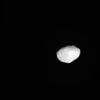
Telesto-N00041270.jpgTelesto90 visiteOriginal caption:"N00041270.jpg was taken on October 11, 2005 and received on Earth October 12, 2005. The camera was pointing toward TELESTO at approx. 19.676 Km away; this image was taken using the CL1 and CL2 filters. This image has not been validated or calibrated
(5 voti)
|
|

Dione-N00041252.jpgExtremely high "albedo" on some of Dione's surface features (3)67 visiteLe montagne (forse una catena) che brillano al Sole rendono questa immagine davvero spettacolare e, se portate il frame sino a full-size e poi lo analizzate con calma, noterete come è anche ben visibile il panorama di Dione situato nel suo lato in ombra.
Quest'ultimo fenomeno, forse, è il risultato del "Saturn-Shine" o "Chiaro di Saturno" (vale a dire che la debole - ma percepibile! - illuminazione del lato di Dione immerso nella notte viene procurata dalla intensa luce che arriva da Saturno).
Un fenomeno del tutto analogo lo possiamo vedere anche noi da Terra quando la nostra Luna - al primo quarto - , ci mostra anche il resto della sua superficie (di regola immersa nell'ombra e non visibile) la quale ci appare debolmente illuminata dal "Chiaro di Terra" - o "Earth-Shine").
Ad ogni modo - ed a parte le piccole annotazioni sul 'Saturn-Shine' di cui sopra - la luminosità dei rilievi di Dione esposti alla luce diretta del Sole ci sembra eccessiva e meritevole di ulteriori e specifiche analisi.
(5 voti)
|
|

Dione-N00041124.jpgDione's Fly-By (3): from about 51.000 Km60 visitenessun commento
(5 voti)
|
|

Rhea-PIA07606.jpgHalf-Rhea, in the darkness...58 visiteOriginal caption:"This half-lit view beautifully captures the ponderously old and cratered surface of Saturn's icy moon Rhea. The sunlit terrain shown here is on the moon's Leading Hemisphere, on the side of Rhea that always faces toward Saturn. North is up and rotated 20° to the left.
The image was taken in visible light with the Cassini spacecraft narrow-angle camera on Aug. 21, 2005, at a distance of approximately 922.000 Km (about 573.000 miles) from Rhea and at a Sun-Rhea-spacecraft, or phase, angle of 88°. The image scale is 6 Km (about 4 miles) per pixel".
(5 voti)
|
|
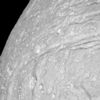
Tethys.jpgIcy cliffs, canyons and crevasses on Tethys (HR)58 visiteOriginal caption:"The surface of Saturn's moon Tethys is riddled with icy cliffs and craters. The most detailed images ever taken of Tethys were captured late last month as Cassini spacecraft swooped past the frozen ice moon. The above image was taken from from about 32.000 Km and shows a jagged landscape of long cliffs covered with craters. At the bottom of many craters appears some sort of unknown light-colored substance, in contrast to the unknown dark substance that appears at the bottom of Saturn's moon Hyperion. Tethys is one of the larger moons of Saturn, spanning about 1000 Km across and its density indicates a composition almost entirely of water ice. Tethys is thought to have been predominantly liquid sometime in its distant past, creating some of its long ice-cliffs as it cracked during freezing".
(5 voti)
|
|

Pandora-PIA07604.jpgOccultation!59 visiteOriginal caption:"Saturn's moon Pandora glides in front of the narrow F-Ring, making the moon's oblong outline visible. The image also shows the A-Ring, the Cassini Division, the B-Ring and part of the C-Ring. This view is from beneath the Ring plane. The image was taken in visible light with the Cassini spacecraft narrow-angle camera on Aug. 23, 2005, at a distance of approximately 1,6 MKM (about 1 MMs) from Pandora and at a Sun-Pandora-spacecraft, or phase, angle of 97°. Resolution in the original image was 9 Km (about 6 miles) per pixel".
(5 voti)
|
|

Tethys-PIA07737.jpgLandslides on Tethys (HR & false colors)59 visiteOriginal caption:"This false-color image, created with infrared, green and ultraviolet frames, reveals a wide variety of surface colors across this terrain. The presence of this variety at such small scales may indicate a mixture of different surface materials. Tethys was previously known to have color differences on its surface, especially on its trailing side, but this kind of color diversity is new to imaging scientists.
This view is centered on terrain at approx. 4,2° South Latitude and 357° West Longitude on Tethys. The view has been rotated so that North on Tethys is up.
The images for this view were obtained using the Cassini spacecraft narrow-angle camera at distances ranging from approx. 18.400 to 19.000 Km (about 11.400 to 11.800 miles) from Tethys and at a Sun-Tethys-spacecraft, or phase, angle of 17°. Image scale is 213 mt (700 feet) per pixel".
(5 voti)
|
|
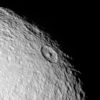
Tethys-PIA07735.jpgTelemachus and Teiresias58 visiteOriginal caption:"The Northern Polar Region of Saturn's moon Tethys seen in this Cassini flyby image is a ponderously ancient surface.
Above the prominent peaked crater Telemachus are the remnants of a very old crater (at the 10 o'clock position relative to Telemachus) named Teiresias. The ancient impact site is so badly overprinted and eroded by impact weathering and degradation that all that remains is a circular pattern of hummocks that mark where the old crater rim existed.
This view is centered on terrain at approximately 1,2° South Latitude and 342° West Longitude on Tethys. The view is rotated so that North is about 40° to the right.
This clear filter view was taken during Cassini's close approach to Tethys on Sept. 24, 2005. The image was acquired using the Cassini spacecraft narrow-angle camera at a distance of approximately 69,200 kilometers (43,000 miles) from Tethys and at a Sun-Tethys-spacecraft, or phase, angle of 21°. Image scale is 410 mt per pixel".
(5 voti)
|
|
| 2244 immagini su 187 pagina(e) |
 |
|
|
|
|
70 | |
|
|
|
|





