| Piú votate - Saturn: the "Ringed Beauty" and His Moons |

Rhea-N00043409.jpgFeatures on the Terminator59 visiteN00043409.jpg was taken on November 26, 2005 and received on Earth November 28, 2005. The camera was pointing toward Rhea that, at the time, was approximately 61.970 Km away.
The image was taken using the CL1 and GRN filters.
(5 voti)
|
|

Japetus-N00043118.jpgJapetus' "smile"...57 visiteOriginal caption:"N00043118.jpg was taken on November 16, 2005 and received on Earth November 17, 2005. The camera was pointing toward IAPETUS at approximately 806.360 kilometers away, and the image was taken using the CL1 and IR1 filters".
(5 voti)
|
|

Japetus-N00043073.jpgJapetus...in a very unusual "look"!67 visiteOriginal caption:"N00043073.jpg was taken on November 03, 2005 and received on Earth November 05, 2005. The camera was pointing toward Japetus at approximately 1.617.411 kilometers away, and the image was taken using the CL1 and CL2 filters. This image has not been validated or calibrated".
(5 voti)
|
|

The Rings-PIA07631.jpgThe sweet colors of the Rings (approx. true colors)55 visiteOrigThe dark Cassini Division, within Saturn's Rings, contains a great deal of structure, as seen in this color image. The sharp inner boundary of the division (left of center) is the outer edge of the massive B-Ring and is maintained by the gravitational influence of the moon Mimas.
Spectroscopic observations by Cassini indicate that the Cassini Division, similar to the C-Ring, contains more contaminated ice than do the B and A-Rings on either side.
This view is centered on a region approx. 118.500 Km (about 73.600 mi) from Saturn's center. (Saturn is about 120.500 Km wide - roughly 74.900 mi - at the equator.) From left to right, the image spans approx. 11.000 Km (about 6.800 mi) across the Ring-Plane. Images taken using red, green and blue spectral filters were combined to create this view, which approximates what the human eye might see. The image was taken with the Cassini spacecraft narrow-angle camera on May 18, 2005, at a distance of approx. 1,6 MKM (about 1 MMs) from Saturn. Res. is 9 Km per px.
(5 voti)
|
|

Japetus-N00043065.jpgLand of night56 visiteOriginal caption:"N00043065.jpg was taken on November 14, 2005 and received on Earth November 15, 2005. The camera was pointing toward Japetus at approximately 554.430 Km away, and the image was taken using the P60 and MT2 filters. This image has not been validated or calibrated".
Nota: questa immagine ci offre, oltre ad una "inquietante" (e comunque davvero molto bella) veduta di Giapeto, anche un interessante ed assai variegato campionario di photographic artifacts (incluse anche alcune strisce di luce che vengono ufficialmente attribuite al transito di Raggi Cosmici).
(5 voti)
|
|

Japetus-N00042866.jpgApproaching Japetus60 visiteOriginal caption:"N00042866.jpg was taken on Nov. 11, 2005 and received on Earth Nov. 11, 2005. The camera was pointing toward Japetus at approx. 480.263 Km away and the image was taken using the CL1 and GRN filters".
Purtroppo, alla fine di questo passaggio (solo relativamente) ravvicinato, non avremo la possibilità di scrutare ancora nelle valli e dentro i crepacci di questa luna divisa a metà: una metà che ci ricorda, in tutto e per tutte, le altre lune del Sistema di Saturno ed i corpi celesti rocciosi "tipici" dello Spazio Esterno (o trans-Marziano). Un'altra metà, invece, completamente aliena, diversa e difficile da spiegare: una metà di Giapeto, infatti, è nera. Che si tratti di depositi di polveri è solo una speculazione e qualora si trattasse effettivamente di polveri, verrebbe naturale domandarsi "da dove" queste polveri provengano.
Ciò che sappiamo, oggi, è che Giapeto è un Corpo Celeste "bifronte" e, forse, dalla doppia natura: tutto il resto (e che NASA ed ESA ci perdonino) è "jargon"...
(5 voti)
|
|

Dione&Co.-PIA07628.jpgDione, Tethys and Pandora60 visiteOriginal caption:"This excellent grouping of 3 moons - Dione, Tethys and Pandora - near the Rings, provides a sampling of the diversity of worlds that exists in Saturn's Realm. A 330-Km-wide (about 205 miles) impact basin can be seen near the bottom right on Dione (at left). Ithaca Chasma and the Region imaged during the Cassini spacecraft¿s Sept. 24, 2005, flyby can be seen on Tethys (middle). Little Pandora makes a good showing here as well, displaying a hint of surface detail. Tethys is on the far side of the Rings in this view; Dione and Pandora are much nearer to the Cassini spacecraft.
Rememeber that Dione is approx. 1.126 Km (about 700 miles) across. Tethys is approx. 1.071 Km (about 665 miles) across and Pandora is 84 Km (roughly 52 miles) across.
This image was taken in visible blue light with the Cassini spacecraft narrow-angle camera on Sept. 22, 2005, at a distance of approx. 1,2 MKM (about 800.000 miles) from Saturn. The image scale is about 5 Km (approx. 3 miles) per pixel on Dione and Pandora and 9 kilometers (6 miles) per pixel on Tethys".
(5 voti)
|
|

Japetus-N00042846.jpgApproaching Japetus57 visiteOriginal caption:"N00042846.jpg was taken on November 09, 2005 and received on Earth November 10, 2005. The camera was pointing toward Japetus at approx. 639.972 Km away, and the image was taken using the IR2 and CL2 filters. This image has not been validated or calibrated".
(5 voti)
|
|

Japetus-N00042823.jpgApproaching Japetus70 visiteOriginal caption:"N00042823.jpg was taken on November 08, 2005 and received on Earth November 09, 2005. The camera was pointing toward IAPETUS at approx. 774,151 Km away, and the image was taken using the CL1 and IR3 filters".
(5 voti)
|
|
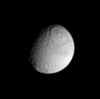
Tethys-PIA07622.jpgOdysseus and Melanthius56 visiteOriginal caption:"Cassini offers up this nice view of the craters Odysseus (at the top) and Melanthius (at the bottom) on Saturn's moon Tethys. Melanthius appears to have an elongated mountain range, rather than a single central peak, at its center.
This is the trailing hemisphere of Tethys, being centered on terrain at roughly 270° Longitude. North on Tethys is up.
This image was taken with the Cassini spacecraft narrow-angle camera on Sept. 20, 2005, through a filter sensitive to wavelengths of ultraviolet light centered at 338 nanometers. This view was obtained at a distance of approx. 1,4 MKM (about 900.000 miles) from Tethys and at a phase angle of 50°. Resolution in the original image was 8 Km (about 5 miles) per pixel. The image has been magnified by a factor of 2 to aid visibility".
(5 voti)
|
|

Pandora-N00042197.jpgPandora?72 visiteOriginal caption:"N00042197.jpg was taken on October 29, 2005 and received on Earth October 30, 2005. The camera was pointing toward PANDORA at approximately 455.248 Km away, and the image was taken using the CL1 and IR1 filters. This image has not been validated or calibrated".
(5 voti)
|
|

Enceladus-PIA07619.jpgEnceladus over the B-Ring59 visiteOriginal caption:"The moon Enceladus seems to hover above the outer reaches of Saturn's B-Ring. Below and to the right of Enceladus, four faint bands lie in the center of the dark Cassini Division.
Recently, scientists have speculated that the particles that make up the dense B and A-Rings might be more like fluffy snowballs than hard ice cubes. The conclusion is based on temperature data obtained by the Cassini spacecraft.
Enceladus' diameter is about 505 Km (such as approx. 314 miles). The icy moon is on the near side of the Rings in this view.
This image was taken in visible light with the Cassini spacecraft narrow-angle camera on Sept. 15, 2005, at a distance of approx. 2,3 MKM (1,4 MMs) from Enceladus.
The image scale is 14 Km (approx. 9 miles) per pixel on Enceladus".
(5 voti)
|
|
| 2244 immagini su 187 pagina(e) |
 |
|
|
|
|
69 | |
|
|
|
|





